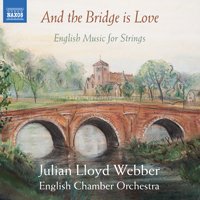
Category: Reviews

  • And the Bridge is Love

    Mail on Sunday 15th March 2015

    ALBUM OF THE WEEK

    On this winning album, Julian Lloyd Webber emerges as a conductor of some distinction, drawing eloquent performances from the English Chamber Orchestra of an enticing blend of familiar and unfamiliar English music for strings, including four world premieres.

    Touchingly, there is also Julian’s final appearance as a cellist, in a performance of Howard Goodall’s And The Bridge is Love, a moving elegy for the daughter of some close family friends, who died tragically young in 2007 aged only 17.

    Julian displays his conducting mettle with an excitingly propulsive account of Elgar’s Introduction And Allegro, a masterpiece that has rarely sounded better on disc.

    In more relaxed mood, he directs elegant performances of Elgar’s Serenade; his haunting Sospiri; and the Chansons De Matin and De Soir.

    There’s also a touching tribute to Julian’s father, William, in a piece dad LW wrote in 1950 entitLed The Moon, a work of real quality that more than justifies its inclusion here.

    And there’s a brief Vaughan Williams rarity: the opening movement of his Charterhouse Suite, originally for piano but arranged for strings in 1923 under the composer’s supervision.

    This is as lovely an album as I expect to hear this year, making a powerful case to put English string music up there among our nation’s greatest musical achievements.

    David Mellor

  • And the Bridge is Love

    Classic

    Classic FM Album of the Week, 23 February 2015

    In this his first recording as a conductor, Julian Lloyd Webber showcases a wide-ranging programme of English music for strings includes the world premiere of Howard Goodall’s moving And the Bridge is Love, in which Lloyd Webber plays cello in a farewell performance, after announcing his retirement from performing.

    There’s also the first ever recording of his father William Lloyd Webber’s The Moon, which was only performed for the first time in 2014.

    Elgar’s Introduction and Allegro, Op. 47, is complemented by novelties in the case of the never-before-recorded arrangements by Elgar’s friend and biographer W.H. Reed of the two Chansons – du Nuit and du Matin.

    This is a beautiful album, with an intriguing mix of the familiar and the unknown. All the signs are that the former cellist Julian Lloyd Webber could be turning into a very fine conductor indeed.

  • And the Bridge is Love

    January 27th, 2015

    The Beauty of the English String Sound

    We forget how much the English contributed to the beauty of orchestral music through their lush pastoral string writing. And The Bridge is Love, a new recording by the English Chamber Orchestra led by Julian Lloyd-Webber, brings all of this back to us. The recording is centred on music by Elgar, with excursions into Vaughan Williams, Delius, and up to modern composers such as Howard Goodall. And, because this is led by cellist Lloyd-Webber, the cello sound comes through beautifully.

    Elgar, who really only achieved his breakthrough with the success of the Enigma Variations, begins the recording with two early 20th-century works: Introduction and Allegro for Strings, Op. 47 (1905) and 2 Sospiri, Op. 70 (1914), but later in the recording are arrangements by W.H. Reed, Elgar’s friend and biographer, of Elgar’s two Op. 15 works: the Chanson de nuit, Op. 15, No. 1 (1897) and the Chanson de matin, Op. 15, No. 2 (1899). Reed made these arrangements in 1939, but the works had originally been violin pieces, the second, written in 1897, dedicated to an amateur violinist in Worcester, and the first, written as a companion piece in 1899. The works were originally orchestrated by Elgar and performed in London in 1901, and these 1939 editions by Reed have never been recorded. They have a lighter feeling than Elgar’s arrangements and there’s a great deal of style in this performance.

    The composer William Lloyd-Webber, father of Julian, was a student of Elgar’s and his influence is evident in the work here. The song, ‘The Moon,’ setting a text by the Welsh poet William Henry Davies (1871-1940) appeared in 1950. Soon after, the composer arranged it for strings and it has never been recorded until now, a century after his birth.

    Frederick Delius, quietly suffering in Paris from partial paralysis, had, as his amanuensis, the young composer Eric Fenby. Fenby made arrangements for string orchestra of two songs ‘to be sung of a summer’s night on the water,’ written for Charles Kennedy Scott and his Oriana Choir. The first performance of the a cappella work was in 1921. Fenby made his arrangements in 1932 and Delius’ wife, Jelka, sent them to Sir Thomas Beecham. Fenby’s arrangements gave a new life to the little works and they remain in the repertoire as orchestral, rather than choral works.

    Other works on this recording include selections from Vaughan Williams’ The Charterhouse Suite, which itself is an arrangement of the 6 Short pieces for Piano; two works from William Walton’s music for the 1944 movie Henry V; and a selection from John Ireland’s A Dowland Suite (1942).

    One notable work on the recording is the title work, Howard Goodall’s And the Bridge is Love, written in 2008. The title comes from Thornton Wilder’s novel The Bridge at San Luis Rey, and was written in honor of a young cellist who died in 2007. The work was commissioned by the Chipping Campden Festival and was given its première in 2008 with Julian Lloyd-Webber as soloist. This performance is carefully crafted and the work is beautiful and fits in well here, despite dating from some 69 to 80 years after most of the other works in this collection. Julian Lloyd-Webber has said that this performance of Howard Goodall’s work is his final recording as a cellist.

    Julian and Jiaxin Lloyd Webber will be performing in Hong Kong on January 31st 2015.

    Maureen Buja

  • And the Bridge is Love

    February 2015

    A disc of English string music that marks Julian Lloyd Webber’s debut recording as a conductor, and takes its title from Howard Goodall’s And the Bridge is Love. There is also sadness hidden away, as with this work for solo cello and strings Lloyd Webber brings to an end his career as a cellist, an injury to his shoulder preventing further concert appearances. When one door closes, another one opens, and we can now enjoy his exceptionally fine account of works by Elgar, an uncommonly virile and fast moving Introduction and Allegro opening a disc that finds the English Chamber Orchestra in fine form. That is equally true of their performance of the Serenade for Strings, though here Lloyd Webber takes a more leisurely view, the sadness he brings to slow central movement spilling over into the finale. Sospiri unfolds in an unhurried pace, and I much enjoy the unaffected reading of the two Chansons in the familiar string arrangement by William Reed Much tenderness in the two string pieces that Walton included in his film score for Shakespeare’s Henry V, and the two short Aquarelles by Delius in Eric Fenby’s arrangement. The novelty is the very attractive The Moon by the conductor’s father William Lloyd Webber which only received its premiere in 2014, and there is another world recording premiere in Goodall’s very sad work written in memory of a teenage cellist. Outstanding sound from the legendary Watford venue. I hope this the first of many from the Lloyd Webber baton. © 2015 David’s Review Corner

    David Denton

  • And the Bridge is Love

    Music Web June 2015

    And the Bridge is Love – English Music for Strings

    This CD represents a first and a last. It is Julian Lloyd Webber’s first disc as a conductor but, sadly, it is also his last as a solo cellist because he has now had to end his distinguished career as a cellist due to health issues.

    His envoi as a cellist is the piece by Howard Goodall which gives the album its title. Goodall wrote this piece for cello and string orchestra with harp in 2008. It was written in memory of Hannah Ryan, the cellist daughter of close family friends of Goodall, who died at a tragically young age in 2007. The title is taken from a book, The Bridge of San Luis Rey by Thornton Wilder. The book is, in Goodall’s words, “a parable of the struggle to find meaning in chance and in inexplicable tragedy.” The piece exploits the cello’s capacity for songful melancholy. The soloist’s material is almost exclusively lyrical with the accompaniment mainly delicate and deliberately uncomplicated. Much of the piece is in a gentle vein and it forms a touching tribute. It seems to me to offer further evidence of Howard Goodall’s ability to communicate effectively with an audience, whether through his own music or when speaking about music more generally.

    Elgar’s music features prominently in the programme. Perhaps that’s not surprising when one considers that throughout his career as a cellist Julian Lloyd Webber displayed empathy for Elgar’s music in his performances of the Cello Concerto. He leads a spirited performance of the Introduction and Allegro. He may not quite match the achievement of Sir John Barbirolli – another cellist turned conductor – in this piece (review) but his account of it is very enjoyable nonetheless. He also offers a cultivated reading of the Serenade, a piece which the ECO must have played countless times but which still sounds fresh here. Incidentally, as proof that one can always learn something, I was very interested to read in the useful notes by Peter Avis that the first professional performance of the Serenade, in 1896, was given, not in Britain, as I would have expected, but in Antwerp. I also enjoyed very much Lloyd Webber’s performance of Chanson de matin. This is light – or at least lighter – music but it’s a very superior example of the genre. There’s a family link here because Peter Avis points out that Lloyd Webber’s mother was a sometime pupil of W. H. ‘Billy’ Reed.

    Family connections are more explicit through the inclusion of The Moon by Julian Lloyd Webber’s father. Apparently this was originally a part-song, written by William Lloyd Webber in 1950. He made the present arrangement for string orchestra shortly afterwards but it remained unperformed until his centenary year, 2014. I’ve heard a few works by William Lloyd Webber on disc in recent years and have enjoyed what I’ve heard. This piece can be added to that list of pleasing discoveries. It’s a charming miniature and it’s given here in a sensitive performance. I am glad that Julian Lloyd Webber has included this little tribute to his father.

    The Delius pieces are nicely done and Walton’s two fine miniatures from his excellent music for the film of Henry V are played with no little poetry. It’s hard to avoid the feeling that the short pieces by Vaughan Williams and Ireland are included to make up the numbers – the former in particular – but the Ireland piece is a most effective arrangement of music originally composed for brass band.

    This is a very enjoyable anthology. I don’t know how much conducting Julian Lloyd Webber had done prior to this assignment but he obtains good and responsive playing from the ECO. It was a shrewd move to make a recording debut with music for strings, an idiom to which he clearly brings a practitioner’s understanding. All music-lovers will have been saddened by his enforced retirement as a cellist. However, it’s clear both from this recorded debut as a conductor and his recent appointment as Principal of Birmingham Conservatoire that we certainly have not seen the last of Julian Lloyd Webber. That can only be a good thing.

    John Quinn

  • And the Bridge is Love

    June 2015

    This is a disc of many firsts and one unfortunate last – Julian Lloyd Webber’s final recording as a cellist before his retirement from playing due to a neck injury that affected his bowing arm. However, this disc also marks his first recording as a conductor.

    He and the English Chamber Orchestra have chosen to explore some of the glorious highways and byways of English string music, the former being represented by deft, full-blooded accounts of Elgar’s Introduction and Allegro for Strings and Serenade for Strings. However, it is the lesser-known pieces that make this disc so attractive. Elgar’s Chanson de nuit and Chanson de matin are presented as world premiere recordings in orchestrations for strings by Elgar’s close friend W H Reed, the LSO’s distinguished leader from 1912 until 1935. So too is the exquisite Sospiri (Sighs), a short work for strings, harp and harmonium that Elgar dedicated to Reed.

    Another first is William Lloyd Webber’s touching 1950 arrangement of his song The Moon, unperformed until 2014. The disc takes its title from Howard Goodall’s 2008 work for solo cello and strings, composed in memory of a teenage cellist friend who died tragically in 2007 and rooted firmly in the yearning, melodic English string-writing tradition. Arrangements by Fenby (of Delius’s Two Aquarelles), Vaughan Williams, Walton and Ireland round off a worthwhile project.

    Anne McAlister

  • Debussy Sonata

    27th June 2007

    Classic brilliance resonates in ancient walls

    Istanbul Concert Review

    Music gently winds through the corridors of the ancient Byzantine structure Hagia Eirini, at the concert, Festival Meetings II, performed by an acclaimed cellist, cello quartet and pianist

    As four cellists raise their bows in the air and strike the cellos strings with utmost grace, Bach’s Air in D Major gently resonates in a former Eastern Orthodox Church, Hagia Eirini Museum (Aya lrini) at the Topkapi Palace on Monday night. As the music gently whines through the corridors of the ancient Byzantine structure and rises to the atrium, a surreal musical journey begins in an enchanting setting of history and culture that creates the perfect atmosphere for music lovers of all ages. Festival Meetings II, featuring an acclaimed cellist, Julian Lloyd Webber, cello quartet çellistanbul and pianist Pam Chowhan is part of the 35th International Istanbul Music Festival. The festival is the latest creation of a creative musician and an ensemble of musicians whose passion for classical sound resonates from their soul. Istanbul’s own cello quartet ‘çeliistanbul’, started the audience on a journey of choral harmonies. Inspired by the city Istanbul and its magical atmosphere, the group is formed of cellists who graduated from the same Conservatoire of music their repertoire includes classical as well as modern works. “I am on a Long, Narrow Road” was a special composition for the quartet based on Asik Veysel’s melody that proved to the audience they were witnessing brilliant performers.

    Each cord was played in unison echoing the emotion of the music on the individual faces and swaying bodies 0r the cellists. The group was one entity playing off each other’s enthusiasm and passion. Their long composition was met with equal pleasure from the audience as each note created tension in the already thick church air. The last note in the composition is held in harmony. The audience holds its breath. Time stops. The note finishes. The stunned audience breaks the silence with loud cheers and applause.

    The group also known for their works of tango and jazz finish off their set with Tango Passionata and Polonaise. The second set welcomes Julian Lloyd Webber to the stage with Pam Chowham accompanying him on the piano. He too begins with Bach’s C Major Adagio followed by Scherzetto. At first the music did not flow together.

    There seemed to be tension as each performer kept looking for signs and warmth the two instruments should create. It was not until Scherzo Pizzicato that the union warmed up and put their bows aside; Webber played the cello with his fingers. Claude Debussy’s Sonata (1915) was long and stunning. Inspired with patriotic sentiments his music flowed with watery magic to dark virtuosity. It was multi-faceted brilliance that was written for the flute, piano and cello and it worked with Chowhan accompanying Webber on the piano. The night was not over yet, as ‘çellistanbul’ joined Webber on stage to perform the last three compositions. Beginning with Astor Piazzolla’s Oblivion, the groups performance highlights not only Webber’s amazing ability to take original scores and create a compelling rhythm, hut to depict character through music that shows his way of bringing life to his playing, It would not be a Webber production without performing one of his brothers most popular songs from the popular musical Jesus Christ Superstar, “I Don’t Know How to Love Him.” The audience was really alive and hoped there was more when the performance ended. The silence was extensive and finally broken with loud applause. The applause brought Webber and the ‘çellistanbul’ quartet back on stage to perform an encore of Astor Piazolla’s Oblivion. This time when the last cord was held, the audience knew once the sound reached the atrium, the performance was truly over. A standing ovation ended a magical myriad of classical ethereal sound that was performed brilliantly.

  • Walton Passacaglia

    June 1997

    BRITISH CELLO MUSIC, Volume I & II

    Julian Lloyd Webber’s performances of British music always carry the imprimatur of authority. and transmit a palpable sense of conviction that never fails to win new devotees to this area of the cello literature. I am especially happy, then, to welcome these splendid offerings back to the catalogs. Lloyd Webber is an artist of missionary enterprise, and his playing is underpinned by a technical assurance that vouchsafes his preeminence as the foremost living exponent of England’s cellistic oeuvre. As a result of his advocacy, works like those collected on these two ASV issues arc increasingly seen as being emblematic of a unique nationalistic subgenre. That these two CDs embrace between them no fewer than six world-premiere recordings bespeaks as much. But that the music is played with such understanding, affection, and profundity of utterance outstrips regular expectations.

    Britten’s Third Suite dates from the spring of 1971, and was premiered by Rostropovich (for whom the previous two Suites and the Cello Symphony were also written) in December 1974. The present performance, which dates from August 1979, is of special import, since it was in fact the first commercial recording of the piece, and it still holds its own in an increasingly competitive field. Julian Lloyd Webber’s account has both the pliant elasticity and the requisite expressive insights to make the most of its frisson and fantasy, but there is a deeper, darker, more elegiac core to this music. Britten’s implementation of the Kontakion, the Russian Orthodox hymn for the departed, is well documented, as is his decision to include an alternative version from English liturgy, and Julian Lloyd Webber plays the English Hymnal interpolation here. The Thema “Sacher,” an intriguing, unaccompanied cryptogram on the letters S-A-C-H-E-R, honored the conductor on the occasion of his seventieth birthday in 1976. A slight sixty-two seconds in duration, the current performance evidences Britten’s ingenuity in the genre, and the playing is magical. Alan Rawsthome’s cello sonata of 1949 (pithy, driven, sometimes truculent, but never crass), makes clever use of recurrent, cyclic themes as earlier motifs are revisited in the Finale: at the time of writing, no other recording exists, so a reading of this quality is the more welcome for its reappearance. The pianist here. and in the remaining accompanied works discussed here (in fact, there is only one other in the case of the first of these two discs, and that is a beguilingly enraptured account of John Ireland’s The Holy Boy) is the pianist and composer John McCabe, with whom Julian Lloyd Webber has enjoyed an especially fruitful collaboration.

    The remaining solo works here are by Sir Malcolm Arnold and Sir William Walton. The former’s 1987 Fantasy for solo cello is, in my view, a splendid addition to the repertoire. Cast in seven highly contrasted movements, its sophistication lurks behind an inscrutability that Hugo Cole describes as “Chinese economy of means.” It is an apt description, and Lloyd Webber’s account (still the only one in the catalog) focuses skillfully on the composer’s desire to draw out the naturalistic, rather than virtuosic, side of the instrument’s persona. The Walton Passacaglia is built along traditional lines (eight-measure theme and ten variations); it condenses Altonian severity and acerbity down to a solitary instrumental voice, and does so masterfully. This performance is mesmeric.

    The second release is devoted to fine readings from both artists of sonatas by Sir Charles Villiers Standford and John Ireland, and two characteristic miniatures by Frank Bridge. The Sonata in G Minor by John Ireland (1923) has been examined in these pages in context of the Marco Polo disc from Raphael Wallfisch and John York (Marco Polo 8.223718). Much as 1 found a lot to admire here (the program is a valuable one, also including the Edmund Rubbra sonata in G Minor, op. 60, and the superb A-Minor Sonata by E. J. Moeran). there remains, on comparison with this ASV version, a degree of blandness and discernible reluctance at times to probe much beyond the outer veneer of the notes. Hence, Julian Lloyd Webber’s playing has instantly more appeal and commu- nicative depth, and John McCabe’s management of the taxing piano part is a model of restraint? perhaps it takes a composer well versed in the ways of both instruments to make this music really work texturally? Of the Bridge pairing, Lloyd Webber relates in his insert note his happenstance discovery of the Scherzetto in a collection of manuscripts at the Royal College of Music, London. He gave the modern premiere of the piece, seventy-seven years after its composition, in April 1976; this slight but delicious encore piece is an ideal foil to the somber mood of the preceding Elegy, dating from 1905. Both performances arc admirable. The other large-scale work is the majestic and uncommonly Brahmsian Second Sonata (op. 93?1893) by Stanford. This work, as deserving of a niche in the repertoire as the similarly neglected Elegiac Variations by Sir Donald Francis Tovey (played quite decently by Rebecca Rust and David Aptcr on Marco Polo 8.223637), receives a robust and impassioned performance here. and. like several of the works contained on these ASV issues, is otherwise unavailable. To sum up. Julian Lloyd Webber’s striking and compelling performances arc of consistent excellence, and recorded sound is likewise entirely serviceable. My only gripe is that the labels with which he is associated, ASV and Philips, have yet to recognize both the musical significance and commercial viability of this area of the cello literature. If they were to relent, however, they would find no better artist for the task than Julian Lloyd Webber, whose performances may be unreservedly commended.

    Michael Jameson

  • Walton Cello Concerto

    November 1997

    Britten Cello Symphony

    BRITTEN: Symphony for Cello & Orchestra

    Julian Lloyd webber (vlc)/ASM/Marriner

    Philips 454 442-2

    Despite alternative versions, this is solo interpretation and orchestral collaboration par excellence. Lloyd Webber, whose cello tone reminds me of the long departed Beatrice Harrison’s, has a special affinity with British composers; and Marriner always comes up trumps in concerts and at sessions where great events are the order of the day. Since Rostropovich’s epic-making world premiere of the Britten, other artists have struggled to emulate the Russian’s visionary performances that we heard back in 1963. This one clarifies two things for me: what a fine work it really is, when the balance of instrumentation is so finely judged and the music is allowed to flow naturally; and just how advanced recording techniques can enhance your musical enjoyment. There are no top-heavy emphases in tuttis, or those solo spotlights that take attention away from the score, but a crystal-clear realization of all this complex work demands.

    Lloyd Webber’s description of the Walton’s ‘Mediterranean warmth and sexuality’ became the subject of a three-way Radio 3 discussion recently. Although Harrell/Rattle [EMI] and Cohen/Litton [Decca] equate the solo cello’s sonorous beauties to Walton’s sumptuously rich orchestral textures, Lloyd Webber’s half-veiled tones balance perfectly with Marriner’s natural, warm-styled accompaniment. This is a glowing account of the work in which dynamics are scrupulously observed throughout, and with no sense of lingering during slower passages – for example, in the first of the three cello cadenzas, (ii) four before 19, Lloyd Webber alters his ‘rubato ad lib’ to an accelerando, in order to match the ‘poco meno mosso’ orchestral re-entry and the overall Allegro appassionato tempo direction.

    An essential addition to the ever-growing British Music discography.

    Newman

  • Walton Cello Concerto

    1997

    Britten: Cello Symphony

    Walton: Cello Concerto

    Julian Lloyd Webber (cello);

    Academy of St Martin in the Fields/Neville Marriner

    Philips 454 442-2 66:35 mins

    These are starkly contrasted works, each written for great Russian cellists: the warmly Romantic Walton Concerto for Gregor Piatigorsky, and Britten’s dark and angst-ridden Cello Symphony composed for Rostropovich. The solo part in the Britten is more truly integrated into the work’s fabric – the material is symphonic in weight and treatment, thus justifying the title.

    Listeners need not be deterred by the sombre nature of the Britten. Repeated hearings are rewarded by the revelation of many riches -like Britten’s brilliantly inventive and arresting orchestrations using unusual combinations such as double bassoon, bass clarinet, tuba and percussion. The Allegro maestoso first movement, for instance, ends with the disconsolate cello, pizzicato, crushed between a plaintively wailing clarinet and the seethings of the lower-pitched instruments sounding like the snarlings of beasts from hell. And, in the Adagio, there is a magical passage where the cello meditates, remotely, over lightly brushed cymbals and distant trumpets before its gentle musings are crushed by cruel, relentless percussion hammerings. Lloyd Webber plays out Britten’s dark drama with deep conviction and he is ardent in the better-known, sunnier and vivacious Walton Concerto. Marriner and his Academy players give virtuoso performances in support.

    Ian Lace

    PERFORMANCE *****

    SOUND *****