

Category: Reviews

  • A Tale of Two Cellos

    A Tale of Two Cellos

    January 2014

    A Tale of Two Cellos – Uncommon piquancy

    Music for two cellos –

    heard by HOWARD SMITH

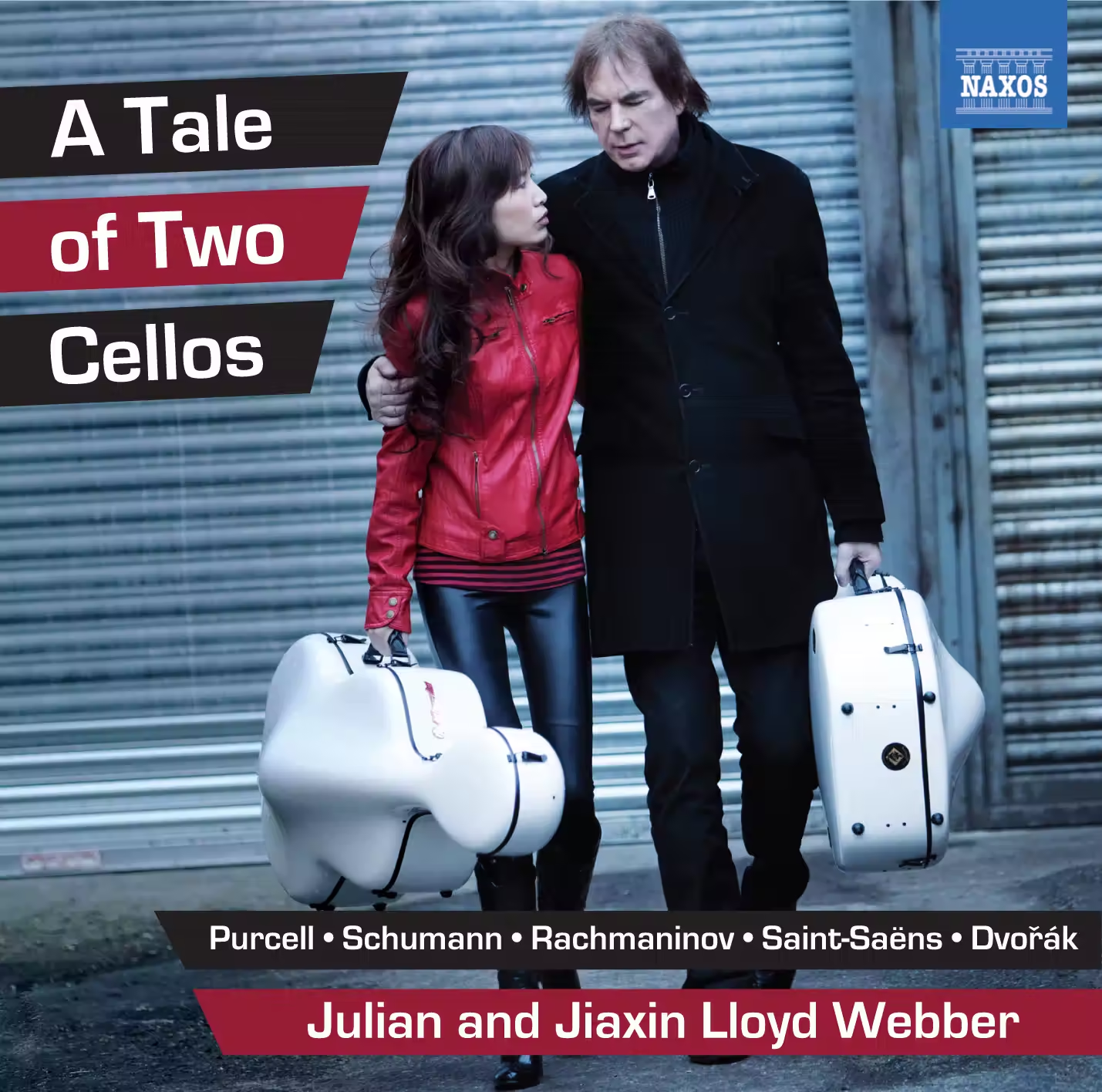
    This release makes a perfect gift. Naxos 8.573251 has twenty-one miniatures — cello duet arrangements, collectively titled A Tale of Two Cellos and featuring Julian Lloyd Webber with his wife Jiaxin Lloyd Webber, plus accompanist John Lenehan, harpist Catrin Finch and others.

    Mr Lloyd Webber’s track record is firmly established, though Jiaxin’s reputation began with her graduation at Shanghai Conservatory of Music in 1997. More recently (2001) she completed a Master’s degree at Auckland University, New Zealand.

    Jiaxin became noted as a chamber music player and a founder member of the Aroha String Quartet. She played frequently with both the Auckland Philharmonia Orchestra and New Zealand Symphony Orchestra. With the Auckland Symphony Orchestra she performed cello concertos by Dvorák, Elgar and Lalo.

    Since her marriage to Julian Lloyd Webber the two have performed for BBC Radio 3, Classic FM, CNN Global TV and BBC TV. They have recorded for Universal Classics and Naxos and they were scheduled to make two further recordings in 2013 as well as touring together with the European Union Chamber Orchestra. The duo disc has uncommon piquancy heightened by its diverse programme and repeated surprise.

    The Lloyd Webbers steer clear of tried and true items such as Saint-Saëns’ The Swan or the opening solo from Von Suppe’s Poet and Peasant overture.

    They enterprisingly cover a span from Monteverdi’s early Renaissance work to modern times. Who could ask more ?

    The duo skip Schubert’s beloved Ave Maria Op 52 No 6 (Ellens dritter Gesang) in favour of Saint-Saëns’ Ave Maria in A major (1860), arranged by Julian Lloyd Webber for two cellos and piano.

    Chiquilin de Bachin (‘The Little Beggar Boy’) emerged through the partnership of Uruguayan poet Horacio Ferrer (born 1933) and Astor Piazzolla. They recorded it together in 1970.

    While as far back as circa 1619 we’re treated to Claudio Monteverdi’s Interrotte speranze, eterna fede, a madrigal for two voices from Book 7, SV 132.

    Indeed between them Mssrs L-W and Lenehan have adapted items from seldom heard corners of the larger melodic repertoire to riveting effect.

    Typically heard around parlour pianos in the late nineteenth and early twentieth centuries was Sweet and Low by Sir Joseph Barnby (1838-1896), arranged by Lloyd Webber for three cellos and harp.

    Shostakovitch wrote The Gadfly Op 97 ‘Prelude’ for a 1955 Soviet film. It was also used for a BBC/PBS miniseries, Reilly, Ace of Spies.

    Fundamental to Indian thought and most likely composed between 1500 and 1000 BC, the Vedic hymns were eventually attributed to the divine breath or to a vision of the seers, viz Choral Hymns for four cellos and harp from the Rig Veda, third group, Op 26 No 1, Hymn to the Dawn.

    There is also a brief variant on the endlessly popular Greensleeves (‘My Lady Greensleeves’, anon / Vaughan-Williams).

  • A Tale of Two Cellos

    A Tale of Two Cellos

    January 2014

    A Tale of Two Cellos

    A Tale of Two Cellos There’s nothing quite like the mellifluous tone of two cellos playing in harmony – and by the end of this attractive disc you’ll be well nigh saturated. In 21 short arrangements, all but one by Julian Lloyd Webber, he and his wife Jiaxin, formerly principal cello in the Auckland Chamber Orchestra, prove their innate musical chemistry in a whole bevy of two-part pieces.

    Enjoyment there is aplenty among the gracefully flowing lines of pieces like Saint-Saëns’s Ave Maria, the soaring melody of Hahn’s Si mes vers avaient des ailes, the sad Piazzolla waltz, full of feeling, and the gentle lilt of William Lloyd Webber’s Moon Silver, with the two cellists moving as one, their skilfully combined sound enhanced by the limpidly clear recording. The harp comes into its own in Holst’s Hymn to the Dawn, where the Lloyd Webbers are joined by two former BBC Young Musician winners, the four cellos perfectly blended in a track of rare beauty.

    JANET BANKS

  • A Tale of Two Cellos

    A Tale of Two Cellos

    December 2013

    A Tale of Two Cellos Review

    Two-cello arrangements from husband-and-wife players

    This is expressly a CD for those who enjoy a pair of cellos, beautifully played and blended together in slow lyrical tunes, with a stylish piano accompaniment.

    I especially enjoyed Greensleeves in Quilter’s version, and the beautiful cello timbre in Pergolesi’s lovely Dolorosa. Dvorak’s Autumn Lament and Schumann’s Summer Calm are also quite haunting. So with Julian Lloyd Webber at the helm, you may enjoy many more of these arrangements – particularly if the disc is dipped into. The recording is beautifully balanced and natural.

    Ivan March

  • A Tale of Two Cellos

    A Tale of Two Cellos

    A Tale of Two Cellos Review

    Dynamic Duo

    A Tale of Two Cellos Disc of the Day: The cello duo Julian and Jiaxin Lloyd Webber present on this Naxos disc their engaging recital programme more or less from Cadogan Hall last week. He, dishevelled but suave, and she, enjoying his witticisms and playing the more difficult part in a Vivaldi arrangement not on the disc, lean in towards each other in intense dialogue for Piazzolla’s waltz Chiquilin de Bachin.

    Mostly they play in soothing thirds and sixths, as in the opener Schubert’s Ave Maria where they mollify the song’s regret. Counterpoint comes with Purcell’s Lost is my Quiet which in concert Julian dedicated to the disturbed nights since Jiaxin gave birth to their daughter three years ago. They play the Tune-A-Day hit Sweet and Low with lulling beautiful tone.

    In concert, he let her have a go on his Stradivarius here, and her sound rang mellow and light. Missing from the concert is brother Andrew’s Pie Jesu, but not father William’s Moon Silver, a gentle three-time dance of wistful elegance. Harpist Catrin Finch plays the accompaniment in the Dolorosa from Pergolesi’s Stabat Mater and cellist Guy Johnston in the Monteverdi madrigal Interotte speranza, giving us the burning vibrancy of three cellos and harp in the most exquisite of Baroque dissonances. Loveliest though comes last in Arvo Paert’s Estonian Lullaby which stutters, starts and ends mid-phrase like one nodding off…..

    Rick Jones

    Music Blog

  • A Tale of Two Cellos

    A Tale of Two Cellos

    Spirited – The Gazette of the English Music Festival December 2013

    A Tale of Two Cellos

    Although this disc only contains a handful of works by British composers, it nevertheless demands a mention for the beauty of the playing featured thereon — and, of course, for those couple of English works.

    The disc ranges from Monteverdi and Pergolesi through to Saint-Saens and Rachmaninov in a rather charming programme that works extremely well as a whole; the first English piece we come across is Holst’s Hymn to the Dawn from the Choral Hymns from the Rig Veda, arranged for four cellos and harp by Julian Lloyd Webber. Julian and Jiaxin Lloyd Webber are here joined by Guy Johnston and Laura van der Heijden (cellos) and Catrin Finch; fascinatingly, this arrangement really does work rather spectacularly well.

    Roger Quilter’s My Lady (Greensleeves) follows in a particularly rich and sonorous rendition; William Lloyd Webber’s Moon Silver is rather lovely, as is the atmospheric version of Purcell’s Lost is my Quiet for ever; while Joseph Barnby’s Sweet and Low starts to bring the disc to a gentle and yet enchanting close; it is followed by Quilter’s Summer Sunset, which provides the penultimate track, before the disc is finally brought to a lilting finish with Arvo Pärt’s much-loved Estonian Lullaby.

  • A Tale of Two Cellos: Mail on Sunday

    A Tale of Two Cellos: Mail on Sunday

    December 22nd 2013

    A Tale of Two Cellos Concert – Cadogan Hall

    Concert of The Week

    The much loved cellst Julian Lloyd Webber has been given a new lease of life musically by his young Chinese wife, Jiaxin, herself a fine player.

    The couple have formed a two-cello duo, and Julian has been busy transcribing unusual things for them to play.

    Their Naxos album, A Tale Of Two Cellos, with the pianist John Lenehan, is one of my CDs of the year, because the material is so fresh and appealing and everything is so well played.

    And now they are going live, with their debut at this well attended Cadogan Hall concert. There were lots of joyous new discoveries: a toothsome waltz by the tango king Astor Piazzolla; a simply beautiful English pastoral piece, Summer Sunset by Roger Quilter; and a touching transcription of a bittersweet Reynaldo Hahn song, among a hatful of highlights. A delightful evening in every way, and the first of many, it seems.

  • A Tale of Two Cellos

    A Tale of Two Cellos

    November 2013

    British cellist Julian Lloyd Webber has recorded major concerto repertory with the leading conductors and orchestras of the world. He has given the premieres of several dozen contemporary works, and he has recorded a number of recitals of short works, designed to appeal to a broad audience. It’s the rare cellist who can pull all of these things off, and this Naxos release gives an idea of why this performer is so well loved on his home turf. The presence of his wife, cellist Jiaxin Lloyd Webber, is certainly part of the charm; the pair have undeniable rapport. Beyond that is the program, which resembles the crowd-pleasers of old.

    Drawing mostly on dual-voice repertory and doing all the arrangements except one himself, Lloyd Webber creates a pleasing selection of works that are brought together by their duo-harmony aspect while not losing their stylistic origins. The single piece not arranged by Lloyd Webber, Astor Piazzolla’s tango song “Chiquilín de Bachín” (here translated as The Little Beggar Boy), is an inspired choice, and in general the selections, ranging from Monteverdi to Arvo Pärt (in unusually tonal mode) to Lloyd Webber himself in full pop splendor, are a very pretty lot: a few of them you’ll have shadowy recollections of, but not a one is hackneyed, and the whole is instantly grasped. Just a lovely choice for lyrical listening.

    James Manheim

  • A Tale of Two Cellos

    A Tale of Two Cellos

    October 22nd 2013

    Miniature masterpieces for cello

    Julian Lloyd Webber has done cellists a big favour in transcribing rare and delectable miniatures from the vocal repertoire, says Julian Haylock

    The original repertoire for two cellos is hardly awash with masterpieces, so Julian Lloyd Webber’s skilled transcriptions of (mostly vocal) pieces are especially welcome. Doubly welcome in fact as he has focussed on the byways of the repertoire, unearthing a host of delectable miniatures many of which will be unfamiliar to string players. How many cellists, for example, are likely to have come across Holst’s ‘Choral Hymns from the Rig Veda’? Yet to hear the third set’s opening ‘Hymn to the Dawn’ played like this, arranged for four cellos and harp (with star guests), you’d have thought it was a rediscovered original.

    No less beguiling is Monteverdi’s ‘Interrotte Speranze’ (from his 7th Book of Madrigals), in which the Lloyd Webbers are joined by Guy Johnston and Catrin Finch, and the latter also graces the other ‘early’ music tracks in this collection: Purcell’s heartfelt’ Lost is My Quiet’ and the Dolorosa from Pergolesi’s Stabat Mater.

    Schumann’s propensity for the alto and tenor registers transfers especially well to the cello, and Lloyd Webber has unearthed two absolute gems in the form of ‘Summer Calm’ (an enchanting rarity that remained unpublished in Schumann’s lifetime) and ‘Evening Star’ from the Op.103 Mädchenlieder (or ‘Girl’s Songs’). We’re all familiar with the much-loved music of Saint-Saëns, Rachmaninov and Dvorák, but I doubt there are many who can easily recall (respectively) the Ave Maria, the chorus ‘The Waves are Dreaming’ or any of the Moravian Duets. Even further off the well-beaten Romantic track are Ethelbert Nevin’s ‘O that we two were maying’ and Joseph Barnby’s ‘Sweet and Low’, exquisitely phrased mini-masterpieces that deserve to be far better known. Radiantly engineered (Mike Hatch) at the Yehudi Menuhin School, this inspired, captivatingly played collection represents the perfect musical antidote for all those long winter evenings ahead.

    Artists: Julian Lloyd Webber (cello), Jiaxin Lloyd Webber (cello), John Lenehan (piano), Catrin Finch (harp), Guy Johnston (cello), Laura van der Heijden (cello)

    Julian Haylock

  • A Tale of Two Cellos

    A Tale of Two Cellos

    March 2nd 2014

    Review: Julian & Jiaxin Lloyd Webber – A Tale of Two Cellos, Nottingham Albert Hall

    The name Lloyd Webber will always generate interest. Music runs in the family for Julian who is the second son of the composer William Lloyd Webber and piano player Jean Johnstone. Now, alongside Shanghai-born wife Jiaxin Cheng, the Barjansky Stradivarius playing cellist has created something very special. The simply superb, heart warming sound created by the harmony of two cellos is impossible not to love.

    Julian Lloyd Webber made his professional debut with the Cello Concerto by Sir Arthur Bliss at the Queen Elizabeth Hall in London in September 1972. Described by Strad magazine as ‘the doyen of British Cellists’ Webber is widely regarded as one of the finest musicians of his generation premiering more than sixty works for the cello.

    Lloyd Webber’s most recent performance, ‘A Tale of Two Cellos’ at Nottingham’s Albert Hall was a fantastic varied musical journey spanning over three centuries, exploring over 20 flowing pieces which the pair had sympathetically transcribed for two cellos, blending harmonies with some unexpected surprises from Quilter, Dvorak, Gershwin, Purcell, Shostakovich, Rachmaninov and Vivaldi, a collection which suited many tastes.

    Stand out pieces included superb arrangements of Piazzolla’s The Little Begger Boy and an exquisite Ave Maria by Saint-Saens with a doth of the cap to Father William and brother Andrew with Moon Silver and the stunning Pie Jesu. Wonderful piano accompaniment by Pam Chowhan enhanced the performance and throughout the well thought out programme of contrasting pieces Webber introduced with humorous delivery.

    It is said that the cello is the closest instrument to the human voice. The two cellos harmonised beautifully creating a very special musical connection with Julian’s powerful strong bright sound against Jiaxin’s more mellow feminine style, the couple swapping instruments towards the end of the recital to see if the audience could tell the difference.

    Concluding with an encore of the Everly Brothers’ All I Have to Do is Dream, the intimate low key evening of atmospheric pieces was a delight to listen to.

    Tanya Raybould

  • A Tale of Two Cellos

    February 8th 2014

    Concert Review: Julian and Jiaxin Lloyd Webber, Queen’s Hall, Edinburgh

    Because the cello so closely resembles the human voice, natural choices were Rachmaninov’s chorus The Waves are Dreaming, Purcell’s duet Lost is my Quiet and Rubinstein’s song The Angel. But the couple also unearthed rarely heard gems such as Roger Quilter’s Summer Sunset, Piazzolla’s charming waltz The Little Beggar Boy and Arvo Part’s hypnotic Estonian Lullaby, complete with soporific bars of silence.

    Although Julian plays a Stradivarius and Jaixin doesn’t, the combined cello sound is warm and seamless – even when they playfully swapped instruments in Joseph Barnby’s Sweet and Low.

    Over the years, Julian has championed his father William’s music and the lilting Moon Silver is testimony to his great gift for melody. His brother, Andrew, demonstrates this too in his sublime 1982 tribute to their father, Pie Jesu.

    Adding heft to the predominantly light repertoire were Julian’s spellbinding performance of Faure’s Elegie and Manuel de Falla’s dizzy Ritual Fire Dance, while Jiaxin delivered spirited versions of Bach’s Adagio in G and Prelude and Gigue from Cello Suite No.1.

    Julian’s informal and witty introductions made for a relaxed and enjoyable evening.

    Susan Nickalls

    (Seen on 6.2.14)