The Philips coupling of the Cello concerto and the Enigma variations, the two most popular of Elgar’s big orchestral works, featuring two artists inseparably associated with Elgar’s music, made the disc an immediate bestseller, and rightly so. These are both warmly expressive and unusually faithful readings, the more satisfying for fidelity to the score, and Julian Lloyd Webber in his playing has never sounded warmer or more relaxed on record, well focused in the stereo spectrum.
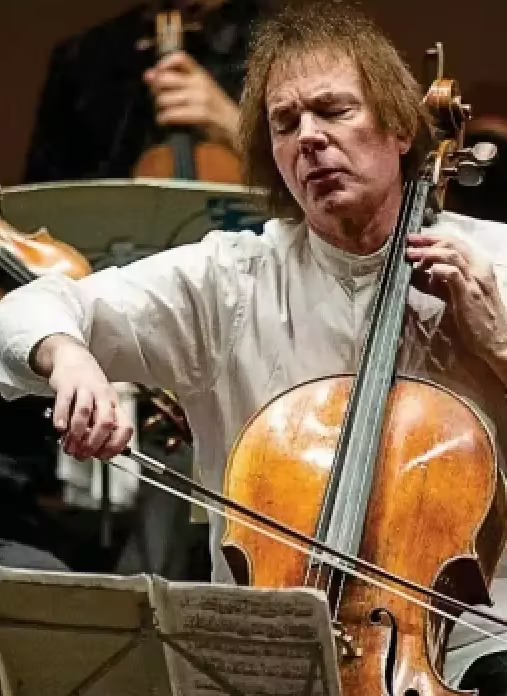
This concert attracted some of the best-known faces in English music as well as a host of young players. It even persuaded Julian himself to brieflv return to the cello, the instrument he played with such dedication for so long.
His 14-year-old daughter had told him that she had never heard him play in public so he spent a good deal of time quietly working on some of his old repertoire, notably a piece by Faure. It was fascinating after a dozen years of silence to hear him, and his playing still has a lovely tone.
But I doubt if we will ever hear much from him again. An injury to his neck prevented him from pursuing his career and, although the surgeons were ready to do their best, it was a risky procedure and Julian decided not to go ahead with it.
The programme was far from predictable, with Lauren Zhang, winner of the 2018 BBC Young Musician contest, making her London debut with the Reminiscences De Norma by Liszt. She has taken up medicine but her talent as a pianist remains pretty obvious. Julian’s wife, Jiaxin, contributed some Bach and the Kanneh-Mason tribe were much in evidence, presided over by their father.
What an outstanding family they are. It’s one thing that out of half a dozen children, one should have great talent, but for all of them to be possessed of musical gifts, that is something else.
Sadly Sheku is injured and could not play, but we heard from his sister Isata, whose excellent piano album I recently reviewed, and the youngest sibling, Mariatu, who, at the age of 16, showed that she too has formidable talent as a cellist.
When Julian gave up the cello, he took on the Roval Birmingham Conservatoire and spent several successful years there developing young talent. And I don’t think he will ever stop doing that. Long may he continue.
LONDON-It has been 12 years since British cellist Julian Lloyd Webber put his cello back in its case for the last time, a herniated disc in his neck having brought a premature end to a career that had begun in 1972 with the first London performance of Arthur Bliss’s Cello Concerto. On April 14 he turned 75, and the birthday party took the form of a gala charity concert at London’s Wigmore Hall, with brother Andrew in attendance. Performers included professional soloists alongside students from the charity, Music Masters.
Sheku Kanneh-Mason was in the original line-up, but a finger injury has been keeping him off the stage of late.
Luckily, the legendary Kanneh-Mason family is never short of a stand-in, so his sister Mariatu Kanneh-Mason was on hand, as was another sister, pianist Isata Kanne-Mason, the birthday boy’s cellist wife Jiaxin Lloyd Webber, and pianists Lauren Zhang (winner of BBC Young Musician 2018, making her London debut), Edward Leung, and Rebeca Omordia.
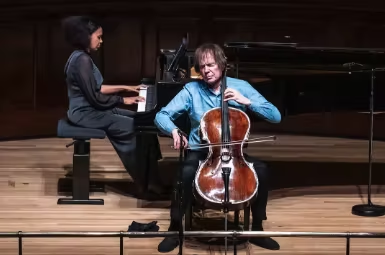
A special occasion: Julian Lloyd Webber revisits his pe-injury prowess at Wigmore Hall
Students from Music Masters were violinists Harry Nim, Ana Neves, and Eric Park, violist Libi Winterstein, and cellist Anna Lea Gonzalez Duba.
After his forced retirement from the concert stage, Lloyd Webber became a public spokesman for the charity Live Music Now and was compelling in his advocacy for music education in Britain at a time when it was under severe threat (sadly, still the case today). In 2015 he became principal of the Royal Birmingham Conservatoire, staying for five years and overseeing the move to a new £57 million building.
There could be no closer fit for Lloyd Webber than Music Masters (tagline: Transforming Lives Through Music), which has as its aim “widening access to high-quality music education from early years to young adulthood, focusing on U.K. communities facing systemic inequality or disadvantage.” Its chair Stuart Mason, father of the Kanneh-Mason clan, said that when Lloyd Webber was mentoring Sheku, he would not let him get away with a single bow stroke that was less than perfect. The two had met when Lloyd Webber was judging the string final of BBC Young Musician 2016, which Sheku went on to win.
With such a wealth of young talent on stage, this was going to be a birthday party with a difference. American-born pianist Lauren Zhang, who gave up an offer from the Curtis Institute to go and study medicine at Harvard, kicked it off with some lyrical and fiery List, his Réminiscences de Norma de Bellini, before Jiaxin Lloyd Webber calmed things down with some Bach. His cello suites had been her study during the Covid lockdown and she was serene in the first suite, a romantic reading with nice dynamic contrast.
Dr. Zhao, a “traditional Chinese face-changing artist.”
After that, it was, said Lloyd Webber, “from the sublime to the – no, I won’t say it,” introducing the wild card on the program, Dr. Zhao, a “traditional Chinese face-changing artist.” The good doctor took to the stage with Jiaxin Lloyd Webber and Edward Leung to bring a bit more color to a performance of “Saliha,” Xiaolong Huang’s arrangement of a popular song by Heng Qian.
It turns out that the art of face changing belongs to the repertoire of Sichuan opera, cultivated in southwestern China since the early 1700s. It was certainly a wacky addition to this birthday party, Dr. Zhao arriving on stage in an exotic costume, his face changing color as advertised before he went down into the auditorium to try and get everyone clapping.
In the second half, 16-year-old cellist Mariatu Kanneh-Mason made her Wigmore Hall debut with big sister Isata at the piano, delivering a mesmeric “Nana” from Falla’s Seven Popular Spanish Songs and a golden account of the Andante from Rachmaninov’s Cello Sonata in G minor.
British-Nigerian pianist Rebeca Omordia, who curates an African concert series at the Wigmore Hall, kicked off with some splashy and powerful Florence Price and later offered three of the “24 Studies in African Rhythms” by Fred Onovwerosuoke from Nigeria- variously contemplative, playful, and compulsive-and finally ripping things up with “Scarbo” from Ravel’s Gaspard de la Nuit.
If Dr. Zhao had been the wild card, Julian Lloyd Webber pulled another rabbit from the hat by walking on stage with a borrowed cello to break his playing embargo. “I’ve done some reckless things in my life,” he said, “but this has to be the most reckless yet.” He gave a beautiful account of Fauré’s Élégie with Rebeca Omordia, the warm tone and intense musicality giving a glimpse back at what was lost after the neck injury. This was no comeback-just an amuse-bouche to store in the memory.
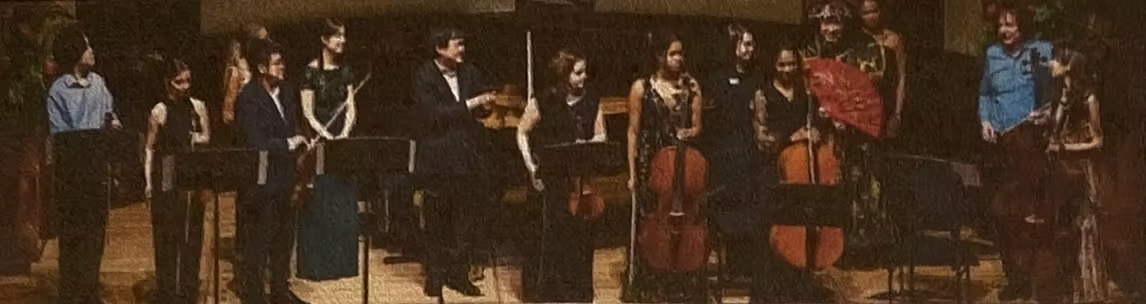
The curtain call for JL Webber’s birthday celebration, a fund-raiser for Music Masters.
After some stately Handel from cellists Anna Lea Gonzalez Duba and Mariatu Kanneh-Mason, 11 performers crowded the stage-including the birthday boy- to round off the party with a spirited account of Vittorio Monti’s Cárdás, arranged for solo violin, two violins, viola, cellos, and piano six hands by the Kanneh-Mason family and composer Tom Coult.
McCabe: Partita for solo cello. Dalby: Variations.
This is a happy grouping of four representative works by notable British composers. Lennox Berkeley the doyen makes the briefest contribution, a well-wrought piece of 1971 that makes an impression beyond the number of its notes. Fricker’s 1956 sonata was first sketched on Ischia and pays tribute to the Walton of its dedication in some spiky rhythms and music of broad lyrical span; it is taut and characterful. McCabe’s unaccompanied partita of 1956 makes an effective mosaic with a preponderance of sombre, passionate movements, closely linked thematically but of wide emotional range. Martin Dalby’s Variations date from the same year (he was 24) and are one of the fruits of his Italian experience. The music is lean and imaginative, with a fantastic pierrot quality that finely exploits the gamut of the cello. Julian Lloyd Webber has all the musicality of his astonishing family, an enviable technique, and will doubtless soon develop the breadth of vision to tap the resources of his instrument to the full. John McCabe makes an ideal partner, with problems of balance solved before they occur.
McCabe: Partita for solo cello. Dalby: Variations.
Many readers will know what a brilliant and musically penetrating cellist Julian Lloyd Webber is; although young, he has won the highest plaudits. This record confirms them; music may be thankful that he has a special concern about the work of living composers.
In case you feel that these are not exciting composers for a brilliant young cellist to advocate, I should say that the Fricker is a powerful work in four movements, strongly lyrical in invention, sympathetic but not a bit ordinary in expression, the sort of music that Brahms might have composed if he had been born a century later, after Schoenberg but untouched by the vanguard of our day. It is a real duo for both performers. The Berkeley is less bold but strongly sustained also, a slow piece followed by a fast one: here Lloyd Webber’s telling articulation and sense of tone-colour are deployed exceptionally; he renders to Berkeley one hundred per cent of what Berkeley imagined when the piece was written, and the recording gives both partners air and vibrancy in the acoustic.
McCabe’s solo Partita is vivid and full of musical sap, individual but creatively indebted to J.S. Bach, and sometimes Bartok (unimpeachable models). The “Funeral March” seems the weak point, the rest quite admirable, like the performance. Dalby’s Variations are active and well made, somewhat subdued for this lively composer until the fiery finale which releases tension, in this performance, as if a tap had suddenly been turned on. Not the most exciting music in the catalogue, but vital, and a record that gratifies good equipment. W.S.M.
A first-class package in every way. As we know from his live performances, Julian Lloyd Webber has a firm, richly coloured and full-focused tone; moreover it records well. His lyrical warmth projects tellingly over the entire range and his involvement in the music communicates consistently and tellingly. He has chosen his accompanists well too. His account of the great Dvorak concerto is full of passionate feeling, with a tender Adagio, and Neumann and the Czech Philharmonic give him thoroughly persuasive backing, playing with plenty of bite in tuttis, the Slavonic exuberance always to the fore. His performance of the Elgar concerto has the huge advantage of Lord Menuhin as his partner, a true Elgarian if ever there was one. It is a performance of real understanding and rare intensity, which never oversteps the work’s emotional boundaries and is imbued with innate nostalgia: the Adagio has a haunting Elysian stillness. The Saint-Saens is played for the splendid bravura war-horse that it is, and we are also given a rare chance to hear the original, uncut version of Tchaikovsky’s Rococo Variations. Lloyd Webber soon proves that it is superior to the truncated version used in most other recordings; moreover his spontaneous warmth in Tchaikovsky’s long-drawn lyrical lines, which he makes sound very Russian in character, makes a perfect foil for the sparkling virtuosity elsewhere.
Among the encores the lovely Traumerei stands out for its freely improvisational feeling and Lloyd Webber’s own catchy, slight but romantic personal tribute to Jacqueline du Pre is played as an ardent, tuneful and timely postscript.
Edinburgh Youth Orchestra **** St Mary’s Metropolitan Cathedral
By SUSAN NICKALLS
THE last of the Edinburgh Youth Orchestra’s Spring concerts drew a capacity audience to hear a varied and ambitious programme which highlighted the considerable abilities of these young musicians.
Close to 100 players delivered a powerful and well-paced performance of Stravinsky’s The Firebird: Ballet Suite. At full-strength the EYO are a force to be reckoned with and it was only in some of the more exposed areas that the occasional weakness was to be found.
In Khachaturian’s Adagio from Spartacus, the laid-back rhythms often came adrift although the string sound was solid throughout. Prokofiev’s musical tale for children, Peter and the Wolf, is popular with audiences of all ages, and the EYO, with narrator Julian Lloyd Webber, gave an animated and often humorous performance. The soloists, who all played superbly, wore hats to indicate their particular character, with conductor En Sao entering into the spirit of things by wearing a wolf hat.
Lloyd Webber then took up his cello to play David Horne’s rather lightweight arrangement of Peter Maxwell Davies’s piano interlude Farewell to Stromness for cello and string orchestra. The lilting melody suited the mellifluous tones of Lloyd Webber’s cello, which were spun like gold in the bright acoustics, but this was often undermined by an accompaniment which tended to flatten rather than lift the tune.
Evening Songs – Delius and Ireland songs arranged for cello and piano by Julian Lloyd Webber
(Naxos Classical 8.572902)
A nice idea; songs by John Ireland and Frederick Delius arranged for cello and played by JLW. 2012 brings fifty years since Ireland died and one hundred and fifty since Delius was born. The transcriptions work well and are played with feeling, tenderness, good tone and love. Ireland’s Sea Fever and The Holy Boy are here; indelible melodies. There’s a good range included. This release is not just for cellists; it’s good to have a different light shone on these ‘settings’, which still sing. Jiaxin Cheng (Mrs JLW) performs on two tracks and John Lenehan is a sensitive pianist. The sound is nicely tangible while allowing space around the instruments.
“…his new Naxos album ‘Evening Songs’ is an endearing collection of ‘songs without words’ by two composers he has long championed: John Ireland and Frederick Delius…Julian has a well-developed nose for enduring melody and ‘Evening Songs’ chronicles an abundance of it.”
EVENING SONGS – DELIUS AND IRELAND **** (Naxos Classical)
This selection of some of Delius’ most beautiful songs arranged for cello and piano demonstrates the composer’s gift for melody.
His Serenade From Hassan is haunting. The cellists, who are husband and wife, explore the thoughtful elegance of John Ireland’s songs, in particular Her Song.