Category: Reviews

  • Bryars Cello Concerto

    The Strad April 1997

    Bryars: Cello Concerto Farewell to Philosophy

    The meditative or reflective forms a key part of Gavin Bryars’ musical vocabulary. The chief delight is Julian Lloyd Webber’s intelligent reading of the solo line – beautifully judged and sustained, gorgeous in tone, subtle in nuance and utterly disarming in the final Farewell, which really does feel like a culmination.

    RODERIC DUNNETT

  • Bryars Cello Concerto

    Le Monde de la Musique November 1996

    CONCERTO POUR VIOLONCELLE FAREWELL TO PHILOSOPHY

    Julian Lloyd Webber (violoncelle), Charlie Haden (contrebasse). Ensemble Nexus (percussions), English Chamber Orchestra, James Judd (direction)

    Auteur de The Sinking of the Titanic, Jesus’ Blood never failed me yet, le compositeur anglais est un original. Son Concerto pour violoncelle multiplie les allusions a Haydn.

    Franck Mallet

  • Bryars Cello Concerto

    The Evening Standard 7th November 1996

    Bryars: Cello Concerto Farewell to Philosophy

    Bald icon Bryars is already a cult figure in certain circles. His music represents the intelligent man’s New Age minimalism. His Cello Concerto Farewell to Philosophy is a beautiful woven and gently elated idyll. Cellist Julian Lloyd Webber sings its long lines with the same plaintive intensity that marked his extraordinary recording of the Delius Cello Concerto.

    Alexander Waugh

  • Bryars Cello Concerto: Gramophone Editors Choice

    Gramophone November 1996 Editor’s choice

    Bryars Farewell to Philosophy

    Lloyd Webber; Haden; Nexus; ECO / Judd. Gavin Bryars’s 1995 Cello Concerto emerges from among shadows with its solo line climbing sadly and patiently. Both pieces emerge from among shadows, the Bryars including harp and low percussion. Lloyd Webber’s tone seems to be perfectly suited to the job, being full-bodied and expressive but relaxed enough to blend with the components of a predominantly dark accompaniment.

    Robert Cowan

  • Bryars Cello Concerto

    The Independent 29th November 1995

    Music, English Chamber Orchestra, Barbican, London

    If names are the consequences of things – as Gavin Bryars states – then what can we make of minimalism? Commissioned by Philips Classics Productions for Julian Lloyd Webber, it seemed well fitted out to match the particular strengths of his playing. Above telling changes of harmony, the soloist unwound a thread of melody. Bryars writes skilfully for the strings. The concerto was subtitled Farewell to Philosophy, an idea given musical substance through allusions to Haydn symphonies.

    NICHOLAS WILLIAMS

  • Vivaldi Concerto for two cellos

    Birmingham Post on May 31 2018

    Orchestra of the Swan at the Royal Birmingham Conservatoire

    May 28, 2018
    Reviewer: Christopher Morley

    May 28, 2018
    Reviewer: Christopher Morley

    It was a wonderful house-warming as Orchestra of the Swan moved into its new Birmingham residence on Bank Holiday afternoon, and there was a packed audience to savour the occasion.

    Julian Lloyd Webber, RBC Principal, was the genial host, his batonless conducting, often with a cellist’s sweep of phrasing and articulation as the music unfolded, drawing performances of utter enjoyment from the OOTS players, whose generous enthusiasm was unbounded.

    There were three cellists in this relationship, Lloyd Webber collaborating with the remarkable Jian Wang (and conducting here scoreless in a work he himself has played countless times) in Haydn’s lovely C Major Cello Concerto. Wang’s initial entry was stunning and imposing, followed by flowing facility of passage-work conveyed through lissomly athletic bowing. The finale proved a spectacular technical display from both soloist and orchestra (such fizzing violin unisons).

    Jiaxin Lloyd Webber partnered Jian Wang in Vivaldi’s G minor Double Cello Concerto, the familiar Vivaldi template enlivened by the empathetic interplay and dynamic energy between the soloists. The Largo, just soloists and orchestral cellos, was particularly affecting, and the quarrelsome finale was theatrically effective, part of it the basis for a Mad Hatter’s Tea Party of an encore, both Lloyd Webbers and Jian Wang all swopping roles.

    Framing these concerti were two great Elgar works for string orchestra, both sounding so well in this wonderful acoustic. The early Serenade was affectionate without affectation, with warm bass-line underpinning, and the Introduction and Allegro of the composer’s confident maturity was grippingly engaged. The solo quartet of OOTS’ sectional principals seasoned the progress with reflectiveness, Lloyd Webber’s brave refusal not to hammer out every beat of each bar, and the busyness of the tutti gave us a texture scudding like clouds, reminding us of the opening of the famous Ken Russell Elgar docu-film. Didn’t he get everything right on that occasion?

    Christopher Morley

  • Haydn Concerto in C

    Birmingham Post on May 31 2018

    Orchestra of the Swan at the Royal Birmingham Conservatoire

    May 28, 2018 Reviewer: Christopher Morley

    It was a wonderful house-warming as Orchestra of the Swan moved into its new Birmingham residence on Bank Holiday afternoon, and there was a packed audience to savour the occasion.

    Julian Lloyd Webber, RBC Principal, was the genial host, his batonless conducting, often with a cellist’s sweep of phrasing and articulation as the music unfolded, drawing performances of utter enjoyment from the OOTS players, whose generous enthusiasm was unbounded.

    There were three cellists in this relationship, Lloyd Webber collaborating with the remarkable Jian Wang (and conducting here scoreless in a work he himself has played countless times) in Haydn’s lovely C Major Cello Concerto. Wang’s initial entry was stunning and imposing, followed by flowing facility of passage-work conveyed through lissomly athletic bowing. The finale proved a spectacular technical display from both soloist and orchestra (such fizzing violin unisons).

    Jiaxin Lloyd Webber partnered Jian Wang in Vivaldi’s G minor Double Cello Concerto, the familiar Vivaldi template enlivened by the empathetic interplay and dynamic energy between the soloists. The Largo, just soloists and orchestral cellos, was particularly affecting, and the quarrelsome finale was theatrically effective, part of it the basis for a Mad Hatter’s Tea Party of an encore, both Lloyd Webbers and Jian Wang all swopping roles.

    Framing these concerti were two great Elgar works for string orchestra, both sounding so well in this wonderful acoustic. The early Serenade was affectionate without affectation, with warm bass-line underpinning, and the Introduction and Allegro of the composer’s confident maturity was grippingly engaged. The solo quartet of OOTS’ sectional principals seasoned the progress with reflectiveness, Lloyd Webber’s brave refusal not to hammer out every beat of each bar, and the busyness of the tutti gave us a texture scudding like clouds, reminding us of the opening of the famous Ken Russell Elgar docu-film. Didn’t he get everything right on that occasion?

    Christopher Morley

  • Elgar Introduction and Allegro

    Birmingham Post on May 31 2018

    Orchestra of the Swan at the Royal Birmingham Conservatoire May 28, 2018 Reviewer: Christopher Morley

    It was a wonderful house-warming as Orchestra of the Swan moved into its new Birmingham residence on Bank Holiday afternoon, and there was a packed audience to savour the occasion.

    Julian Lloyd Webber, RBC Principal, was the genial host, his batonless conducting, often with a cellist’s sweep of phrasing and articulation as the music unfolded, drawing performances of utter enjoyment from the OOTS players, whose generous enthusiasm was unbounded.

    There were three cellists in this relationship, Lloyd Webber collaborating with the remarkable Jian Wang (and conducting here scoreless in a work he himself has played countless times) in Haydn’s lovely C Major Cello Concerto. Wang’s initial entry was stunning and imposing, followed by flowing facility of passage-work conveyed through lissomly athletic bowing. The finale proved a spectacular technical display from both soloist and orchestra (such fizzing violin unisons).

    Jiaxin Lloyd Webber partnered Jian Wang in Vivaldi’s G minor Double Cello Concerto, the familiar Vivaldi template enlivened by the empathetic interplay and dynamic energy between the soloists. The Largo, just soloists and orchestral cellos, was particularly affecting, and the quarrelsome finale was theatrically effective, part of it the basis for a Mad Hatter’s Tea Party of an encore, both Lloyd Webbers and Jian Wang all swopping roles.

    Framing these concerti were two great Elgar works for string orchestra, both sounding so well in this wonderful acoustic. The early Serenade was affectionate without affectation, with warm bass-line underpinning, and the Introduction and Allegro of the composer’s confident maturity was grippingly engaged. The solo quartet of OOTS’ sectional principals seasoned the progress with reflectiveness, Lloyd Webber’s brave refusal not to hammer out every beat of each bar, and the busyness of the tutti gave us a texture scudding like clouds, reminding us of the opening of the famous Ken Russell Elgar docu-film. Didn’t he get everything right on that occasion?

    Christopher Morley
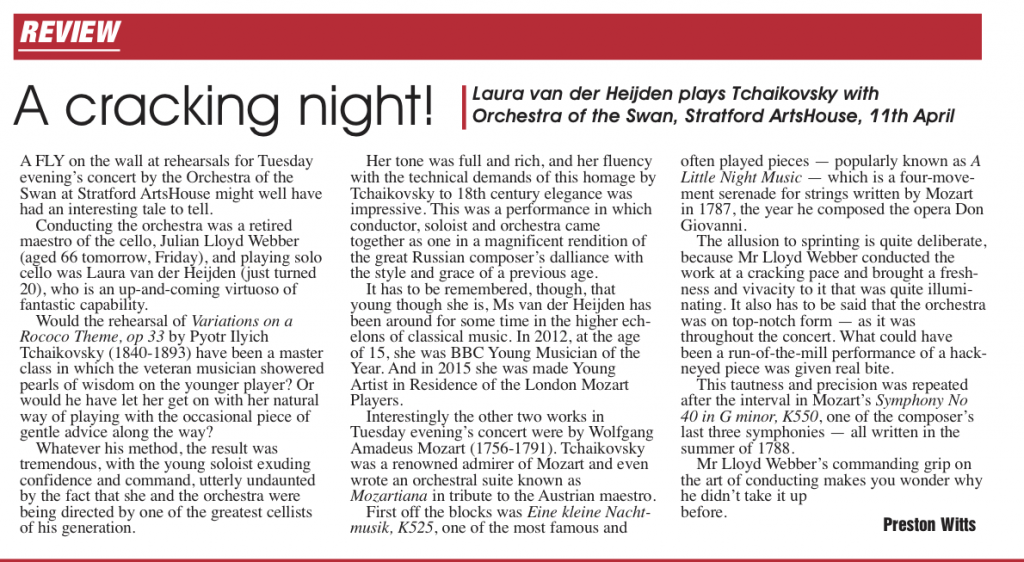
  • Mozart, Eine Kleine Nachtmusik & Symphony no.40

    Birmingham Post, April 20 2017

    Orchestra of the Swan, Birmingham Town Hall

    Full Article by Christpher Morley – click here

    Review, April 2017

    A Cracking Night! by Preston Witts

  • Encore! Travels with My Cello Vol.2

    Gramophone March 1987

    Julian Lloyd Webber (vc);

    Royal Philharmonic Orchestra / Nicholas Cleobury.

    Lloyd Webber’s cello is off on its travels again: Catfish Row, Sweden, Turkey, France, Skye, Spain, Japan, ‘Somewhere’, Germany, India, Vienna. And one geographically unidentifiable, Vangelis for his Une apres-midi. This is written for synthesizers, which on this occasion imitate an orchestra unbelievably well; indeed, the live solo cello, perhaps unnerved by all the surrounding machinery, here takes on a bit more of the standard synthesizer quality than its accompanists do.

    Otherwise it feels at home, singing its way naturally through a repertoire varied not only by geography. Most is familiar: Bess, Jesu joy. Song of India, and such; some is not: Hamabe no uta is not, Taube’s Nocturne is not. For this last Taube’s son, Sven-Bertil the actor, contributes some guitar-playing: for the Carmen Habanera there is also an effective guitar, but played by a different player. Basically the accompaniment is the RPO contributing some gorgeous sounds, but also inevitably raising the question of whether these sounds are out of proportion accompanying a solo string-player in basically light repertoire. Once, for McCartney’s When I’m 64, highly uncharacteristic sounds (not at all out of proportion!) are made: I expect the players enjoyed themselves greatly!

    And of course Lloyd Webber contributes, everywhere, gorgeous cello-playing: always simple in outline, always just right for the simple outline concerned. He contributes, too. short notes on the various pieces, which (seemingly exceptionally for today) are actually printed in the right order! So far as they go, that is; the note on the last piece seems to have been mislaid somewhere.

    M.M.