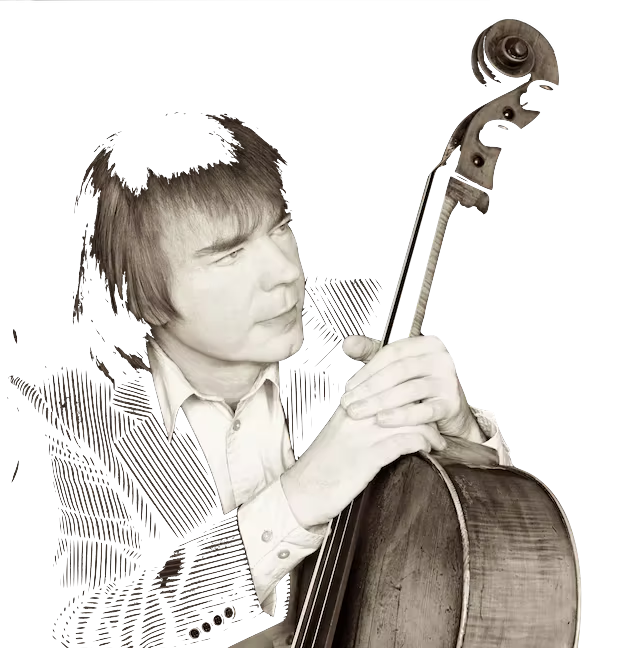

From ‘The Importance of Elgar’ published by Boydell and Brewer, 2026
I was a teenager when my godfather, the composer Herbert Howells, presented me with a score of Elgar’s Cello Concerto which he inscribed: To Julian, from H.H. to whom E.E. once said of this work, “It’s just an old man’s darling”. A few weeks later my interest in Elgar was further kindled by a performance of his First Symphony at the Royal Festival Hall during which the inspirational maestro, John Barbirolli, not only managed to drop his baton enough times to derail an entire Olympic relay race but also fashioned a performance of such emotional intensity as to be utterly irresistible.
Two such seismic events so close together marked the beginning of my absorption in both Elgar’s music and the character of the man himself. I began ‘borrowing’ my father’s luridly orange 850cc Mini to head west out of London towards Elgar Country. Along the way to Worcestershire, the contours of the land, the distinctive towns and villages, the lure of the valleys and the hills – and whatever else might lie beyond – all these things made a huge impression on an adolescent boy who had previously known very little beyond the confines of London.
Often I only made it as far as the north Cotswolds, but whenever I could I would venture further towards the Malvern Hills along the glorious road from Stow-on-the-Wold to Tewkesbury that winds its way across hillsides which remain as cold and windswept today as when Elgar wrote those rustling semiquavers in the Scherzo of his First Symphony.
I sometimes wonder which of Elgar’s works were most dear to his heart; the ones he would most want audiences to be hearing today? Or, to pose the question another way, which works are the essence of Elgar? Was the real Elgar the bombastic, tub -thumping composer of five Pomp and Circumstance marches, the Banner of St George, the Imperial March and much else besides? Or was the real Elgar the lover of the countryside who liked nothing more than to walk the hills – with or without his dog or dogs – and who liked to dream his dreams while fishing on the banks of the River Wye with his close friend the violinist, WH ‘Billy’ Reed.
Reed was the leader of the London Symphony Orchestra and he became a hugely important figure in Elgar’s life almost as soon as they first met when Elgar guest-conducted the orchestra. Reed was also my mother’s violin teacher at the Royal College of Music and she recalled him as “a lovely man with twinkly eyes who was always happy to talk about Elgar”. She also claimed it was Reed who began the tradition of audiences applauding the arrival of the orchestra’s leader simply because “they were so pleased to see him!”
From Reed we know that Elgar hated discussing the ‘meaning’ of his music: ‘Elgar was always very reticent and unwilling to discuss the inner meaning of anything he had composed. There was nothing he disliked more. He would change the subject abruptly or retire into his inner self with some such observation as “Oh, I don’t know anything about music. Let us go out and see the river, or go up to the common, and do something sensible for once”. Occasionally, though, he let things slip out. I remember once when we were rehearsing the First Symphony, and … a passage was being played in too matter-of-fact a manner to please him, he stopped and said, “Don’t play it like that: play it like” – then he hesitated, and added under his breath, before he could stop himself – “like something we hear down by the river”. I never can play or hear that phrase but I am with him ‘down by the river’ again as I have been so many times.’ [1]
Much as Elgar disliked revealing anything about the source of his inspiration it is interesting that, whenever he did, he so often mentions nature: “My idea is that there is music in the air, music all around us, the world is full of it and you simply take as much as you require.” [2] And writing to his friend and publisher AJ Jaeger: “The trees are singing my music — or have I sung theirs? I suppose I have.” [3] Then there is Elgar’s famous ‘deathbed’ comment to his friend, the theatre producer Barry Jackson, when Elgar ‘rather feebly’ tried to whistle the opening theme from his Cello Concerto. “Barry” he said with tears in his eyes, “If ever you’re out walking on the Malvern Hills and hear that, don’t be frightened, it’s only me.” [4]
I believe it is no accident that Elgar’s most internationally performed major work is his Cello Concerto – almost entirely misunderstood at its premiere yet, today, globally recognised as a masterpiece. It has no tub-thumping, no sense of triumphalism – it is the music of one human being expertly conveying his deepest emotions to his fellow human beings through the medium of music.
It is also nature music, something that seems increasingly remote in today’s urban-centric world. As Gainsborough and Constable literally painted the British countryside, Elgar also had an extraordinary ability to portray nature through music in the same way that he allowed us to visualise his ‘friends pictured within’ in Enigma Variations. Thus his importance as a chronicler of the British countryside becomes ever more significant as the landscape, and the wildlife within it, that Elgar knew and loved so well continues to disappear at alarming speed. Present day farming practices lethal to wildlife (73 million birds lost in the last 50 years) and the habitats needed to sustain it have resulted in an increasingly barren land and the sights and sounds of the countryside Elgar recorded so often in his music are fast vanishing.
When we were rehearsing for our recording of Elgar’s Cello Concerto the conductor, who had known Elgar so well, offered me just one piece of interpretive advice. As I started the lilting 9/8 first movement theme rather too loudly, Yehudi Menuhin interrupted me: “Please play this as if it’s coming from far away over the hills”.
I played this extraordinary piece of music many, many times and I can write, without hesitation, that it has been a constant, significant presence in my life. The slow movement in particular carries a spiritual depth ‘beyond tears’, resigned to its fate, and it is no surprise that Elgar chose to share his obvious affection for it with my godfather. In his Cello Concerto Elgar gives us his essence and, whenever he does that, his music will continue to reach minds and touch hearts forever.
Julian Lloyd Webber, January 2024
[1] WH Reed. ‘Elgar as I Knew Him’, V. Gollancz Ltd, 1936
[2] In conversation, 1896
[3] Letter to August Jaeger, 11 July, 1900
[4] In conversation, 1934