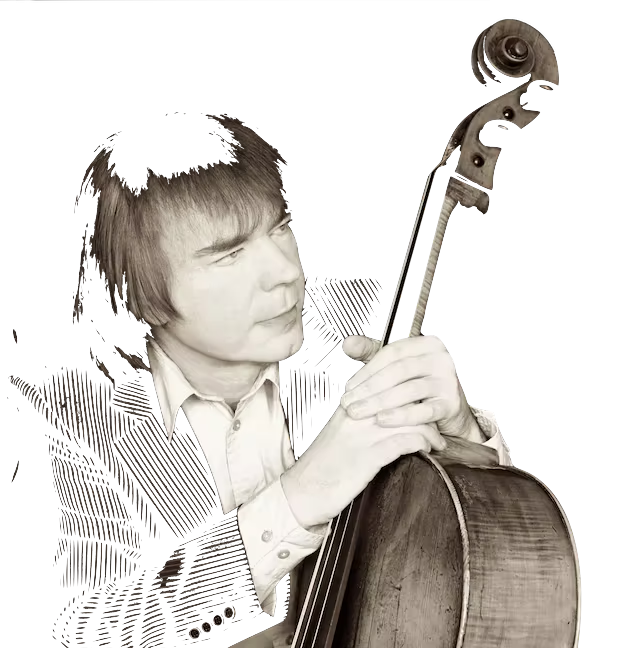

“Beatrice Harrison was the leading British cellist of her generation”. An oft-repeated judgement, but we should not be too distracted by the adjectives ‘British’ or even ‘cellist’ as Harrison was a global trailblazer for all female instrumentalists.
Born on December 9th 1892, in the foothills of the Himalayas, Harrison was the second of a quartet of musical daughters. Her father belonged to a distinguished military family; her mother Annie was a striking, raven-haired Celt whose own singing ambitions had been thwarted. Both parents were determined to ensure that their talented children would have the best training possible and her father made the extraordinary decision – for those days – to abandon his own military life to concentrate entirely on his daughters’ musical upbringing.
Harrison made her Queen’s Hall debut in 1907, aged 14, playing three substantial works for cello and orchestra (including Saint-Saens 1st Concerto) under the baton of Henty Wood. Soon after, she left England to study in Germany with Hugo Becker who, three years later, entered her for the coveted Mendelssohn Prize in Berlin. Harrison won, becoming both the youngest competitor and the first cellist to win. On hearing the news, the German Kaiser sneered “An English girl, never. For golf, perhaps, but music NO!”
Returning to England in triumph, Harrison made her ‘adult’ debut at the Queen’s Hall in June 1911, again conducted by Wood. This time the programme belonged to her and consisted of three of the most demanding works available to cellists at the time: Haydn’s Concerto in D, the Dvorak Concerto and – for good measure! – Tchaikovsky’s Variations on a Rococo Theme. Reviews were ecstatic, often referencing Casals and – significantly – The Times remarked on an ‘undefinable quality’ in her playing.
With her career now established, Harrison’s pioneering spirit came to the fore. She became the first female cellist to play in Carnegie Hall and the first to play with the Chicago and Boston Symphony orchestras. She developed an interest in contemporary music which, in December 1919, made her an obvious choice to record Elgar’s recently composed concerto with the composer conducting. She introduced Kodaly’s demanding Sonata for Solo Cello to England (and to many American and European cities), Honegger’s Sonata and, with sister May, Ravel’s Sonata for Violin and Cello. To these were added a plethora of new works by British composers especially written for her which included Delius’s Concerto and Sonata, John Ireland’s Sonata, Arnold Bax’s Concerto and Sonata along with many works by Grainger, Quilter, Scott and York Bowen.
On the night of 19th May 1924, Harrison became world-famous when the BBC relayed her ‘duetting’ with a nightingale in the garden of her Surrey home. The broadcast achieved a worldwide audience of millions and Harrison’s subsequent ‘cello and nightingale’ relays from her garden became regular, much-anticipated events. But these infamous soirees with nightingales began to obscure Harrison’s finest achievements. As George Bernard Shaw wrote to her in 1936: “I shall reproach the BBC for not broadcasting your recent recital. It will do them good to be told that you are the greatest cellist in Europe, and therefore presumably in the world. That confounded nightingale probably got you listed as Variety….!”
Yet the nightingale ‘episodes’ were very much a part of Harrison’s persona. They demonstrated her belief that music was “simply an extension of nature” and they enabled Beatrice to achieve her dream of “bringing my music to the ordinary people”.
My guess is that Harrison was an even better cellist than her few substantial recordings suggest. To today’s ears her portamenti can sound too ‘gloopy’, although her tone is never less than beautiful and her phrasing is often inspired. Fine as it is, her Elgar Concerto recording doesn’t quite do her justice (although who could forget her thrilling accelerando in the first movement’s famous scalic run up to a top E at its in tempo reappearance; now nearly always spoiled by the same turgid rallentando.) Sadly there is no recording of the Kodaly Sonata, but we do have her Delius Sonata (with Harold Craxton), Brahms’ E minor Sonata (with Gerald Moore) and, fascinatingly, the Prelude and Gigue from Bach’s Suite No. 3 which she recorded as early as 1920 – sixteen years before Pablo Casals!
From the vantage-point of the twenty-first century it is easy to forget what a true pioneer Beatrice Harrison was. Her playing was blessed with a wonderful spontaneity of phrasing and great natural facility. But what, I suspect, so beguiled and tempted those nightingales was that ‘indefinable quality’ which her playing possessed in such rare abundance.
Recommended recording: Brahms’ Sonata in E minor, Op. 38 with Gerald Moore