

Category: Reviews

  • Turkish Daily News

    Turkish Daily News 27th June 2007

    Classic brilliance resonates in ancient walls

    Istanbul Concert Review

    Music gently winds through the corridors of the ancient Byzantine structure Hagia Eirini, at the concert, Festival Meetings II, performed by an acclaimed cellist, cello quartet and pianist

    As four cellists raise their bows in the air and strike the cellos strings with utmost grace, Bach’s Air in D Major gently resonates in a former Eastern Orthodox Church, Hagia Eirini Museum (Aya lrini) at the Topkapi Palace on Monday night. As the music gently whines through the corridors of the ancient Byzantine structure and rises to the atrium, a surreal musical journey begins in an enchanting setting of history and culture that creates the perfect atmosphere for music lovers of all ages. Festival Meetings II, featuring an acclaimed cellist, Julian Lloyd Webber, cello quartet ‘ellistanbul and pianist Pam Chowhan is part of the 35th International Istanbul Music Festival. The festival is the latest creation of a creative musician and an ensemble of musicians whose passion for classical sound resonates from their soul. Istanbul’s own cello quartet ”eliistanbul”, started the audience on a journey of choral harmonies. Inspired by the city Istanbul and its magical atmosphere, the group is formed of cellists who graduated from the same Conservatoire of music their repertoire includes classical as well as modern works. ‘I am on a Long, Narrow Road’ was a special composition for the quartet based on Asik Veysel’s melody that proved to the audience they were witnessing brilliant performers.

    Each cord was played in unison echoing the emotion of the music on the individual faces and swaying bodies 0r the cellists. The group was one entity playing off each other’s enthusiasm and passion. Their long composition was met with equal pleasure from the audience as each note created tension in the already thick church air. The last note in the composition is held in harmony. The audience holds its breath. Time stops. The note finishes. The stunned audience breaks the silence with loud cheers and applause.

    The group also known for their works of tango and jazz finish off their set with Tango Passionata and Polonaise. The second set welcomes Julian Lloyd Webber to the stage with Pam Chowham accompanying him on the piano. He too begins with Bach’s C Major Adagio followed by Scherzetto. At first the music did not flow together.

    There seemed to be tension as each performer kept looking for signs and warmth the two instruments should create. It was not until Scherzo Pizzicato that the union warmed up and put their bows aside; Webber played the cello with his fingers. Claude Debussy’s Sonata (1915) was long and stunning. Inspired with patriotic sentiments his music flowed with watery magic to dark virtuosity. It was multi-faceted brilliance that was written for the flute, piano and cello and it worked with Chowhan accompanying Webber on the piano. The night was not over yet, as ”ellistanbul’ joined Webber on stage to perform the last three compositions. Beginning with Astor Piazzolla’s Oblivion, the groups performance highlights not only Webber’s amazing ability to take original scores and create a compelling rhythm, hut to depict character through music that shows his way of bringing life to his playing, It would not be a Webber production without performing one of his brothers most popular songs from the popular musical Jesus Christ Superstar, ‘I Don’t Know How to Love Him.’ The audience was really alive and hoped there was more when the performance ended. The silence was extensive and finally broken with loud applause. The applause brought Webber and the ”ellistanbul’ quartet back on stage to perform an encore of Astor Piazolla’s Oblivion. This time when the last cord was held, the audience knew once the sound reached the atrium, the performance was truly over. A standing ovation ended a magical myriad of classical ethereal sound that was performed brilliantly.
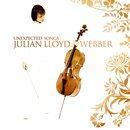
  • Unexpected Songs

    Classic FM Magazine September 2006

    Unexpected Songs review

    Unexpected Songs CDIt’s always interesting to see cellists push out the walls of their comfort zone. On Unexpected Songs – the title a hint towards the sheer breadth of music therein – Britain’s leading cellist ventures into ethnic territory Arrangements of pieces by Nitin Sawhney (the wistful Songbird), and a traditional African lullaby sit alongside classical pieces by Chopin, Schubert, Elgar and Orff, as well as folk, soundtrack excerpts (‘Hushabye Mountain’ from Chitty Chitty Bang Bang is spine-tingling) and show tunes, including brother Andrew’s title track, taken from the musical Song And Dance and featuring Michael Ball. The spectral harp of guest star Catrin Finch enchants throughout.

    Anna Britten

  • Unexpected Songs: ArkivMusic.com 2006

    Available on Amazon

    ArkivMusic.com 2006

    Unexpected Songs review

    Release Date: 07/18/2006

    Label: Emi Classics

    Composer: Richard M. Sherman, Traditional, Astor Piazzolla, Michael Balfe, Frédéric Chopin, Sir Edward Elgar, Nikolai Rimsky-Korsakov, Oscar Rasbach, Reynaldo Hahn, Amy Woodforde Finden, Nitin Sawhney, Gabriel Fauré, Roger Quilter, Franz Schubert, Carl Orff, James Horner, Edward MacDowell, Andrew Lloyd Webber

    Performer: Catrin Finch, Julian Lloyd Webber, Pamela Chowhan, Steafan Hannigan, Pete Lockett, John Lenehan, Michael Ball

    Unexpected Songs CDI normally don’t get too excited about recitals such as this one, but Unexpected Songs appealed to me because much of the repertoire is so, well…unexpected. Yes, we’re given the obligatory Fauré Sicilienne (arranged by the composer himself), and Schubert’s Ständchen, and Chopin’s E-Minor Prelude, but we’re also given arrangements of songs I associate with singers from a bygone era—people such as Jan Peerce, Richard Tauber, and Dame Clara Butt. Indeed, one rarely hears Rasbach’s Trees (“I think that I shall never see/a poem as lovely as a tree”) or Amy Woodforde-Finden’s Kashmiri Love Song without also hearing the hiss and crackle of a 78-rpm record in the background. Arranging Elgar’s “In Capri” (from Sea Pictures) also was an interesting idea, as was an arrangement of “In trutina” from Orff’s inescapable Carmina burana. Both work well in this guise. If the names Caractacus Potts and Truly Scrumptious mean anything to you, then you’ll know I am alluding to Chitty Chitty Bang Bang, the movie musical from the 1960s. “Hushabye Mountain,” one of the loveliest songs from the Richard Sherman’s score, works just splendidly as a duet for cello and harp. So does “I Dreamt I Dwelt in Marble Halls,” from Michael Balfe’s The Bohemian Girl. When was the last time you heard that, outside of your grandmum’s house? Perhaps to remind us that he is Andrew Lloyd Webber’s brother, the cellist has ended the CD with one of ALW’s very best songs—not “Memory” from Cats, but the eponymous “Unexpected Song” from Song & Dance. Here the cellist is joined by Michael Ball, who sings the song with unexpected restraint. A quiet bravo!

    With Unexpected Songs, Julian Lloyd Webber has created a fine cello CD for late-night listening. There’s no grandstanding, and no emotional excess to disturb the quietly wistful mood throughout. It’s as if a lover were gently murmuring in your ear. I also like the subtle contribution of Steáfán Hannigan’s uilleann pipes in numbers, such as the opening Star of the County Down/Lady D’Arbanville, and his whistling (!) in The Lea Rig. A little folkishness can go a long way, and I am glad that someone had the good sense to stop applying the “local color” long before it turned into a cliché. As a result, Unexpected Songs, while not just unexpected, is also tasteful.

    This CD won’t rock anyone’s world, but in a stressful world filled with the bland and the obvious, Unexpected Songs is packed with quietly savory surprises.

  • Travels with my Cello

    Gramophone March 1985

    TRAVELS WITH MY CELLO. Julian Lloyd Webber (vlc);

    English Chamber Orchestra

    Nicholas Cleobury. Phillps 412 231 -2PN. Form 412 231-1PH (2/85).

    Including.- Flight of the bumble-bee; Golliwog s cake walk; Londonderry Air; Pizzicato Polka;

    The Swan: Andante affettuoso; Ave Maria; Sabre Dance (all arr. Palmer).

    “The cello can do far more than most people think”, says Julian Lloyd Webber in the sleeve-note, and goes on to prove it in virtuoso performances of 12 show-off pieces. His own arrangements for cello and piano of these wide-ranging items have been published, and should encourage emerging cellists. Here we have the English Chamber Orchestra adding just the right degree of polish in its accompaniments arranged by the record s producer Christopher Palmer. Some of the music chosen for these transcriptions will seem odd to music purists: the Bach/Gounod Ave Maria starts with Bach s First Prelude on piano solo, then the cello enters with Gounod s vocal line, and the whole orchestra gradually joins them. Nevertheless, this is a CD which does much to further Julian Lloyd-Webber s aim of “bringing a vast new audience to the cello”, just like his recent book which has the same title as the disc, Travels with my Cello (Pavilion Books.)

    JOHN BORWICK

  • The Singing Strad

    BBC Music Magazine, May 2021

    The Singing Strad CD

    Small but perfectly formed, The Singing Strad (Decca 485 1567) encapsulates two decades of recordings by Julian Lloyd Webber across three discs. Released to mark his 70th birthday, it represents the cellist at the top of his game before injury forced his retirement from public performance. What else would be at the heart of such a set than Elgar’s Cello Concerto? His recording is surrounded by other great cello statements, including works by Saint-Sa ns, Shostakovich, Tchaikovsky and Vaughan Williams. It all makes for a fine birthday celebration.

  • The Singing Strad

    The Arts Desk

    Julian Lloyd Webber: The Singing Strad (Decca)

    Cellist Julian Lloyd Webber’s playing career was curtailed in 2014, a herniated disc in his neck causing a loss of strength in his right arm. He’s been busy since then, heading the Royal Birmingham Conservatoire until 2020 and more recently a member of the advisory panel which recently produced the UK government’s Model Music Curriculum. This set has been released to celebrate Lloyd Webber’s 70th birthday, its three discs collecting recordings made for Philips in the 1980s and 90s. You might have dismissed him as a lightweight thanks to a series of bestselling crossover discs stuffed with miniatures, but there are some marvellous things here, the range of repertoire testament to Lloyd Webber’s versatility. A 1986 recording of the Elgar concerto directed by Yehudi Menuhin is a treat, as much for Menuhin’s sensitive conducting as for Lloyd Webber’s pure-toned playing. And Holst’s Invocation is a real find, the two works the weightiest items on a disc containing British music. The shorter items are enjoyable, notably an arrangement of the slow movement of Vaughan Williams’ Tuba Concerto. The French disc opens with a convincing version of Saint-Sa ns’s A minor Concerto before a selection of shorter pieces, including “Le Cygne” and Faur ‘s affecting l gie. Bizet’s “Habanera as cello solo”, with added guitar, is cheesy fun, other transcriptions including Debussy’s Clair de lune and a snippet of Faur ‘s Dolly Suite. That the performances convince is as much to do with engineering as playing technique, Philips’ producers securing a consistently credible balance between soloist and orchestra.

    A selection of Russian music includes the original version of Tchaikovsky’s Rococo Variations conducted by Maxim Shostakovich, and an excellent version of the Shostakovich Cello Sonata with Lloyd Webber partnered by composer and pianist John McCabe. They’re superb in the ruminative “Largo”, and the sonata’s curt, throwaway ending is nicely done. Rimsky-Korsakov’s Flight of the Bumblebee as cello solo? That’s here too fluff, but spectacular. A winning compilation, released at budget price.

  • The Singing Strad

    Music Web International

    Julian Lloyd Webber (cello)

    The Singing Strad – A 70th Birthday Collection – rec. 1984-1999 various locations – DECCA 4851567 [3 CDs – 211:11]

    To commemorate Julian Lloyd Webber s 70th birthday, Decca have released this three CD set, chosen by the musician, of his favourite recordings. It is a timely reminder of what we lost when a herniated disc forced him into retirement in 2014.

    The subtitle of this collection is no accident, as Lloyd Webber really does let his cello sing throughout.

    If we were talking about a singer and not a cellist, one of the first things I would mention would be the naturalness of his breathing. Virtually everything on this set is played as though it were sung and Lloyd Webber s way of singing never displays a hint of breathlessness, even at high speed.

    Lloyd Webber, alongside his considerable gifts as a cellist, clearly has a happy knack of curating his recordings. Here he conveniently presents us with three discs, respectively featuring the music of England, France and Russia. Each disc features a substantial concertante work alongside all manner of bon-bons.

    For all that a lot of the music on these well filled CDs might be termed light , Lloyd Webber always treats them with the utmost respect. Even the Pie Jesu from his brother Andrew s Requiem, which I expected to be horribly mawkish, acquired a touching dignity in Julian s hands.

    Not all of his choices seem to me in the best of taste. The arrangement of the Habanera from Carmen, replete with flamenco guitar and trumpets, transported me to a rather tacky restaurant entertainment. An impression not helped by Lloyd Webber singularly lacking the razzmatazz to pull off such a confection. But this willingness to take risks is part of what makes this set so enjoyable you never know what s around the corner. So for the occasional Habanera, we get plenty of things like Debussy s Beau Soir, a delectable reading.

    This elegant, natural way of playing is particularly well suited to the music on the French disc. Here his manner reflects the influence of his teacher Pierre Fournier. His virtuosity is worn lightly and is always put at the service of the music.

    There is nothing especially Russian about Lloyd Webber s approach to the music on the Russian disc. His manner is restrained and classy rather than heart on sleeve. I found this a particularly winning way with the Tchaikovsky Rococo Variations, a work of which I am not generally overly fond. Again and again Lloyd Webber s restraint pays dividends and I was genuinely surprised how much emotional depth he found in the piece.

    As a minor curiosity, the Ave Maria by Giulio Caccini included on the Russian disc turns out to be a fake/misattribution (depending on how charitable one is feeling) of a work by the 20th century Russian composer Vavilov who had a penchant for this sort of thing. Regardless of its provenance, Lloyd Webber proves yet again a convincing advocate. The orchestral arrangements, as here, are often a little soft centred but never less than effective and always unobtrusive.

    The whole set ends on a more challenging note with a sparkling account of the Shostakovich cello sonata. The finale is scintillating. Much though I enjoyed the lighter fare on offer throughout this set, the success of this performance made me regret slightly that Lloyd Webber hadn t included some more challenging stuff like this. After all, he has been responsible for a significant number of commissions and premieres an aspect of his career not reflected here.

    The whole thing kicks off with what must surely be the finest recording Lloyd Webber ever made his partnership with Yehudi Menuhin in the Elgar cello concerto. For me, this is one of only a very small handful of performances of this work that deserve to stand alongside Du Pr s famous account with Barbirolli. I would probably go so far as to say that I marginally prefer Lloyd Webber and Menuhin. Cellist and conductor are in absolute communion from first bar to last. Lloyd Webber, in his chatty notes, mentions Menuhin saying to him before they began the recording something Elgar had said on his deathbed: play the first theme as though it were coming over the hills . This is the quality I hear stamped on every bar of this wonderful performance.

    Whilst none of the rest of the music included on the English disc reaches the heights of the Elgar concerto, Lloyd Webber is a sensitive guide who clearly loves all the music he plays. I would recommend sampling his way with the Percy Grainger version of Brigg Fair (better known from the Delius orchestral work). Lloyd Webber has a very special way with a sotto voce and the last verse captures it perfectly.

    I approached a three-CD box set of mostly lighter cello music with some fear of stomach ache from too much sugar but Lloyd Webber s immaculately tasteful way with everything here kept me from any such overload. I found myself asking whether, for all his fame and success, we have all, myself most definitely included, rather underestimated this superb cellist?

    David McDade

  • Sullivan Cello Concerto

    Gramophone Good CD Guide 1999

    Sullivan Cello Concerto in D major (reconstr. Mackerras and Mackie). Symphony in E major, “Irish”. Overture di ballo.

    Elgar Romance, Op. 62 (arr. vc).

    Julian Lloyd Webber (vc); London Symphony Orchestra / Sir Charles Mackerras; Royal Liverpool Philharmonic Orchestra / Sir Charles Groves.

    EMI British Composers CDM7 64726-2 (71 minutes: ADD/DDD: 4/94). Items marked from CDC7 47622-2 (2/87), recorded 1986; HMV ASD2435 (2/69), recorded 1968.

    Sir Charles Groves’s sturdy yet affectionate reading of Arthur Sullivan’s wholly charming Irish Symphony was always one of the best of his EMI offerings with the RLPO and the 1968 recording remains vivid. In the sparkling Overture di hallo, again, Groves conducts with plenty of character. There are also first-rate performances of Sullivan’s undemanding Cello Concerto from 1866 (in a fine reconstruction by Sir Charles Mackerras – the manuscript was destroyed in Chappell’s fire of 1964) as well as Elgar’s wistful little Romance (originally for bassoon). This is a thoroughly attractive mid-price reissue.

  • Sullivan Cello Concerto

    The Los Angeles Daily News March 13th 1987

    Sullivan’s only concerto a classic

    SULLIVAN: CELLO CONCERTO IN D

    HERBERT: CELLO CONCERTO NO. 2

    ELGAR: ROMANCE

    Julian Lloyd Webber, Sir Charles Mackerras, London Symphony Orchestra.

    Our rating: B

    Sir Arthur Sullivan (of Gilbert and) wrote but one concerto, but we’ve had to wait until now to hear a recording of it (Angel CDC 47622, CD). And even this performance hinges on a lucky break that the man who last conducted it (Mackerras in 1953) had a memory so photographic, he was able to reconstruct the orchestral parts that were destroyed in a 1964 fire.

    It’s a delightful find, too, particularly the bucolic third movement with its lengthy, effortlessly flowing outbreaks of perpetual motion for the cellist. It might not be top-drawer Sullivan, with only the faintest pre-echoes of the Gilbert and Sullivan comic operas, but it could easily carve out a place in the too-small cello repertory – and Webber plays it with warmth and affection.

    Webber – whose brother Andrew is the massively popular musicals composer, also essays a cello transcription of Elgar’s sentimental but pleasant “Romance” that lay unknown until 1985, as well as the sometimes brooding, conventionally Romantic but not-too-sweet concerto by Victor Herbert. The whole CD is quite a programming coup; two attractive cello concertos by composers whom almost everyone thought were exclusively welded to the stage.

    RICHARD S. GINELL

  • Romantic Cello Concertos

    Musical Opinion April 2010

    Romantic Cello Concertos CD

    JULIAN LLOYD WEBBER: ROMANTIC CELLO CONCERTOS

    Rodrigo: Concierto como un divertimento; Delius: Concerto for cello and orchestra+;

    Lalo: Cello Concerto in D minor

    Julian Lloyd Webber, cello; London Philharmonic Orchestra, Jesus Lopez-Cobos, conductor; +Philharmonia Orchestra, Vernon Handley, conductor

    Sony Music 88697570022

    1 hour 17 minutes

    Romantic Cello Concertos CDThis welcome reissue contains three of the soloists best concerto performances, especially the Delius (which is inspired). The work that Rodrigo wrote for Lloyd Webber, with its arresting bolero opening and sustained melodic interest, was first heard in 1982; the Sunday Times verdict of sumptuously listenable-to remains the most apt epithet The Lalo has always been a valuable contribution to the restricted cello repertoire with its appealing blend of strength and fancy all clothed in highly effective writing for the instrument, one wonders why it is not heard more. Both these concertos need a conductor who is thoroughly at home in the Spanish idiom and can bring his own flair to the proceedings (just as Pedro de Freitas Branco did in the case of the Lalo on the old Decca 78s with the legendary Suggia). López-Cobos is ideally cast here in support of his flamboyant soloist, and the extremely happy results carry to the listener.

    The Cello Concerto was Delius’s favourite among his three string concertos, admired not only by Percy Grainger and others in his immediate circle but (perhaps a little surprisingly) by Elgar, who said he yearned to conduct it. Delius’s amanuensis Eric Fenby attributed its relative neglect to its difficulty and its rhapsodic form, though this particular recording has shown ever since its first incarnation on LP that the two essential requirements are a cellist and a conductor who thoroughly understand Delius’s idiom and can get inside his sound-world: in other words, two Delians through and through. Lloyd Webber and Vernon Handley both on top form and in perfect harmony of understanding, fully meet these requirements in this finely- tuned conception: with the newly-remastered recording sounding better than ever, this performance maintains its position as first choice.

    Lyndon Jenkins