Julian Lloyd Webber, Jiaxin Cheng cellos John Lenehan piano
Nexos 8572902 (63’ • DDD)
I play this CD when my wife is out of the house because, alas, she does not share my love of Delius and Ireland, which is a pity as I find their gift for melody irresistible and their songs particularly attractive, even if they speak of a vanished age. Of the 21 examples here, 18 are transcriptions by Julian Lloyd Webber, who plays with an appropriately vocal sensibility. John Lenehan’s always welcome accompaniments adorn highlights such as Delius’s “Slumber Song”, Ireland’s “Sea Fever” and Eric Fenby’s glorious arrangement of Delius’s “Serenade” from Hassan. Two duets – Ireland’s “In Summer Woods” and Delius’s “Birds in the High Hall Garden” – feature Lloyd Webber’s wife, Jiaxin Cheng, so there’s harmony on that particular home front on the subject of Delius and Ireland!
Delius Five Songs from the Norwegian – Sunset; Slumber Song. Birds In the High Hall Garden. Three Shelley Songs – Love’s Philosophy. Over the mountains high. Hassan – Serenade. Seven Danish Songs – Through long, long years; In the Seraglio Garden. Little Birdie. With your blue eyes
Ireland Spring Sorrow. Evening Song4. Sea Fever. The Holy Boy. Baby. The Three Ravens. Hope. Ladslove. Summer Schemes. Her Song. In Summer Woods
Julian Lloyd Webber, Jiaxin Cheng vsc John Lenehan pf
Nexos 8572902 (63’ • DDD)
Lloyd Webber and wife in English ‘songs without words’
In this interesting experiment of ‘songs without words’ by Delius and Ireland, Julian Lloyd Webber brings an especially sensitive ‘voice’ to the Barjansky-Stradivarius cello on which Alexandre Barjansky gave the premiere of Delius’s Cello Concerto in Vienna in January 1921, not simply by creating that traditional ‘singing’ tone we expect from the instrument but also in the subtle changes of register and tone he lends to his own arrangements (all bar three), with the legerdemain of John Lenehan’s delicate accompaniments. Hearing the songs of both composers without the texts, and played with such attention to contour and gradation, reminds us just how masterly and diverse both composers were in their art of the solo song, and indeed how far each composer developed his own individual concept of the genre.
In the case of Delius, the early, more Grieg-inspired ‘Sunset’, ‘Slumber Song’ and ‘Birds in the High Hall Garden’ (a first recording), and the pianistically athletic ‘Love’s Philosophy’, contrast markedly with the languorous ‘In the Seraglio Garden’ and yearning ‘Through long, long years’ from the Seven Danish Songs of 1896-97, with their sense of extended, symphonic melody and pointillistic harmonies. Among the choice of Ireland’s songs there are the old favourites ‘Sea Fever’ and ‘The Holy Boy’ (in Ireland’s own arrangement), but they are played here with an insight into that nostalgic melancholy that only Ireland knew how to articulate.
The sweep of ‘Ladslove’ and the introspection of ‘Her Song’ are also deeply affecting in this idiom, as are the two duets with Jiaxin Cheng of Ireland’s two part-songs, ‘Evening Song’ and ‘In Summer Woods’. As the title of the disc suggests, this is an ideal collection to while away the summer evenings.
Delius. In the Seraglio Garden. Little Birdie. Love’s Philosophy. Over the Mountains High. Slumber Song. Sunset. Through Long Long Years. With Your Blue Eyes (all arr. Lloyd Webber). Birds in the high Hall-garden (arr. Lloyd Webber/Lenehan/Robert Threlfall). Hassan — Serenade (arr. Eric Fenby). Ireland. Baby. Evening Song. Her Song. Hope. In Summer Woods. Ladslove. Sea Fever. Spring Sorrow. Summer Schemes. The Three Ravens (all arr. Lloyd Webber). The Holy Boy (arr. Ireland).
Julian Lloyd Webber (cello); John Lenehan (piano), with Jiaxin Cheng (cello).
Delius and Ireland both have anniversaries in 2012, and while not obvious bedfellows — I doubt indeed that, despite their dates (1862- 1934 and 1879-1962 respectively) and their temperaments, they were ever acquainted, though of course it is possible, recording them together is a nice idea. The cellist Julian Lloyd Webber is a devotee of both and has in the past recorded both the Delius Cello Concerto and Cello Sonata and also the Ireland Sonata and much of the Ireland chamber repertoire. Now he has had the bright thought of not just setting them alongside each other but of doing so via their songs. Both could almost be called prolific in this area: Ireland wrote over 90, Delius over 60. Yet the catalogue does not teem with recordings thereof.
Eric Fenby and Julian Lloyd Webber
So Lloyd Webber has borrowed 21 of them for his own instrument, and arranged them accordingly himself, except for three where a cello arrangement was pre-existing. The division is very fair: Ireland has just one more than Delius: they alternate, singly or in pairs, on the disc, a sensible set-up. What emerges – as if we needed reminding — is the great gift of each man for melody: divorced from their texts, which are sometimes embarrassing period pieces, they work almost better in this form (about the only one that doesn’t, oddly, is the inevitable Sea Fever, perhaps because Masefield’s words are so familiar and Ireland’s setting so exact. It feels just a little… baritonal!) If the flavour of the whole, as evidenced by the disc’s overall title ‘Evening Songs’, is slow and nocturnal and languorous, this is surely no matter.
Lloyd Webber is joined by his cellist wife Jiaxin Cheng for a couple of numbers, both by Ireland for women’s voices: they intertwine mellifluously. John Lenehan is the ideal accompanist. The recording is unobtrusively excellent, and there are neat, brief notes by Lyndon Jenkins of the Delius Society and Bruce Phillips of the John Ireland Trust, as well as a paragraph of special pleading by the cellist himself, in which he recalls accidentally encountering a Delius song quite recently and being suddenly struck by the notion of singing it on the cello. (It was Birds in the high Hall-garden from the Tennyson cycle Maud, track 3 on the disc and how right it here sounds.)
Evening Songs Julian Lloyd Webber and John Lenehan ****
NAXOS 8.572902
‘Lloyd Webber also celebrates Delius’s 150th, and the 50th anniversary of the death of another of his passions, John Ireland, with Evening Songs, 21 highly recommended arrangements for cello and piano on a Naxos disc. Delius wrote 61 songs, few of them memorable, but Julian makes much of the best of them, with his attentive partner, the pianist John Lenehan. The Ireland items make more of an impact, especially his carol The Holy Boy, and Sea Fever, based on John Masefield’s poem.’
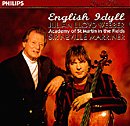
English Idyll, Academy of St Martin in the Field, Marriner (Philips)
“English Idyll, Julian Lloyd Webber’s latest anthology, could have been one of those discs none of us really needs. But Lloyd Webber is an exceptional artist, the playing eloquent, the selection shrewd and adventurous. A fascinating anthology of little-known miniatures.”
VAUGHAN WILLIAMS: Romanza. ELGAR: Romance in D min.. Op. 62; Une idylle, Op. 4/1.
Discs: 2 Pieces for cello and chamber orchestra. GRAINGER: Youthful rapture; Brigg Fair (arrangement).
DYSON: Fantasy. IRELAND: The holy boy. WALFORD DAVIES: Solemn melody.
Holst: Invocation, Op. 19/2. Cyril Scott: Pastoral and reel.
The highlights of Julian Lloyd Webber’s programme of English concertante miniatures are the Holst Invocation, with its nocturnal mood sensitively caught, and George Dyson’s Fantasy, where the playing readily captures Christopher Palmer’s description: ‘exquisitely summery and sunny — its chattering moto perpetuo evokes images of bees and butterflies’. Grainger’s passionate Youthful raptlure is given just the right degree of ardent espressivo, as are Delius’s warmly flowing Caprice and Elegy, written (during the composer’s last Fenby period) for Beatrice Harrison.
The two transcriptions, Vaughan Williams’s Romanza (originally part of the Tuba concerto) and the Elgar Romance, conceived with the bassoon in mind, were both arranged for the cello by their respective composers and are effective enough in their string formats, although by no means superseding the originals. However, Lloyd Webber gives the full romantic treatment both to John Ireland’s simple tone-picture, The holy boy, and to Grainger’s arrangement of Brigg Fair, to which not all will respond. For the closing Cyril Scoff Pastoral and reel (with its telling drone effect) he returns to a more direct style, with pleasing results. Sympathetic accompaniments and warm, atmospheric recording.
“Julian Lloyd Webber”s large circle of admirers will find this book written with the same lack of pomposity which characterises his many live appearances.”
Julian Lloyd Webber, Anniversary Gala, Royal Festival Hall, London
*****
As a postscript to my tribute to Julian Lloyd Webber a fortnight ago, his 60th birthday gala was a joy because of the inspired blend of material, both familiar and unfamiliar.
Of course, room was found in the first half for Julian’s Elgar Concerto, but then he really let his hair down – and he’s still got a lot of it. There was some Villa-Lobos sexily sung by Danielle de Niese; some amazing Ellington with Cleo Laine throwing off her 83 years with all the charisma of a great trouper; and a beautiful, newly composed piece for cello and strings by the American Eric Whitacre in the best English pastoral tradition.
Room was also found for tributes to Julian’s father William, whose beautiful Benedictus was radiantly played by Tasmin Little, and birthday greetings from brother Andrew, accompanying Julian and his wife Jiaxin in some Phantom Of The Opera arrangements.
During a terrific evening Julian proved his versatility over and over again under the benevolent baton of another great friend, Christopher Warren-Green, and a tireless Philharmonia.
Public event was a celebration of a ‘beautiful, temperamental instrument’
Cellist Julian Lloyd Webber’s 60th birthday gala at London’s Royal Festival Hall on April 14 was a celebration of the “beautiful, temperamental instrument” (his words) that dominates his life. It was also a reminder of his remarkable versatility—he shared the stage with his wife, the cellist Jiaxin Cheng; and his composer brother, Lord Andrew Lloyd Webber; violinist Tasmin Little; soprano Danielle de Niese; jazz singer Dame Cleo Laine; and the Philharmonia Orchestra, conducted by Christopher Warren-Green.
Notwithstanding a heartfelt performance of the Elgar Cello Concerto, Lloyd Webber was keen to look ahead rather than to bask in past glories, which is why he ended the program playing alongside schoolchildren drawn from the In Harmony project that he chairs. It also explains the inclusion of the premiere of a work written specially for him: Eric Whitacre’s The River Cam for cello and strings, which the American composer also conducted.
“It’s just a little postcard [of the countryside near the English university city of Cambridge, where he spent the fall of 2010 as a Visiting Professor and Composer in Residence],” Whitacre told the orchestra during rehearsal.
Unnecessary modesty: the wistful beauty of this ten-minute work charmed audience and players alike.
After the piece had come together for the first time, Lloyd Webber was heard to exclaim, “I’m stunned.”