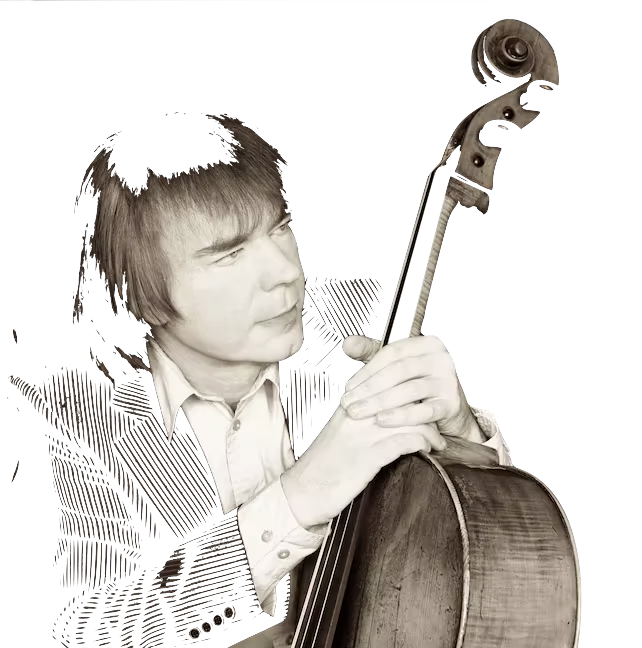

Last month my travels took me to two very different musical birthplaces. In Worcester, for the alarming pleasure of taking part in BBC TV’s Question Time, I could not resist driving those few extra miles to the village of Broadheath to revisit Elgar’s birthplace and marvel once again at how a self taught musician from such humble beginnings went on to become one of England’s greatest composers. The little cottage where Elgar was born is beautifully preserved – although the Elgar Foundation which looks after it is disgracefully under-funded. After Worcester my next stop was California where I would play Elgar’s Cello Concerto. From there to America’s Mid-West for further Elgar performances in places where his autumnal masterpiece had never been played before. Within days I had travelled from rolling Worcestershire countryside to the flattest place you could ever see. Think Lincolnshire for two hundred miles in every direction and you have Lubbock, Texas – the birthplace of my second composer, Buddy Holly. Suddenly I can feel hackles rising on both sides of the musical ‘divide’. How could a rock n’ roller from Texas possibly be mentioned in the same breath as Sir Edward Elgar? I admit the links are tenuous – although I’m sure somebody once told me Buddy liked a dash of Lea and Perrins with his chilli – but, as Elgar transformed English music so Holly – in the two years between making his first record and his tragically early death, aged 22, in a plane crash – transformed rock n’ roll. It is impossible to imagine what Holly might have achieved for, both in his music and his thinking, he was way ahead of his time. Long before Paul McCartney recorded with Stevie Wonder and Michael Jackson, Holly was looking to make an album with Ray Charles in an era when it was unthinkable for a ‘nice white Texan boy’ to work with a black singer. In the weeks before his death Holly confided to his wife that he wanted to write film scores “and maybe some kind of classical piece for the Spanish guitar”. Then came February 3rd 1959 – ‘the day the music died’, as Don McLean lamented in his song American Pie. Buddy Holly deserves his posthumous fame. Any doubters have only to listen to True Love Ways or Raining In My Heart from his final New York session to know that here was a musician with unique powers of expression. Holly died absurdly young but, in his two years of recording, he achieved a directness of communication that few manage in a lifetime.
Whether you die at 22, like Buddy Holly, or at 94, like the conductor Sir Adrian Boult, a performer’s lot is not necessarily a happy one. In my thirties my American manager warned me: “Your hardest years are yet to come – at 40 you will no longer be ‘a bright young star’ and, until you reach 60, you will not be a ‘grand old man’.” Thanks, I thought, flouncing nonchalantly out of his office, mentally singing ‘O misery, misery. What’s gonna become of me?’ from Buddy’s Raining In My Heart. Yet my manager was being too kind. At 60 Sir Adrian Boult was ‘removed’ from his post as chief conductor of the BBC Symphony because he had reached retirement age – but, presumably, not yet ‘grand old man’ status. (In his 80’s and 90’s the BBC were begging Boult to return). And what happens to the musicians who somehow fall by the wayside in those dreaded years between pubescence and senescence? Where, for example, is Peter Katin – Decca’s favoured British pianist in the 1950’s – whose superb Rachmaninov recordings disappeared from public consciousness many years ago along, regrettably, with Mr Katin himself? My Wigmore Hall diary for January lists a ‘farewell’ recital by Peter Katin, now 73, on January 8th. Catch him while you can.
The death, last month, of tenor Franco Bonisolli, left me feeling rather guilty. Readers may remember that I mocked his eccentric escapades which included giving his audience ‘the finger’ during a recent production of Mascagni’s Cavalleria Rusticana. But our robotic age needs more Bonisollis not less. Arrivederci, Franco. Thanks for all the pleasure you gave us.