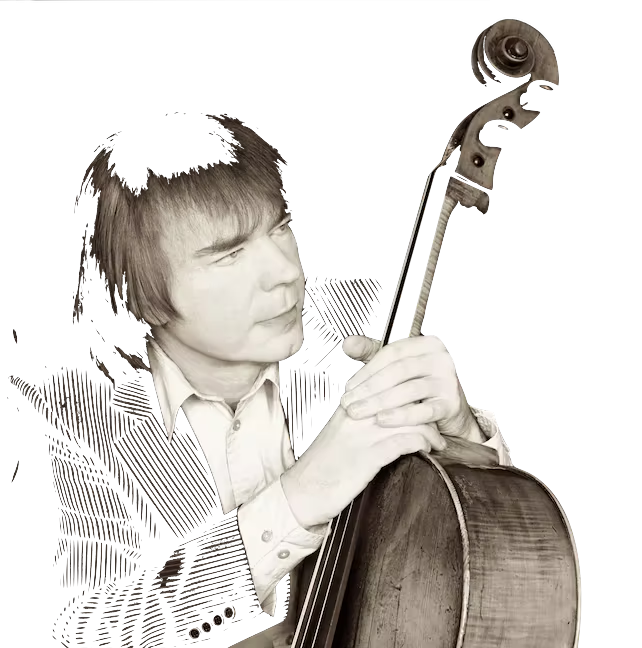

At the tender age of seventeen I learned – to my dismay – that I would be ‘leading’ the cello section of the Royal College of Music’s orchestra. It was my first term as a student at the august establishment and I was inexperienced in many aspects of life. Moreover, as my previous participation in various youth orchestras had been solely concerned with discovering the opposite sex – a pleasure denied to me at school – I remained especially inexperienced in the art of orchestral playing. Suddenly, I found myself being forced to negotiate all manner of weird key changes, time signatures and huge numbers of ‘bars rest’. Numeracy being another weakness in my limited juvenile armoury, I lived in constant fear that by ‘coming in wrong’ I might drag my new-found orchestral colleagues from Vivaldi to cacophony.
Worst of all, every so often, I’d turn over a page and see the dreaded word (in capitals) SOLO at the bottom. Surrounded by the vast sounds of the orchestra I realised it would be only too soon that the rest of the cello section deserted me and I’d be left to suffer all on my own. The audience aren’t expecting you to play by yourself and when it happens you can feel their eyes swivel in your direction with surprise and anticipation. It is a truly terrible moment which brings to mind a story of the violinist Fritz Kreisler who, having temporally forgotten he was playing at Carnegie Hall that evening, suddenly caught sight of a row of cod on a fishmonger’s stall. Transfixed by their beady, staring eyes, he cried out: “My God, I’m supposed to be giving a concert this evening!”
Certainly I would not choose to swap places with an orchestra’s principle cellist for a moment – their job is far more frightening than mine. Yet an undoubted compensation of orchestral playing is the companionship found amongst the musicians who have a camaraderie you rarely experience as a soloist – when ships often pass in the night but seldom dock in the same port. Which is why I have no sympathy for the shrill squeaks emanating from the Beethoven Orchestra of Bonn’s violin section whose players are demanding more euros than the rest of the orchestra because they play more notes.
They are taking their claim to court in May, leaving behind woodwind and brass sections quavering with rage and some distinctly crotchety percussionists. Notes of discord are already wafting their way down the Rhine: “ These musicians are not manual workers”, seethes a spokesman from the German Orchestral Association – who evidently believes the violin should be played with the feet. To minimise disharmony, these ‘fiddlers’ should do some bowing and scraping before they find themselves strung up. Meanwhile, I’m off to practice Martinu’s all-too-rarely heard Concerto for Cello, Winds, Percussion and Piano.
Suddenly there is a spate of classical music on BBC Televison. Three hour-long doses of ‘The Genius of Mozart’ on BBC 2, the return of ‘Young Musican of the Year’ and – astonishingly – a Fame Academy peak-time special on young musicians neatly slotted between EastEnders and My Family . Even if it was mildly surreal to see Andi Peters passing judgement on a violinist and even if the director did seem scared to show more than five seconds of music at a stretch, it was a start. Now, what price Classic Idol?
Having pranged my car en route to a concert in Suffolk the other day, my manager was forced to let the organisers know that I was going to be d elayed. Moments later her phone rang: it was the local Suffolk paper. “Is Mr Lloyd Webber alright?”, asked the reporter excitedly, “We hear he’s had an accident!”. “Yes, he’s fine” replied my manager. “Are you sure?” persisted the reporter. “Yes, he’s fine” replied my manager. “Well what about his Stradivarius then – has that been damaged?” “No, both Mr Lloyd Webber and his cello are fine” replied my manager. “Oh…. ‘bye then” said the reporter dejectedly. Sorry not to have been of assistance.