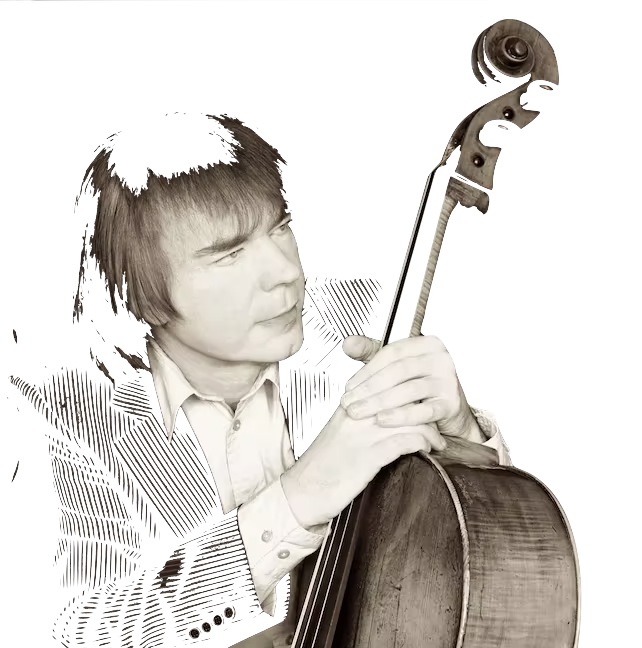

“Why do you play this symphony?” the cellist, Paul Tortelier asked conductor Claudio Abbado. “It is not a good work. I implore you not to play bad music.” “You should get to know this composer’s music better” replied Abbado “Do you know all his works?” “God save me from such a thing” said Tortelier.
This brief encounter was relayed by the great French cellist to the writer David Blum who published a collection of his conversations with Tortelier in 1984. Note the year, because you will find very few classical musicians today who are prepared to resist the prevailing wind.
Not that I have anything against Gustav Mahler, the recipient of Tortelier’s barbs – even if he didn’t write any cello music and even if it is necessary to severely curtail the intake of fluid before attending (and especially before playing) one of his lengthier offerings.
But the classical music world’s dedicated following of fashion neither helps its cause nor, most importantly, its audience. Half a century ago Rachmaninov was the highest profile victim of the classical fashion stakes. For years his music was regarded as being little more than fin-de-siecle schmaltz: his Second Piano Concerto was dismissed as “a mournful banqueting on jam and honey” at its New York premiere. Today his stock rides high – this summer’s Proms season features all four of his piano concertos, both symphonies and a host of other works including his remarkable Vespers (All Night Vigil). But those with a taste for Cesar Franck, for example, will have to wait a long time to hear any of his music in the concert hall. Franck’s Violin Sonata maintains a tenuous hold on the repertoire but whatever has happened to the once ubiquitous Symphony or the fine Symphonic Variations for Piano and Orchestra?
Franck is a good example of a once popular composer who has been all-but expunged from the repertory. Perceived wisdom has it that his music – like Rachmaninov’s before him – is too indulgent and lacks subtlety: in a word it is too ‘cheesy’. Do audiences agree? I don’t think so. But it is conductors who rule the roost and conductors who select the music we hear. And, being human – although Nigel Kennedy may disagree with me about that – they are hardly averse to choosing works that show off their podium skills.
Which is why Delius’ music barely gets a look in nowadays. Half a century ago conductors like Beecham, Barbirolli and Sargent had the confidence to slip in such tasty Delian morsels as ‘A Song Before Sunrise’ or ‘Summer Night On The River’ without worrying that the music ends quietly and there is no burst of applause at the finish.
But in case you are thinking that it’s only the romantics who suffer from classical music’s mood swings, consider the plight of those twentieth century titians Honegger and Hindemith. Perhaps their contrapuntal complexities do not suit every palette but their music hardly deserves such total neglect. Honegger once observed that “the first requirement for a composer is to be dead” but his idea of a good career move has singularly failed to bring his music to life. Even his once slightly popular overture Pacific 231 – a quirky piece depicting an express train – spends most of its time gathering dust in a siding.
Sometimes it seems as if the choice of music we hear in the concert hall is becoming ever more limited. But all is not lost. At the London Philharmonic conductor Vladimir Jurowski has been winning rave reviews for performances of Honegger’s large scale works and the new Proms supremo, Roger Wright has made some brave choices in his first season this summer – could anything be less fashionable than Ethel Smyth’s Concerto for Horn and Violin?(August 4).
Both Wright and Jurowski deserve applause for their enterprise as the classical canon – seven hundred years old and still growing – is far more than a restrictive ‘hall of fame’ and is filled with hidden treasures.