Tag: reviews1

  • A Tale of Two Cellos

    A Tale of Two Cellos

    November 2013

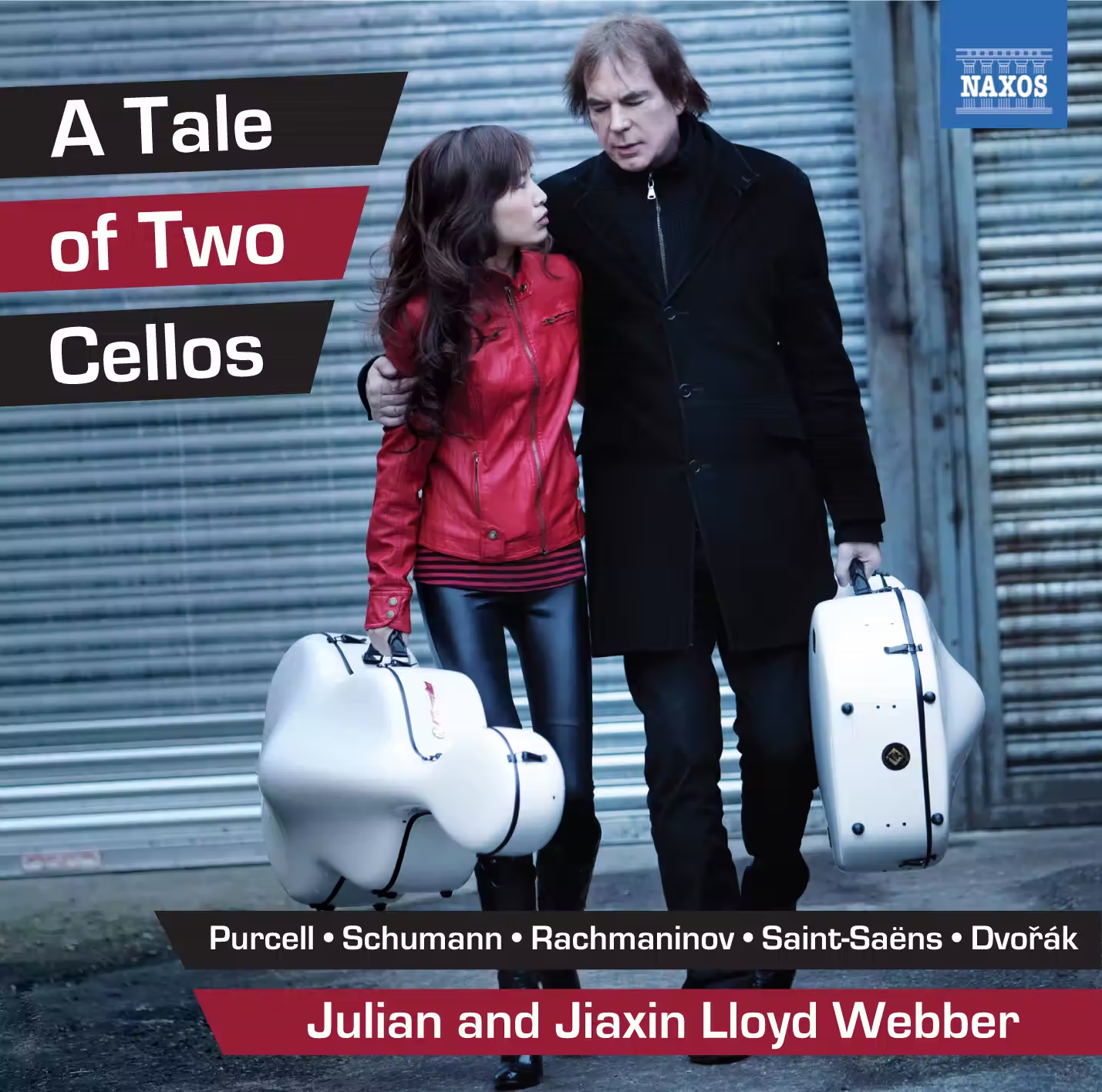
    British cellist Julian Lloyd Webber has recorded major concerto repertory with the leading conductors and orchestras of the world. He has given the premieres of several dozen contemporary works, and he has recorded a number of recitals of short works, designed to appeal to a broad audience. It’s the rare cellist who can pull all of these things off, and this Naxos release gives an idea of why this performer is so well loved on his home turf. The presence of his wife, cellist Jiaxin Lloyd Webber, is certainly part of the charm; the pair have undeniable rapport. Beyond that is the program, which resembles the crowd-pleasers of old.

    Drawing mostly on dual-voice repertory and doing all the arrangements except one himself, Lloyd Webber creates a pleasing selection of works that are brought together by their duo-harmony aspect while not losing their stylistic origins. The single piece not arranged by Lloyd Webber, Astor Piazzolla’s tango song “Chiquilín de Bachín” (here translated as The Little Beggar Boy), is an inspired choice, and in general the selections, ranging from Monteverdi to Arvo Pärt (in unusually tonal mode) to Lloyd Webber himself in full pop splendor, are a very pretty lot: a few of them you’ll have shadowy recollections of, but not a one is hackneyed, and the whole is instantly grasped. Just a lovely choice for lyrical listening.

    James Manheim

  • A Tale of Two Cellos

    A Tale of Two Cellos

    October 22nd 2013

    Miniature masterpieces for cello

    Julian Lloyd Webber has done cellists a big favour in transcribing rare and delectable miniatures from the vocal repertoire, says Julian Haylock

    The original repertoire for two cellos is hardly awash with masterpieces, so Julian Lloyd Webber’s skilled transcriptions of (mostly vocal) pieces are especially welcome. Doubly welcome in fact as he has focussed on the byways of the repertoire, unearthing a host of delectable miniatures many of which will be unfamiliar to string players. How many cellists, for example, are likely to have come across Holst’s ‘Choral Hymns from the Rig Veda’? Yet to hear the third set’s opening ‘Hymn to the Dawn’ played like this, arranged for four cellos and harp (with star guests), you’d have thought it was a rediscovered original.

    No less beguiling is Monteverdi’s ‘Interrotte Speranze’ (from his 7th Book of Madrigals), in which the Lloyd Webbers are joined by Guy Johnston and Catrin Finch, and the latter also graces the other ‘early’ music tracks in this collection: Purcell’s heartfelt’ Lost is My Quiet’ and the Dolorosa from Pergolesi’s Stabat Mater.

    Schumann’s propensity for the alto and tenor registers transfers especially well to the cello, and Lloyd Webber has unearthed two absolute gems in the form of ‘Summer Calm’ (an enchanting rarity that remained unpublished in Schumann’s lifetime) and ‘Evening Star’ from the Op.103 Mädchenlieder (or ‘Girl’s Songs’). We’re all familiar with the much-loved music of Saint-Saëns, Rachmaninov and Dvorák, but I doubt there are many who can easily recall (respectively) the Ave Maria, the chorus ‘The Waves are Dreaming’ or any of the Moravian Duets. Even further off the well-beaten Romantic track are Ethelbert Nevin’s ‘O that we two were maying’ and Joseph Barnby’s ‘Sweet and Low’, exquisitely phrased mini-masterpieces that deserve to be far better known. Radiantly engineered (Mike Hatch) at the Yehudi Menuhin School, this inspired, captivatingly played collection represents the perfect musical antidote for all those long winter evenings ahead.

    Artists: Julian Lloyd Webber (cello), Jiaxin Lloyd Webber (cello), John Lenehan (piano), Catrin Finch (harp), Guy Johnston (cello), Laura van der Heijden (cello)

    Julian Haylock

  • A Tale of Two Cellos

    A Tale of Two Cellos

    March 2nd 2014

    Review: Julian & Jiaxin Lloyd Webber – A Tale of Two Cellos, Nottingham Albert Hall

    The name Lloyd Webber will always generate interest. Music runs in the family for Julian who is the second son of the composer William Lloyd Webber and piano player Jean Johnstone. Now, alongside Shanghai-born wife Jiaxin Cheng, the Barjansky Stradivarius playing cellist has created something very special. The simply superb, heart warming sound created by the harmony of two cellos is impossible not to love.

    Julian Lloyd Webber made his professional debut with the Cello Concerto by Sir Arthur Bliss at the Queen Elizabeth Hall in London in September 1972. Described by Strad magazine as ‘the doyen of British Cellists’ Webber is widely regarded as one of the finest musicians of his generation premiering more than sixty works for the cello.

    Lloyd Webber’s most recent performance, ‘A Tale of Two Cellos’ at Nottingham’s Albert Hall was a fantastic varied musical journey spanning over three centuries, exploring over 20 flowing pieces which the pair had sympathetically transcribed for two cellos, blending harmonies with some unexpected surprises from Quilter, Dvorak, Gershwin, Purcell, Shostakovich, Rachmaninov and Vivaldi, a collection which suited many tastes.

    Stand out pieces included superb arrangements of Piazzolla’s The Little Begger Boy and an exquisite Ave Maria by Saint-Saens with a doth of the cap to Father William and brother Andrew with Moon Silver and the stunning Pie Jesu. Wonderful piano accompaniment by Pam Chowhan enhanced the performance and throughout the well thought out programme of contrasting pieces Webber introduced with humorous delivery.

    It is said that the cello is the closest instrument to the human voice. The two cellos harmonised beautifully creating a very special musical connection with Julian’s powerful strong bright sound against Jiaxin’s more mellow feminine style, the couple swapping instruments towards the end of the recital to see if the audience could tell the difference.

    Concluding with an encore of the Everly Brothers’ All I Have to Do is Dream, the intimate low key evening of atmospheric pieces was a delight to listen to.

    Tanya Raybould

  • A Tale of Two Cellos

    February 8th 2014

    Concert Review: Julian and Jiaxin Lloyd Webber, Queen’s Hall, Edinburgh

    Because the cello so closely resembles the human voice, natural choices were Rachmaninov’s chorus The Waves are Dreaming, Purcell’s duet Lost is my Quiet and Rubinstein’s song The Angel. But the couple also unearthed rarely heard gems such as Roger Quilter’s Summer Sunset, Piazzolla’s charming waltz The Little Beggar Boy and Arvo Part’s hypnotic Estonian Lullaby, complete with soporific bars of silence.

    Although Julian plays a Stradivarius and Jaixin doesn’t, the combined cello sound is warm and seamless – even when they playfully swapped instruments in Joseph Barnby’s Sweet and Low.

    Over the years, Julian has championed his father William’s music and the lilting Moon Silver is testimony to his great gift for melody. His brother, Andrew, demonstrates this too in his sublime 1982 tribute to their father, Pie Jesu.

    Adding heft to the predominantly light repertoire were Julian’s spellbinding performance of Faure’s Elegie and Manuel de Falla’s dizzy Ritual Fire Dance, while Jiaxin delivered spirited versions of Bach’s Adagio in G and Prelude and Gigue from Cello Suite No.1.

    Julian’s informal and witty introductions made for a relaxed and enjoyable evening.

    Susan Nickalls

    (Seen on 6.2.14)

  • A Tale of Two Cellos

    February 5th 2014

    A Tale of Two Cellos

    Review: Julian and Jiaxin Lloyd Webber at St. George’s Hall, Liverpool

    A Tale of Two Cellos It’s no secret music is a family affair for the Lloyd Webbers. Dad William was an organist and composer, mum Jean a piano teacher, while eldest son Andrew dabbles in the West End. Then there’s Julian, the Stradivarius-playing cello virtuoso and figurehead of the In Harmony project which has worked such wonders in West Everton.

    The newest addition to the clan is Shanghai-born fellow cellist Jiaxin who married Julian Lloyd Webber five years ago. The couple are currently on the road with an intriguing new repertoire borne from looking for a project to do together.

    They’ve taken all kinds of music, from Greensleeves to a Shostakovich film score, Vivaldi to Ireland, and Purcell to Arvo Part, and transcribed it for two cellos (hence the title) with a piano accompaniment, on tour played with lovely lilting serenity by Pam Chowhan.

    Vocal duets of course work particularly well for this most human of instruments, Julian Lloyd Webber’s Strad a warm and mellow baritone and Jiaxin’s cello harmonising in bass-baritone fashion.

    The cello also has a melancholic timbre which evokes images of a bygone Mittel-Europe, and which came to the fore in Rachmaninov’s The Waves are Dreaming, in the lovely, longing phrasing of Shostakovich’s Gadfly prelude, and, hopping continents, a waltz by Piazzolla which was a masterclass in musical storytelling. You could just imagine yourself in a late-night milonga.

    Elsewhere the well thought out programme, interspersed with Lloyd Webber’s often humorous introductions, included Reynaldo Hahn’s If My Songs Were Only Winged, played with thoughtfulness and aching sweetness; a fierce de Falla solo from Julian and a chocolately Bach Prelude from Jiaxin; and the delightful and richly melodic Moon Silver, composed by William Lloyd Webber.

    Catherine Jones

  • A Tale of Two Cellos

    A Tale of Two Cellos

    February 2014

    Festival’s coup for audience on Sunday morning

    Julian Lloyd Webber & Jiaxin Cheng, Old Swan Hotel, Harrogate.

    The Harrogate International Festivals’ first Spring Sunday Series coffee concert at the Old Swan Hotel, was a real treat. A wonderful performance by one of the world’s leading cellists – none other than Julian Lloyd Webber and his accomplished cello playing wife Jiaxin Cheng. Not forgetting Pam Chowhan on the piano. Wow!

    It was to be a glorious musical romp through established cello pieces and other music, possibly written for the female voice, but this morning arranged, in most instances, for two cellos, but interspersed with the odd solo cello and solo piano! How to comment on 21 pieces of music, plus an encore? Not practical, so I will mention just a few of them.

    As one might expect most of the items were relatively short otherwise you would have had great difficulty in packing so many pieces into two hours, including an interval. Summer Woods by Ireland was delightful, actually quite a well known piece, Prelude from Shostakovich’s The Gadfly had wonderful harmonies and was a change from The Romance, more normally heard. Bach’s Adagio in G, again well known and exquisitely performed. The Little Beggar Boy by Piazzolla written in memory of a beggar boy who used to come to a restaurant that he frequented, selling roses. The Harvesters by Dvorak – great fun. After the interval Jiaxin played solo Bach’s Prelude & Gigue from Cello Suite No. 1, she is a fine musician in her own right.

    Julian Lloyd Webber introduced each piece, giving insights into the origin and the reason he had chosen it. At this point he lost his music, but opted to continue without any apparent problem, such is his ability. The next piece was a delightful play on words – entitled Lost is my Quiet, JLW commented it reflected his disturbed sleep pattern since the arrival of their baby two years ago.

    Pam Chowhan was a superb accompanist with the ability to be quietly in the background, but yet a powerful player when the music so required. In this instance she played Rachmaninov’s No. 12 Prelude in G sharp minor with great sensitivity.

    We moved on to the family music, as he described it with pieces by his father and famous brother Andrew, including Pie Jesu written in memory of their father’s death – an excellent composition and now very popular.

    Humour returned as, for the next piece Sweet and Low by Barnby, they swapped instruments – Jiaxin playing Julian’s Stradivarius! – at the end of the piece she pretended not to give it back to him. For an encore we had a complete change to Bryant’s All I have to do is Dream popularised by the Everly Brothers.

    I think this was one of the finest concert performances I have been lucky enough to enjoy, as I know the audience did. The musicianship was beyond criticism. Julian Lloyd Webber did us proud and we loved it.

    By George Pyman, Harrogate Advertiser

  • A Tale of Two Cellos

    A Tale of Two Cellos

    January 31st 2014

    Review: Julian and Jiaxin Lloyd Webber at Bramall Music Building, Birmingham

    Cellist Julian and wife Jiaxin must have had an interesting time choosing a programme to suit the many tastes anticipated. With confident support from pianist Pam Chowhan more than 20 pieces covered a wide time–scale with some charming arrangements of songs and interestingly adjusted works for the three musicians.

    Father William and brother Andrew both featured with heart stopping sonorous works:Moon Silver, Pie Jesu – truly lovely.

    It is said that the cello is the closest instrument to the human voice, so with A Tale of Two Cellos Mr and Mrs sang musically throughout with true togetherness.

    Maggie Cotton

  • And the Bridge is Love

    April 2015

    Elgar: Introduction and Allegro; Serenade for Strings; Sospiri; Chanson de Matin; Chanson de Nuit

    William Lloyd Webber: The Moon

    Howard Goodall: And the Bridge is Love

    Vaughan Williams: Charterhouse Suite – Prelude

    Delius: Two Aquarelles

    Walton: Henry V— Passacaglia, ‘Touch her soft lips and part’

    Ireland: A Downland Suite-Minuet

    Julian Lloyd Webber (‘cello), English Chamber Orchestra, conducted by Julian Lloyd Webber

    Here we have absolute delight tinged with a touch of sadness. Delight that the Society’s President has given us such a wonderful disc as conductor: sadness that it includes his final recording as a ‘cellist.

    Howard Goodall’s And the Bridge is Love was composed in memory of a young ‘cellist, Hannah Ryan, who died in 2007, and it was premièred by Julian Lloyd Webber in 2008. It is a most moving piece, around 12 minutes long, and receives a most moving performance on this disc.

    A ‘cellist, John Barbirolli, first recorded the Introduction and Allegro in 1927 and made the piece his own: now another takes on his mantle and proves a worthy successor. Lloyd Webber’s years of experience as a string player, combined with his natural sense of how the music should flow — and especially where it should breathe – give these performances by the English Chamber Orchestra a vibrant quality. Just listen to the Introduction and Allegro’s final pizzicato chord – a full, ringing. sound, perfectly balanced — and you will see just what one string player’s supreme ability can bring to a string group. Sospiri tugs at the heart-strings, at it should, and the Serenade sounds newly-minted. The two Chansons are given in arrangements for string orchestra by Billy Reed: well worth hearing, particularly as you’ll probably have recordings of Elgar’s orchestrations already.

    To my mind, the other gem on this disc is the short piece by Lloyd Webber senior, arranged by him from a part-song of 1950, but not performed until last year. I happened to be playing the disc while others were in the house, and they were all drawn to the music room by The Moon.

    The disc was produced by Andrew Keener, engineered by Mike Hatch and recorded in the Watford Colosseum – a triple guarantee of quality. It is, however, a shame that no-one thought to name the players in the solo quartet. The second violinist, in particular, is outstanding, both individually and as a member of the quartet. I remember my ten-year-old son telling me that playing second was much harder than first, as you didn’t just have tunes to play. There’s a lot in what he said.

    Richard Wiley

  • And the Bridge is Love

    April 2015

    Editor’s Choice

    Delius Two Aquarelles (arr. Fenby) Elgar Chanson de nuit, Op 15 No 1. Chanson de matin, Op 15 No 2 (both arr. WH Reed). Introduction and Allegro, Op 47. Serenade, Op 20. Sospiri, Op 70 Goodall ‘And the Bridge is Love’ Ireland A Downland Suite – No 3, Minuet W Lloyd Webber ‘The Moon’ Vaughan Williams The Charterhouse Suite – No 1, Prelude Walton Henry V – Passacaglia: Death of Falstaff; Touch her soft lips and part English Chamber Orchestra / Julian Lloyd Webber vc Naxos © 8573250 (70’. DDD)

    A neck injury may have forced Julian Lloyd Webber to retire from the concert platform as a soloist but this conspicuously accomplished programme demonstrates he also possesses a considerable talent for wielding the conductor’s baton. Howard Goodall’s poignantly elegiac And the Bridge is Love for solo cello, strings and harp (composed for the 2008 Chipping Campden Festival) gets top billing on the cover; needless to report, Lloyd Webber plays with total commitment in what was his final recording as a soloist – and the ECO is with him every step of the way. There are three more world premiere recordings: Elgar’s Chanson de nuit and Chanson de matin are heard in WH (‘Billy’) Reed’s wonderfully idiomatic transcriptions(and most disarmingly Lloyd Webber shapes them, too); and we also get a sweetly lyrical miniature, The Moon, by William Lloyd Webber (19 14-82).

    However, what really make this anthology worth investigating are the strikingly articulate, scrupulously prepared and consistently involving readings of the remaining British masterworks for string orchestra, for which Lloyd Webber displays a striking affinity. In his imaginative hands Elgar’s towering Introduction and Allegro has a big-hearted candour, contrapuntal clarity and bracing vigour that make you sit up and listen. Nor could anyone miss the very real sense of heartache and shuddering passion that inform Sospiri (where the harmonium contribution is most tastefully integrated within the luminously textured whole). The Serenade, too, comes off very well, Lloyd Webber procuring playing of unruffled poise, generous depth of feeling and alluring tonal lustre from the ECO. Elsewhere, Delius’s Two Aquarelles are essayed with exceptional perception (I was put in mind of Norman Del Mar’s incomparably poetic way with this music), while both Walton’s Henry V diptych and the delectable Minuet from Ireland’s A Downland Suite receive raptly communicative and ideally pliable treatment.

    Admirably produced by Andrew Keener, and with sound emanating from Watford Town Hall that is rich and glowingly realistic to match (take a bow, Mike Hatch), this enormously enjoyable Naxos anthology deserves every success, and I for one look forward to future releases under Julian Lloyd Webber’s personable lead.

    Andrew Achenbach

  • And the Bridge is Love

    April 2015

    Elgar: Introduction and Allegro; Serenade for Strings; Sospiri; Chanson de nuit; Chanson de matin; plus works by Vaughan Williams, William Lloyd Webber, Delius, Goodall, Walton and Ireland

    English Chamber Orchestral

    Julian Lloyd Webber (cello)

    Noxos 8.573250 70:07 mins

    Julian Lloyd Webber made this recording some months before announcing his unwished-for retirement from cello playing, due to a long-standing injury. So might conducting be an area that could fruitfully open up for him instead? On the evidence of this release, one would very much hope so. The only works he features in here as a soloist are Howard Goodall’s And the Bridge is Love (composed in memory of a family friend who had tragically died young), and The Moon by his father, William Lloyd Webber. To judge from Lloyd Webber Jnr’s trademark tawny-brown, gloss-free finely sustained sound, there’s no audible sign of any falling-off of quality in this department.

    And as a conductor, he evidently has the ability to make a difference to collective performance-level (the English Chamber Orchestra plays characterfully and vividly at every point) while not getting in the music’s way — a combination of qualities nicely suited to this line-up of string works. Those by Elgar come across especially well (apart from Sospiri, here sounding a notch over-ripe). The Introduction and Allegro crackles along with crisp energy, with the four (uncredited) solo players delivering some lovely moments; and Lloyd Webber’s sureness of touch in the Serenade for Strings exactly captures the music’s unpretentious warmth.

    Malcolm Hayes

    PERFORMANCE

    (ELGARSERENADE) *****

    (THE REST) ****

    RECORDING ****