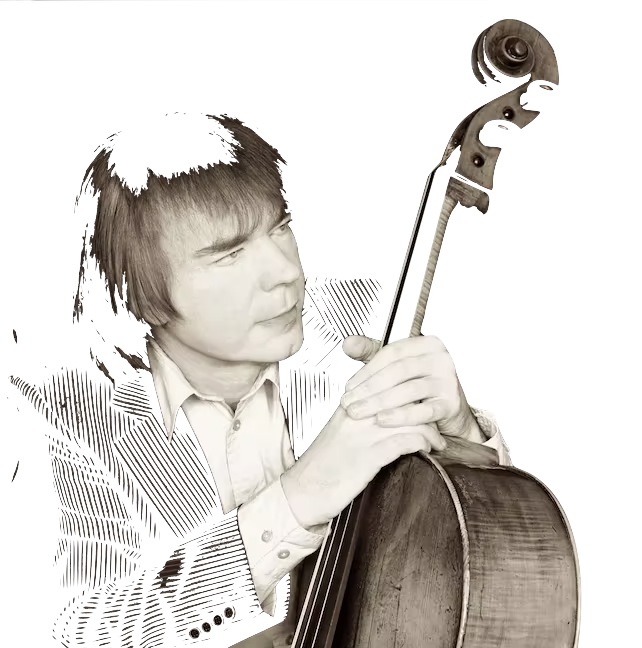

Once again the touchy topic of ‘contemporary music’ has reared its none-too-pretty head. The Guardian’s Martin Kettle asks “What is the most recently composed piece of classical music to have achieved a genuinely established place in the repertoire?” and concludes it is Shostakovich’s First Cello Concerto, composed in 1959. In The Times Richard Morrison writes “For most of the late Twentieth Century the very words ‘new music’ evoked a bone-shakingly dissonant, intellectually opaque, well-nigh impenetrable experience that would be either unpleasant or turgid and usually both.” Given the reaction when I dared to broach this subject in a speech to the World Economic Forum seven years ago, you might perhaps forgive my reluctance to re-enter the fray. “A self-confessed hater of the avant-garde” was one of the less damning verdicts delivered by atonalists following my 1998 lecture. What evidently upset the serialists were my assertions that “for many years it was only acceptable to write in one style” and that “it cannot be good for music to straight-jacket its composers.” However, as someone who has premiered new cello works by composers such as Gavin Bryars, Michael Nyman, James Macmillan and Philip Glass (all of whom are bound to have been called ‘avant-garde’ by someone, somewhere), I went on to emphasise the vital importance of contemporary classical music: “To survive, classical music must be a living, developing art. New music must be coming through, taking its listeners on fresh adventures, pushing at boundaries, exciting its audience. Today there is a much healthier climate for new music. Musicians and critics are willing to judge a new piece on its own terms.” Perhaps I was being too optimistic, for there still seems to be a strange reluctance to programme new classical music that is popular with the public. In his response to Martin Kettle, the Proms controller Nicholas Kenyon, refers to John Tavener’s 1991 Proms commission ‘The Protecting Veil’ as having “reached huge audiences around the world”. On disc, yes, but how many live performances is it receiving? Gorecki’s Third Symphony is a further example of a new composition which has sold huge numbers on CD but rarely – if ever – makes it to the concert hall. Sadly the impression persists that new compositions which have proved attractive to audiences are considered too populist by certain powerful figures in the classical music world. From the viewpoint of my personal career I may be “monumentally stupid” – as my 1998 speech was condemned by one such ‘gentleman’ – to return to the ‘forbidden’ issue. But my profession can no longer afford to sweep it under the carpet.
The arrival of a Tesco Express in my neighbourhood may seem an unlikely subject for a music column. But the rampant conglomerate’s acquisition of the London-based Europa/Harts group of grocers is having a knock-on effect in each of the communities concerned. In South Kensington the local newsagents, run for more than twenty years by a Sri Lankan family, has seen its sales of popular magazines decimated by the Tesco Chain-Store Massacre and may be forced to close. Doubtless the area will soon be swamped with copies of Hello! and OK! with not a specialist music magazine in sight.
Following last year’s ‘great gigs’ by those ageing warriors, Simon and Garfunkel (whose support act was that even older brace of antagonists, the Everly Brothers) I observed that all these ‘famous musician – and friend’s’ concerts had become too cosy by far and that we needed some ‘famous musician – and enemies’ concerts instead. So I am delighted that Cream – the sixties super group comprising lead guitarist Eric Clapton, drummer Ginger Baker and bass guitarist Jack Bruce – which broke up ‘in a storm of acrimony’ thirty-six years ago have re-formed. Dates are scheduled at the Royal Albert Hall in May and, so far, the signs are good. Said Baker, 65, “I haven’t spoken to Jack in years. Cream broke up because I couldn’t stand being in his presence. Just because we’ll play music together doesn’t mean that we have to speak to each other.” Can’t wait.