
Musical America
April 17, 2026 | By Keith Clarke, Musical America
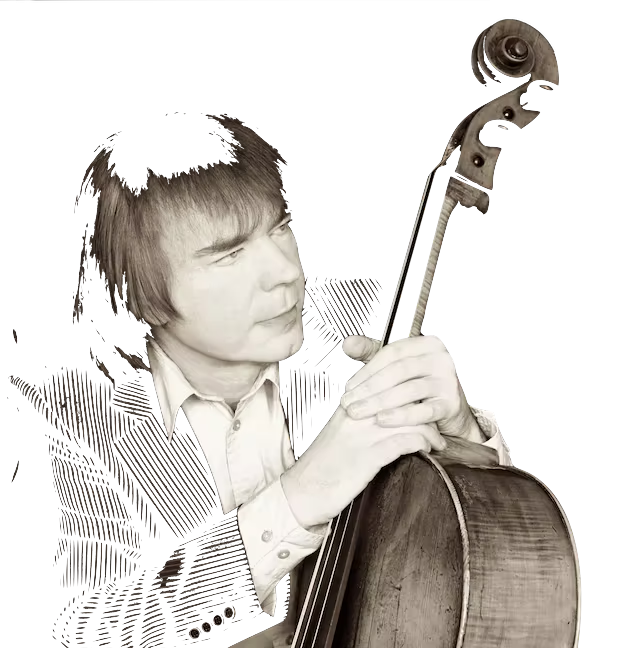
LONDON-It has been 12 years since British cellist Julian Lloyd Webber put his cello back in its case for the last time, a herniated disc in his neck having brought a premature end to a career that had begun in 1972 with the first London performance of Arthur Bliss’s Cello Concerto. On April 14 he turned 75, and the birthday party took the form of a gala charity concert at London’s Wigmore Hall, with brother Andrew in attendance. Performers included professional soloists alongside students from the charity, Music Masters.
Sheku Kanneh-Mason was in the original line-up, but a finger injury has been keeping him off the stage of late.
Luckily, the legendary Kanneh-Mason family is never short of a stand-in, so his sister Mariatu Kanneh-Mason was on hand, as was another sister, pianist Isata Kanne-Mason, the birthday boy’s cellist wife Jiaxin Lloyd Webber, and pianists Lauren Zhang (winner of BBC Young Musician 2018, making her London debut), Edward Leung, and Rebeca Omordia.
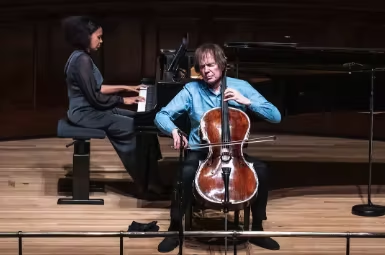
A special occasion: Julian Lloyd Webber revisits his pe-injury prowess at Wigmore Hall
Students from Music Masters were violinists Harry Nim, Ana Neves, and Eric Park, violist Libi Winterstein, and cellist Anna Lea Gonzalez Duba.
After his forced retirement from the concert stage, Lloyd Webber became a public spokesman for the charity Live Music Now and was compelling in his advocacy for music education in Britain at a time when it was under severe threat (sadly, still the case today). In 2015 he became principal of the Royal Birmingham Conservatoire, staying for five years and overseeing the move to a new £57 million building.
There could be no closer fit for Lloyd Webber than Music Masters (tagline: Transforming Lives Through Music), which has as its aim “widening access to high-quality music education from early years to young adulthood, focusing on U.K. communities facing systemic inequality or disadvantage.” Its chair Stuart Mason, father of the Kanneh-Mason clan, said that when Lloyd Webber was mentoring Sheku, he would not let him get away with a single bow stroke that was less than perfect. The two had met when Lloyd Webber was judging the string final of BBC Young Musician 2016, which Sheku went on to win.
With such a wealth of young talent on stage, this was going to be a birthday party with a difference. American-born pianist Lauren Zhang, who gave up an offer from the Curtis Institute to go and study medicine at Harvard, kicked it off with some lyrical and fiery List, his Réminiscences de Norma de Bellini, before Jiaxin Lloyd Webber calmed things down with some Bach. His cello suites had been her study during the Covid lockdown and she was serene in the first suite, a romantic reading with nice dynamic contrast.
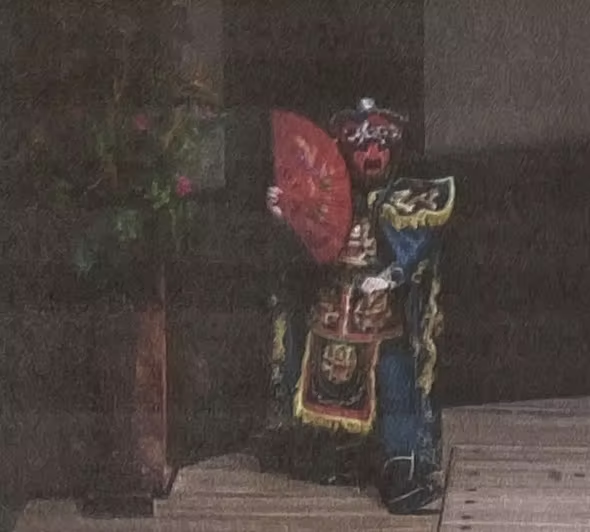
Dr. Zhao, a “traditional Chinese face-changing artist.”
After that, it was, said Lloyd Webber, “from the sublime to the – no, I won’t say it,” introducing the wild card on the program, Dr. Zhao, a “traditional Chinese face-changing artist.” The good doctor took to the stage with Jiaxin Lloyd Webber and Edward Leung to bring a bit more color to a performance of “Saliha,” Xiaolong Huang’s arrangement of a popular song by Heng Qian.
It turns out that the art of face changing belongs to the repertoire of Sichuan opera, cultivated in southwestern China since the early 1700s. It was certainly a wacky addition to this birthday party, Dr. Zhao arriving on stage in an exotic costume, his face changing color as advertised before he went down into the auditorium to try and get everyone clapping.
In the second half, 16-year-old cellist Mariatu Kanneh-Mason made her Wigmore Hall debut with big sister Isata at the piano, delivering a mesmeric “Nana” from Falla’s Seven Popular Spanish Songs and a golden account of the Andante from Rachmaninov’s Cello Sonata in G minor.
British-Nigerian pianist Rebeca Omordia, who curates an African concert series at the Wigmore Hall, kicked off with some splashy and powerful Florence Price and later offered three of the “24 Studies in African Rhythms” by Fred Onovwerosuoke from Nigeria- variously contemplative, playful, and compulsive-and finally ripping things up with “Scarbo” from Ravel’s Gaspard de la Nuit.
If Dr. Zhao had been the wild card, Julian Lloyd Webber pulled another rabbit from the hat by walking on stage with a borrowed cello to break his playing embargo. “I’ve done some reckless things in my life,” he said, “but this has to be the most reckless yet.” He gave a beautiful account of Fauré’s Élégie with Rebeca Omordia, the warm tone and intense musicality giving a glimpse back at what was lost after the neck injury. This was no comeback-just an amuse-bouche to store in the memory.
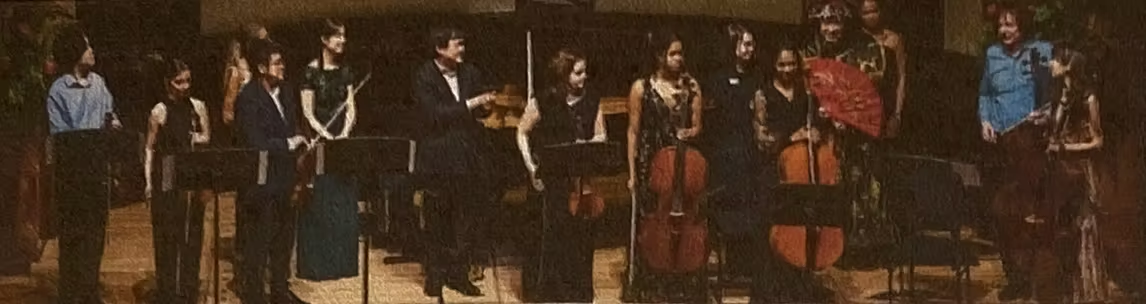
The curtain call for JL Webber’s birthday celebration, a fund-raiser for Music Masters.
After some stately Handel from cellists Anna Lea Gonzalez Duba and Mariatu Kanneh-Mason, 11 performers crowded the stage-including the birthday boy- to round off the party with a spirited account of Vittorio Monti’s Cárdás, arranged for solo violin, two violins, viola, cellos, and piano six hands by the Kanneh-Mason family and composer Tom Coult.
musicmasters.org.uk
Photos by Clive Barda