
The Daily Yomiuri
6th December 1986
Webber Shows Natural Cello Ability
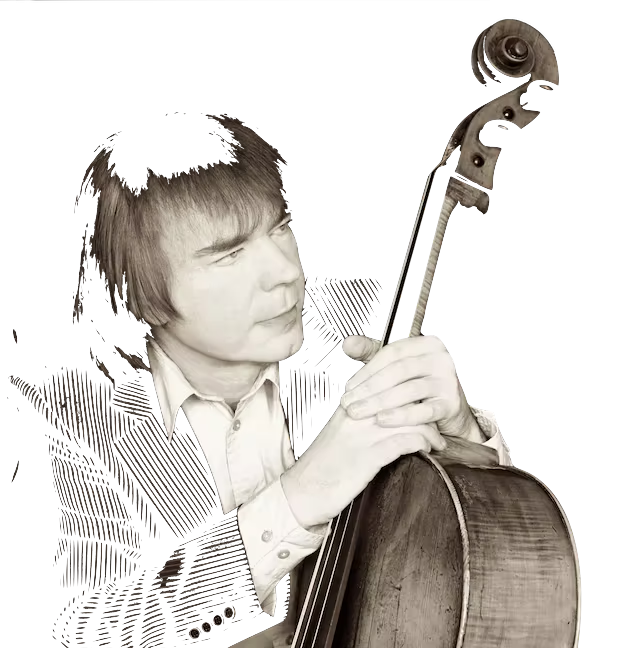
Julian Lloyd Webber, a singularly talented cellist, is highly motivated and breaks fresh ground in the field of classical music with his cello, a Stradivarius called ‘Barjansky’ and made around 1698.
Since 1983 the cellist has been travelling with this cello and an intimate relationship between Webber and ‘Barjansky’ has accordingly developed.
Webber says ‘Barjansky’ is a difficult and temperamental instrument but he has now developed a personal rapport with it.
Webber is now at the stage of proving the intrinsic virtue of this exquisite instrument. Following the first successful concert with the program of the concertos of Elgar in E minor and Haydn in D major (Hob VII b-4) with the Japan Philharmonic Symphony Orchestra conducted by Jiri Belohlavek on Oct. 22, the next concert was held at Hitomi Memorial Hall on Oct. 24 with the Consort Philharmonic Ensemble under the baton of Katsuhiko Tamaki.
Although on this day, the ensemble gave a general impression of not responding ideally to the cellist, the soloist’s natural musical ability was fully felt through beautiful and bright tones.
Haydn’s Cello Concerto No. I in C major (Hob. VII b-1) was a centerpiece of the program, which included short pieces and intermezzi of the ensemble.
This concerto was discovered in 1961 and first performed in Prague in 1962. It is presumed to have been composed in 176S while another famous concerto in D major (1783) was the only extant work of Haydn’s concertos for cello.
In this concerto, his clarity and virtuosity in the meticulous parts were musically and flexibly presented. In the slow parts, he demonstrated beautiful quality in allowing the sounds of the cello to be freely expressed. The second movement, the Adagio was the most profoundly moving. From the beginning, the long lyrical lines were finely shaped and until the end of the final tone of the movement enthralled with its singing cantilena.
The profound sensitivity in the soft tones was particularly impressive. Here, the ensemble stayed well within acceptable dynamism. ‘Ave Maria’ by Gounod and ‘Hamabe no Uta’ 9Song of Seashore) by Tanezo Narita, which is well known among Japanese and is Webber’s favorite among the collection of Japanese songs he has heard, were enjoyably presented.
Bridge’s Scherzetto was communicated in natural directness and the vivid nuances were expressed by the contrast of the rich refined sound. Webber is an extraordinary artist. I think we can continue to count on him to pursue excellence.
By Mitsuko Orr