
The New York Times
1st January 1984
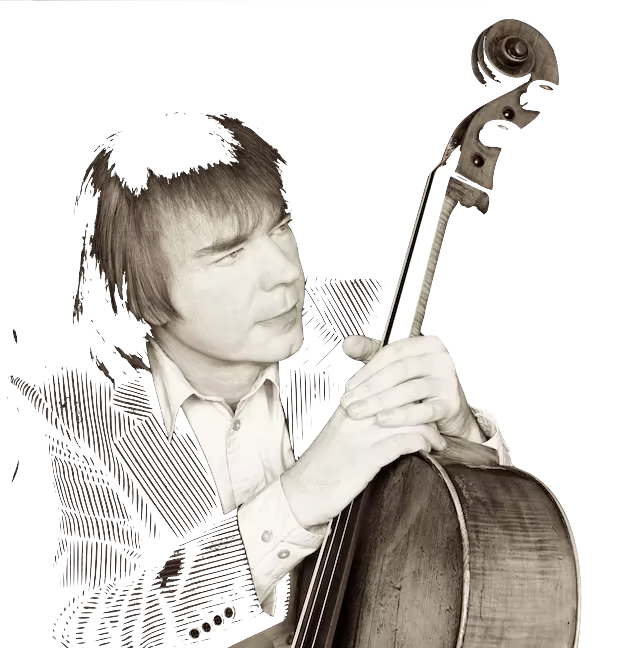
Julian Lloyd Webber plays Delius
Young Cellist Excels in Varied Repertory
Another young cellist who is making a considerable reputation for himself, particularly in Europe, is Julian Lloyd Webber, a British player who seems to have a special interest in conservative 20th-century music. The first of his two most recent disks features a work he commissioned in 1979, the “Concerto como un Divertimento” by the Spanish composer Joaquin Rodrigo. This is a slight departure for Rodrigo: While the outer movements retain the kind of Iberian folk flavor that has been an identifying hallmark of Rodrigo’s music of the last 45 years, the central movement features a simple cello melody set over a misty, delicate and almost atonal backdrop. At the center of this unusual movement, he provides an attractive cadenza that moves be¬tween plucked guitar-like figuration and bowed chords, and which seems, at its climax, to refer to the cadenza of the “Concierto dc Aranjuez,” Rodrigo’s best known work.
The Lalo Concerto, although a 19th-century work, is a logical companion piece: Like the Rodrigo, it makes references to typically Spanish melodic materials, while demanding the kind of Romantic expressivity that the cello yields so willingly. Mr. Webber brings a fulsome tone and an understated flair to both works (British RCA RL 25420, digital; imported by International Book and Record).
He seems even more at home, however, on his second disk, which features neglected works for cello and orchestra by Delius, Hoist and Vaughan Williams (British RCA RS 9010, digital). The Delius is, for the most part, a bright, leisurely score that abounds in sweeping pastoral writing and lovely, extended cello lines that allow Mr. Webber to display his considerable facility without seeming unduly theatrical. Hoist’s early “Invocation” gives the cellist even sweeter material, and the “Fantasia on Sussex Folk Songs,” composed for Casals, is a lush piece with a surprisingly extroverted cadenza that seems a bit incongruous amid the implicity of the folk tunes.
Allan Kozinn