
Stereo Review
February 1994
RECORDING OF SPECIAL MERIT
Performance: Eloquent Recording: Excellent
Lili Boulanger, younger sister of Nadia, was acknowledged as an important composer when she died in 1918 in her twenty-fifth year. She produced a large body of work, and five years before her death she became the first woman to win the Prix de Rome. The seven works recorded here identify Boulanger as a composer who must have found her own voice remarkably early. Most appealing are the first two, miniature tone poems for piano trio composed in the last year of her life and rescored for orchestra before she died. The poignant D’un soir triste, at a little more than eleven minutes the longest by far of the pieces on this side, is an intensely tragic and yet remarkably subtle work, the sort of thing that creates an aural world of its own. I’d like to hear the orchestral setting, and I can’t imagine how both versions could remain for so long so completely unknown to us. The first trio piece is actually an arrangement of an aria from Boulanger’s cantata Faust el Helene, the work that won her the Prix de Rome. The next two pieces, for piano solo, and the last two, for violin and piano, are slighter and a bit less individualistic but remarkable for their sumptuous yet clear coloring.
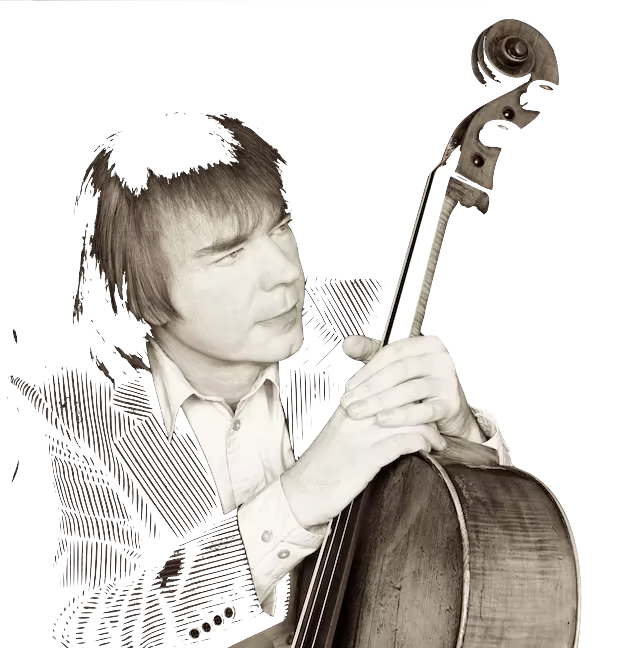
Delius, of course, is a much better-known composer than Lili Boulanger, but his Cello Sonata is about as unfamiliar as the Boulanger pieces recorded here. It is a lovely discovery in this eloquent, thoroughly idiomatic performance by Julian Lloyd Webber and Eric Fenby, who was Delius’s amanuensis in the composer’s final years. Here, by way of spoken preamble, Fenby reads a passage from his book Delius As I Knew Him describing a performance of the sonata at the beginning of his relationship with the composer some fifty-five years ago. The solo pieces that fill out the side are less imposing but interesting enough in their own terms. The polka, Delius’s first published work (Jacksonville, Florida, 1885), is an agreeable piece in a music-hall style.
Both composers are extremely well served on this beautifully recorded disc, and so is the listener in being given these opportunities to acquaint himself with works of character and substance in performances that will probably stand as definitive for some time.
R.F.