
Detroit Free Press
7th January 1984
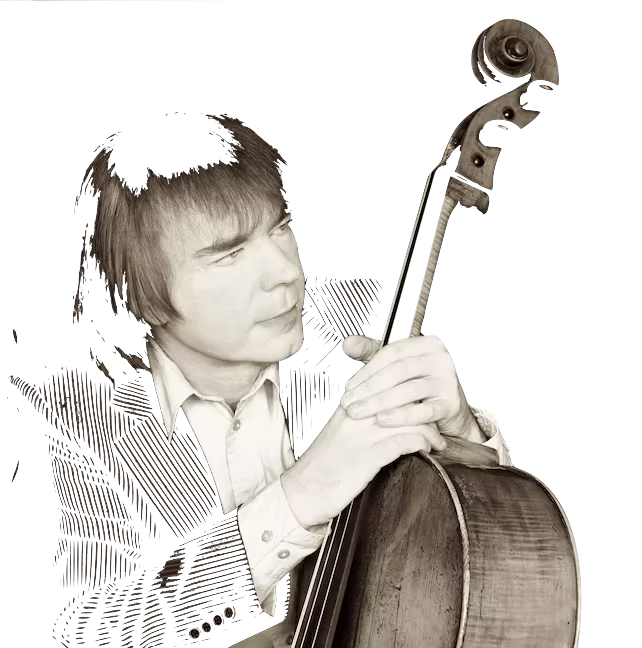
Julian Lloyd Webber plays the Rodrigo Cello Concerto
DSO presents British cellist and his new Spanish concerto
Three debuts ushered in 1984 for the Detroit Symphony Orchestra’s audience Thursday night at Ford Auditorium.
The debutantes were Japanese conductor Hiroshi Wakasugi, British cellist Julian Lloyd Webber and the new; cello concerto Spanish composer Joaquin Rodrigo wrote for Lloyd Webber.
LLOYD WEBBER and the concerto provided more satisfaction than Wakasugi. Commissioned by Lloyd Webber and dedicated to him, the concerto, which the composer titled “Concierto como un Divertimento,” was completed in 1980. Thursday night marked its American debut.
It is a tasteful work of sunny disposition, with pleasant melodies, vital rhythms, piquant harmonies and logical formal organization. It is also deftly scored – the orchestral accompaniment is of chamber size – and manages to be wholly accessible and considerably fresh at the same time. The performance suffered somewhat from Wakasugi’s often sluggish and tentative orchestral accompaniment, but that may have been due to insufficient rehearsal time.
LLOYD WEBBER had no such problems. He played the new concerto with conviction and fervor, and with a technique that seems totally secure. He tore through the fiendishly difficult double-stops, rapid scales and bouncing bow passages of the second-movement cadenza with consummate skill, and produced elegantly soulful sound in the major melodic passages scattered through the work. He obviously believes strongly in the concerto’s merit, and made a most convincing case for it.
The audience response to the concerto was highly favorable, something not normally associated with contemporary pieces. “When was the last time,” I overheard a woman say at intermission, “you heard a modern piece with a melody?”
Wakasugi, who was born in 1935 and who has made his career primarily with European orchestras,opened the program with Charles Griffes’ orchestration of his 1915 piano piece, “The White Peacock,” And while its vaguely impressionistic measures were detailed with precision, I think the original piano version is stronger.
THE PROGRAM closed with Schumann’s First Symphony (“Spring”). Everyone knows the problems inherent in Schumann’s four symphonies, especially his clumsy orchestrations and blunt developmental ideas. But the music, given the right interpretation, can transcend those limitations, providing a unique, if eccentric, satisfaction; Wakasugi’s reading didn’t do that. It was frenzied rather than sweet, stodgy rather than playful, overly driven rather than graceful. He controlled the orchestra with more success than he did in the concerto (although his sound balances were often out of kilter), but he missed the special magic this music contains.
John Guinn