
Gramophone
May 1992
(original version)
MIASKOVSKY Cello Concerto in C minor,Op.66.
SHOSTAKOVICH The Limpid Stream. Op.39 Adagio.
Nocturne, Op. 19 No. 4.
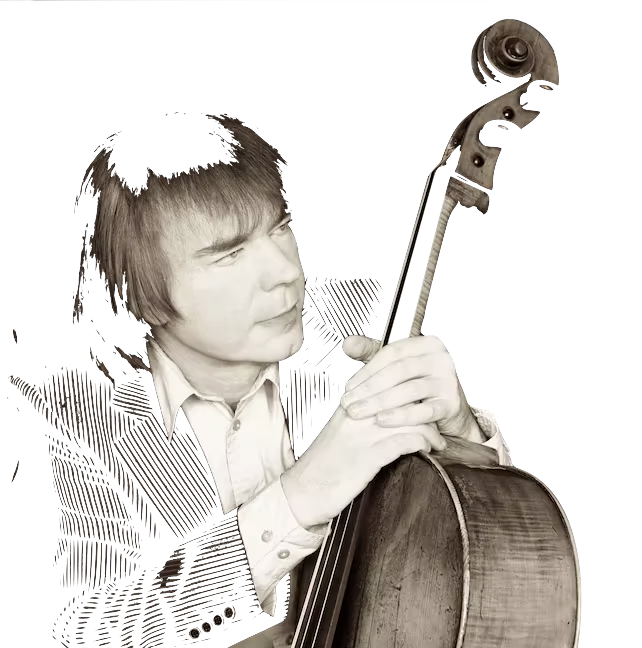
Julian Lloyd Webber (vc); London Symphony Orchestra / Maxim Shostakovich.
Philips CD 434 106-2PH (63 minutes:DDD).
A valuable disc, and an enjoyable one. Miaskovsky’s Cello Concerto has remained unjustly neglected by record companies since Rostropovich’s 1956 EMI recording with Sargent and the Philharmonia (available recently in a fine CD transfer, 11/8 – but since deleted). The Shostakovich Adagio as far as I can tell, has never been recorded in this form. It does turn up in the 1951 Ballet Suite No. 2 – slightly cut, and with unhappily bolstered orchestration by the Suite’s compiler, Lev Atovmian. The relative restraint of this original 1935 score, particularly in a performance as expressive as this one, is infinitely preferable, trioiigh its brief, central climax still retains its overwhelming force. Stalin’s reaction to Lady Macbeth in 1936 is common knowledge; less well known is that The Limpid Stream too was condemned by Pravda under the caption “Falsity in Ballet”.
Not even Miaskovsky escaped the State’s accusing finger in the second round of condemnations (in 1948), despite winning a Stalin Prize for his Cello Concerto and being titled “People’s Arlist” in 1946. The concerto (1944-5) is modestly orchestrated – the orchestral forces are identical to those used by Brahms in his First Piano Concerto, and it shares with the Elgar and Delius concertos an autumnal mood, albeit wilh an essentially Russian brooding and introspection, given full weight here with Lloyd Webber and Maxim Shostakovich, at 32 minutes, taking four minutes longer than Rostropovich and Sargent. They take their time over the Rococo Variations as well: a more ‘authentic’ account of the Original version (described on the score as the “Composer’s Version” i.e. without the cut and rearranged order of the ‘standard’ version) than those recorded by Walllisch (Chandos) and Isserlis (Virgin Classics), both of whom incorporate a few features from the ‘standard’ version – though you would he unlikely to spot the differences, mainly in the fifth variation, without a score. Lloyd Webber’s smooth, rich tone, has not the faintest trace of a rough edge: this is supremely elegant playing.
Jonathan Swain