
The Miami Herald
14th May 1994
(original version)
Rococo Variations stunning illumination of Tchaikovsky
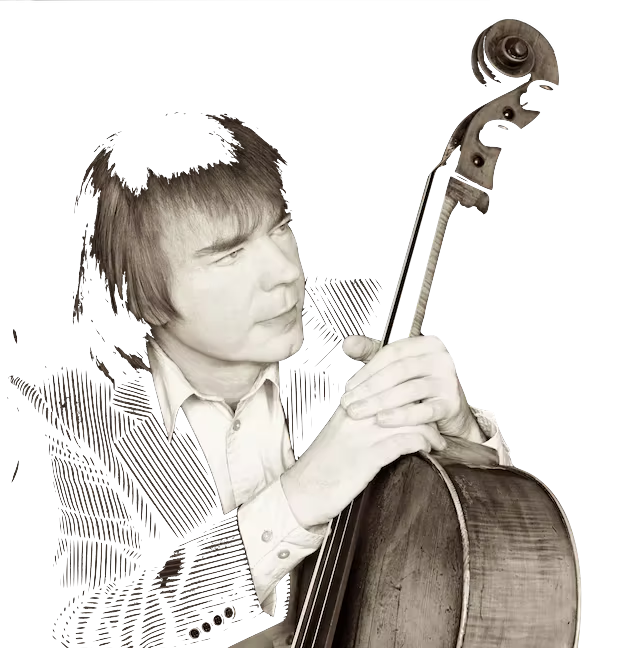
Tchaikovsky has been royally feted at the Florida Philharmonic ‘Proms’. Last month, Marin Alsop and Joshua Bell converged brilliantly on the Violin Concerto in a program that also held a resilient performance of the Fifth Symphony. And Wednesday night, James Judd joined his compatriot, British cellist Julian Lloyd Webber, in a performance of the Rococo Variations that was so exquisite it will remain indelible.
In decades of concertgoing, I’ve become a hopelessly spoiled aisle-sitter. I can vividly recall the Rococo Variations played incisively by such cellists as Pierre Foumier, Andre Navarra, Antonio Janigro, Leonard Rose, Mstislav Rostropovich – and, not so long ago with the Florida Philharmonic, Janos Starker, But never have I heard the intimate character of this masterwork more eloquently drawn and penetrated than by Julian Lloyd Webber.
Not only is he a superlative cellist with seemingly effortless technique, but he also is a marvelous musician who pays keen attention to tender tone coloring. He can turn fluted harmonics into the wispiest filaments of tone, and he knows all about this work as a Tchaikovskian salute to Mozart. Judd knows about such things, too. Remember how he once brought out the Hande-lian overtones in Beethoven’s Consecration of the House Overture. Well, this time there was superb transparency of orchestral texture and a chamber music rapport with Lloyd Webber. Each variation sounded freshly minted – in fact, one variation traditionally omitted since the first performance by Fitzenhagen in 1877 was restored here so that the old war horse sounded even newer. A deserved standing ovation coaxed Lloyd Webber into a poignant encore: the first movement of a Malcolm Arnold fantasy.
Judd and the Philharmonic also offered first-rate performances on their own. Tchaikovsky’s seldom-heard Hamlet Fantasy Overture sounded like a major masterwork, too, profoundly enriching in its broad theme for cellos, reinforced by violas and double basses. This is an unjustly neglected score filled with lovely woodwind parts, including that reflective oboe solo, so thoughtfully yet fluidly phrased by John Dee.
The Fourth Symphony also was exceptionally well-played, even minus the luscious tone of more famous orchestras. Judd I captured enough of the drama in the heroic moments, probing the work with extraordinary understanding of inner detail. He even clued the audience into one folk theme that inspired Tchaikovsky in this symphony by asking a Russian-speaking Philharmonic player to sing the folk tune (quite nicely) for the audience. When great music is recreated with such acute perception, it’s no longer the cake of leisure; it is the bread of life.
By JAMES ROOS