
The Australian
15th March 1999
(original version)
ASO strikes chord in romancing crowds
Adelaide Symphony Orchestra Takuo Yuasa, conductor. Julian Lloyd Webber, cello. Adelaide Town Hall.
JUDGING by the full house for the Adelaide Symphony Orchestra’s opening Town Hall concert of the year, the orchestra’s enterprising publicity strategies seem to be working.
The first of three Romantic Symphonies concerts was an all-tsarist Russian program spanning the middle 1800s to the early years of our century.
Takuo Yuasa is a skilful and experienced conductor, but he started badly with a breathless reading of Glinka’s Ruslan and Ludmila, Overture, obscuring its elegant statements in a hurried dash for the finishing line.
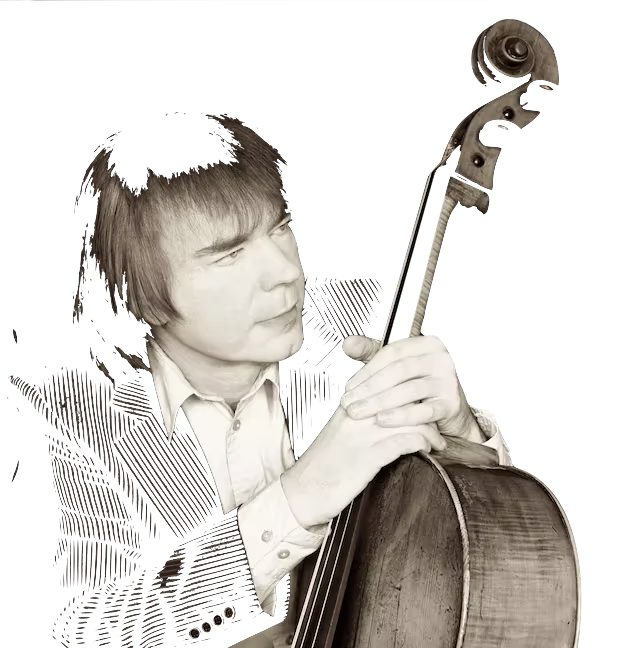
Julian Lloyd Webber is a fine cellist and a commanding presence. Tchaikovsky’s 1876 Variations on a Rococo Theme was a splendid vehicle for his individual style, especially as it was given as the composer wrote it and not in the considerably distorted form in which it was first published.
Written for a transparently scored, Mozart size orchestra, the spare texture gives the cello plenty of room to speak, and Lloyd Webber filled the hall with a stunning range of beautiful sounds.
The virtuoso element of this piece lies in perfect clarity of melodic line rather than athletic feats of fingerwork and Lloyd Webber’s lovely tone, finely judged bowing and perfect upper register intonation made this a memorable performance.
In response to the audience’s warm reception, he played music by Malcolm Arnold, a reminder that Lloyd Webber is an enthusiastic supporter of new music.
The short first half left room for Rachmaninov’s enormous Second Symphony, written in the last days of Old Europe before the world changed forever in 1914.
The music perfectly reflects the atmosphere of that time – luxurious, extravagant and expansive but a shade over the top – in Russian musical terms, the revolutionary Stravinsky was getting ready to launch his first startling orchestral missiles, but this work is a fine example of the last stages of a great period.
The 24 minutes of the first movement was greeted with scattered applause, but there were more than 40 minutes still to come and a punishing outlay of sustained energy called for.
The ASO, fresh from its Wagnerian triumph of last year, was well able to weave Rachmaninov’s elaborate tapestry of sound, unison strings in full melodic voice often counterpointing the strong quartet of horns led by Philip Hall.
Outstanding wind solos were Peter Duggan on cor anglais and Gregory Blackman’s sinuous and extended clarinet melody in the slow movement. A promising Start to the ASO’s mainstream concert year.
TRISTRAM CARY