
Classics Today
December 2004
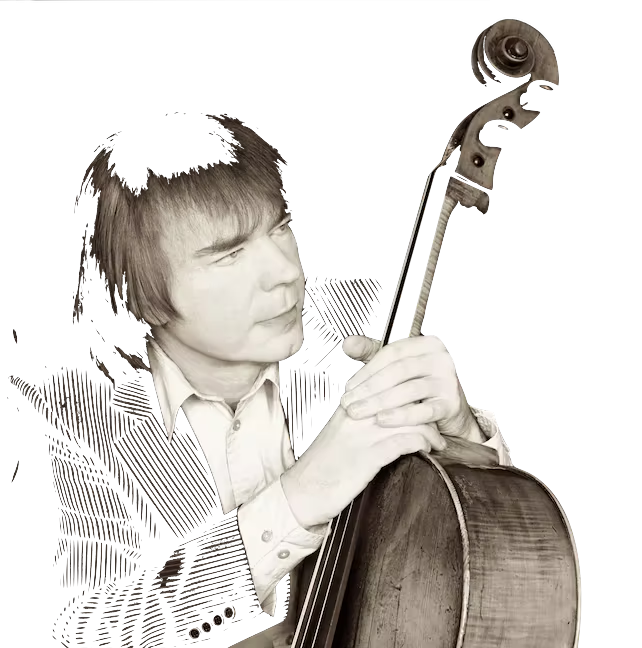
The coupling is a logical one: the cello concertos of Elgar and Walton, played by British cellist Julian Lloyd Webber, an empathetic artist with a special affinity for English cello literature. Lloyd Webber’s recording of Elgar’s Cello Concerto in E minor was made in July 1985, with the Royal Philharmonic Orchestra conducted by Yehudi Menuhin. It is a deeply-felt performance, imbued with a touching degree of modesty, placing it among this artist’s finest documents on CD. Lloyd Webber’s plangent tone and unhurried approach fully engages the nobility and the valedictory content of the work in equal degree. Particularly moving is the Adagio, notable for its restraint and for much exceptionally beautiful quiet playing. Frequently compared with the classic 1965 EMI recording by Jacqueline Du Pré with the London Symphony Orchestra under Barbirolli, Lloyd Webber’s account is no less powerfully eloquent.
Curiously however, when this performance first appeared, it was paired with Menuhin’s recording of Elgar’s Enigma Variations, generally a splendid account, now supplanted by Lloyd Webber’s 1996 performance (with the Academy of St. Martin in the Fields under Neville Marriner) of the Cello Concerto by William Walton. That’s not to say that Lloyd Webber’s Walton is any less convincing nor impressive than his Elgar, but simply that the earlier Philips Digital Classics package had seemed well worth preserving. This reading of the Walton concerto, however, has been beautifully recorded. The meticulously balanced production allows the complex inner fabric of Walton’s score to be laid clearly before the listener, and Lloyd Webber understands its underlying luxuriance, debating its opulence and expressive warmth to good effect. Compared with Lyn Harrell’s EMI version with Simon Rattle and the City of Birmingham Symphony, the Lloyd Webber/Marriner collaboration is more deeply considered and more faithful to the letter of the score, and the slightly smaller orchestral resources employed help the soloist to prove convincingly that in expressive terms, less is often more. Another worthy inclusion in the Phillips 50 series, but the original coupling of Elgar’s concerto and Variations seemed more or less complete in itself, so why change it?
Michael Jameson