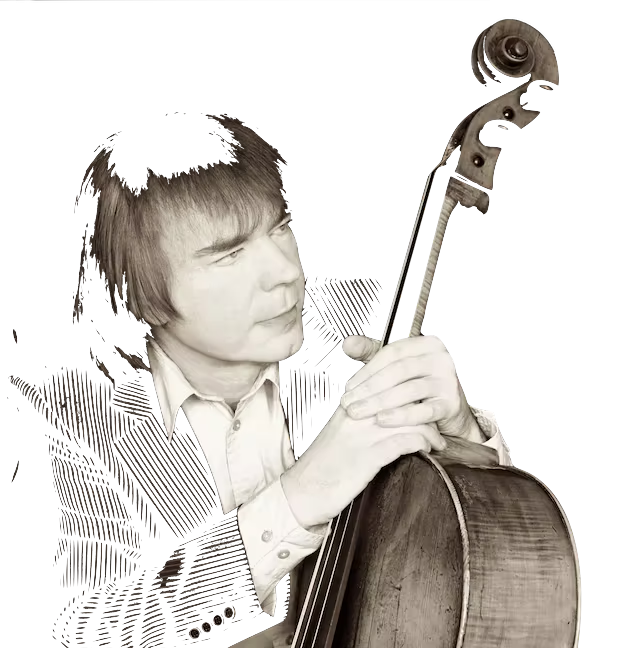

Something amazing is happening this weekend. No, Leyton Orient are not in the cup final but BBC 2 will be showing a ‘live’ classical concert. In the forty years since BBC 2’s inception, the channel’s coverage of classical music has declined to the point where to witness a concert relay which has nothing to do with the Proms is almost as extraordinary as the thought of my boyhood icons lifting the hallowed trophy at the Millennium Stadium. Yet at 5.15 tomorrow afternoon BBC 2 will host another final: the biennial ‘BBC Young Musician of the Year’ competition which, of course, should really be called the ‘BBC Young Musician of Every Other Year’ competition – to expect the BBC to showcase this country’s young musicians more than once every two years is obviously be asking far too much. Although by farming the semi-final rounds out to BBC4, the BBC has criminally downgraded its own competition, this year’s final looks especially interesting –as at least one of the four competitors has world class potential. But, in an age when the competition’s viewing figures have plummeted from 20 million in its heyday to an anticipated 1.5 million this weekend, what kind of future can the winner look forward to? Is classical music really living on death row? Is it really a tougher place to be than ever before? And what pitfalls lie in wait for an unsuspecting young musician suddenly catapulted to fame? These are intricate questions and their answers could fill a book. Although one or two merchants of doom would have it otherwise, there will always be room for classical musicians of genuine talent. But, to survive long-term, the winner will need many other qualities. They will need immense dedication year in year out, massive stamina to cope with all the travelling as well as the performances, great human relations skills (dealing with managers, record companies, press, fellow musicians etc.) and the hide of a fairly stocky rhinoceros! And that’s just for starters. Good judgement is also vital and the first decision for the winner will be who they select to manage them. A good manager is essential to guide a young musician through the jungle of their chosen sphere. Which engagements should be accepted? What repertoire should be performed? And, most crucial of all, which is the most suitable record company – assuming, of course, that any of them are interested? Myriad further perils lie in wait. For example, even the most experienced performer can be suddenly stricken by concert nerves. The great cellist Casals was so nervous on his Viennese debut that he dropped his bow: “With panic I felt it slip from my fingers! I tried desperately to regain control but the bow shot from my grasp and sailed into the audience landing several rows behind!” Then there are the delayed flights that mean you go straight into rehearsal as soon as you arrive in New Zealand after two days in a plane and a thirteen-hour time change. And the dodgy stomach-bugs picked up somewhere in transit. And the noisy hotel rooms. And the ego-centric conductors. And did someone mention critics? The life of a solo musician is tough and exhausting, both physically and mentally, and there will be many times when a soloist has to put their profession before their personal life. Is it worth it? Only the individual musician can know – but I would definitely make the same choice again. Why? Let Pablo Casals provide the answer. After a particularly moving performance he was asked: “Mr Casals, can you tell me, are we in heaven or still on earth?” Softly, he replied: “On an earth that is……….harmonised.”
It seems that the British Broadcasting Corporation’s flagship Symphony Orchestra are scouring the planet for a conductor to succeed the American, Leonard Slatkin, but were unable to find one in time for last Thursday’s Proms launch. Why don’t they choose a British conductor when Martyn Brabbins, Mark Elder, Daniel Harding and Richard Hickox – to name but four – would all fill the job with distinction? We should be told.