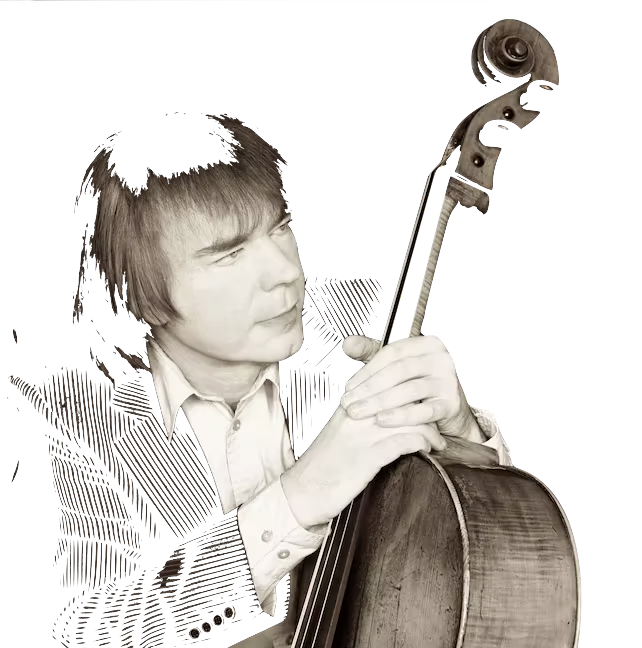

The other day I felt a ‘tiny twinge’ in my left hand – the one that does all the intricate finger-work (actually it was more than a ‘tiny twinge’ but I couldn’t possibly say so). Being a bit of a ‘big girl’s blouse’ – or whatever it was the tabloids called Becks when he emerged plastered after his dressing room showdown with Fergie – I decided to visit a hand specialist. I was told to have a cortisone injection into my hand immediately. Perturbed, I visited a second specialist. I was told that on no account should I ever have a cortisone injection in my hand. Confused, I saw a third specialist who prescribed both industrial strength anti-inflammatory drugs and ultrasonic treatment. This combination worked and I am relieved to report that my career-threatening ‘tiny twinge’ has disappeared. So is my wife. For a musician pacing around like a caged beast, unable to play, cannot be the easiest person to live with. Not only was I devastated to think of all the future projects that might never happen, but I was astounded by the sudden realisation that my hands were not immune to the constant punishment I inflict upon them. Also there was the little matter of survival. Because, in common with nearly every solo instrumentalist I know, I have absolutely no insurance. How foolhardy, you may say – like my accountant, who pooh-poohed my idea that if anything really went wrong, I could sell my valuable Stradivarius. Yet, for a musician, selling your instrument is hardly an attractive option. Not only is it a final admission that your playing days are over, but it would feel like selling your best friend and companion to the highest bidder. Surely, though, I must have insured my hands? Great idea. I investigated it once. But the requirement that you had to break most – if not all – of your fingers in several places seemed a trifle excessive. A more cunning ruse, I thought, would be to take out insurance against ‘non-appearance’. After all, sudden deafness, blindness or even severe haemorrhoids are hardly conducive to playing the cello. But the terms were as ludicrous as they were expensive. I had to be unable to perform for at least six weeks (no ‘girl’s blouse’ flu claims). And if I undertook any alternative employment, the insurance payments would cease immediately (no more columns for this newspaper). The most worrying aspect of ‘musician’s injuries’ is that we are terrified to admit that everything might not be ‘hunky-dory’, for news travels faster in the music profession than the proverbial ferret up a trouser leg. If you do admit to having so much as a toothache there will be at least twenty people queuing up to take your place. Admitting to something worse like ‘guitarist’s nipple’ would be professional suicide. And as for ‘cellist’s scrotum’, I am tempted to say don’t even go there.
The days when a soloist could turn up, play their concerto and be twenty miles back down the motorway before the orchestra had even returned to the platform for the second half, have long since disappeared. Nowadays, something more akin to blood is required. You need to give a ‘pre-concert’ talk, meet a group of schoolchildren who play whichever instrument you play during the interval and attend a sponsor’s dinner afterwards. All of which is fair enough, I suppose, in these cash-strapped times for the arts. But there are occasions, after a concert, when all you want to do is sit somewhere quietly and ruminate by yourself. Especially when – as happened to me recently – you have just discovered a magnificent hostelry near the hall serving ale from the cask and a juicy, chewy, succulent Welsh Rarebit over the bar. So I am not ashamed to say that I made my excuses: “I am so tired and I must be fresh for tomorrow’s rehearsal” and set off happily to the pub. Several pints – and a couple of Welsh Rarebit’s later – my reveries were interrupted by a stout tap on my shoulder. The sponsors had finished their meal and arrived at the pub for a little ‘nightcap’.