
Classical Music October 1978
Rachmozartian gold
THE AROMA of big business positively oozed from the Benson and Hedges music festival at Snape Maltings. Apart from the “Golden Girls” in immaculate uniforms with scrupulous hairdos, lavishing large bundles of dahlias on all the performers, there was the large table cloth emblazoned with B & H squarely confronting the camera for the announcement of the winner of the singing competition.
The concerts were devoted to the chamber music of Mozart and Rakhmaninov. If the array of personalities on show was not quite as glittering as last year, there were, amongst much that was at best routine and at worst unfortunate, some memorable and half a dozen remarkable performances. In general the finest concerts were not given by the “establishment” (represented by Annie Fischer, Tams Vásáry and Bozena Betley — none of them on the best form) but by the younger generation.
Jean-Philippe Collard, the French pianist, in his first recital in this country (October 6) made a tremendous impact in Rakhmaninov’s Etudes Tableaux and the G sharp minor Prelude. Very tall, with huge hands and long fingers, he conjures a relaxed fluid line, soft textured and subtle — a far cry from the frenzied thumping of more obviously dexterous virtuosi (we were given a piano-destroying example of that style on October 4 by Craig Sheppard, pounding through the Second Sonata like an ox on egg- shells). Despite his height and his reputation in France as a hard- hitting tennis player, Collard is a gentle, almost immobile, pianist, although the fire is there when it is needed.
The Alban Berg Quartet’s account of Mozart’s K458 (The Hunt) was one of the high points of the week; lively but not lightweight, with a Viennese dynamism and a faultless unanimity of ensemble. The young American clarinettist Richard Stoltzman’s unique fluting tone and extraordinarily responsive partnering of Vásáry and Atar Arad (like Andrés von Toszeghi later in the week taking over the pieces Cecil Aronowitz was to have played) in the E flat trio, K498, and in the Clarinet Quintet with the Amadeus had many usually unimpressable musicians proclaiming him the world’s finest.
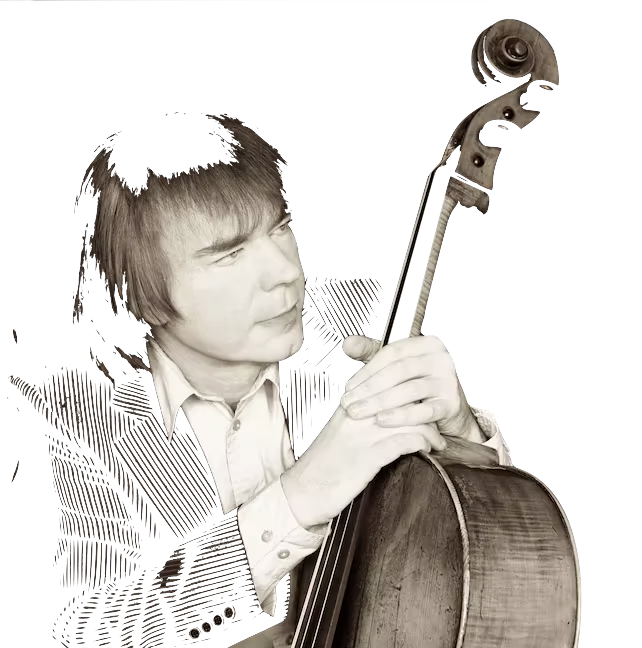
Opinion was firm, though, that one of the finest items was Julian Lloyd Webber and Roger Vignoles in Rakhmaninov’s Op 19 Cello Sonata. Their playing was passionate and lyrical, intense but above all integrated, achieving the sense of unity that happens only when the players immerse their personalities in the music. Vignoles (whose accompanying throughout the week was of the highest order) threw off the almost perversely difficult piano part with apparent nonchalance and was fresh and ready the following morning to accompany the two Russian contestants in the Gold Award.Rachmozartian gold