
The Plymouth Herald April 2009
Concert marks end of an era
THEY may have had fewer than 20 players, but the European Union Chamber Orchestra, under the assured leadership of Matthias Wollong, filled the hall with an opulently vibrant and full-blooded sound, whilst still able to play with the subtlest of pianissimos whenever the music demanded.
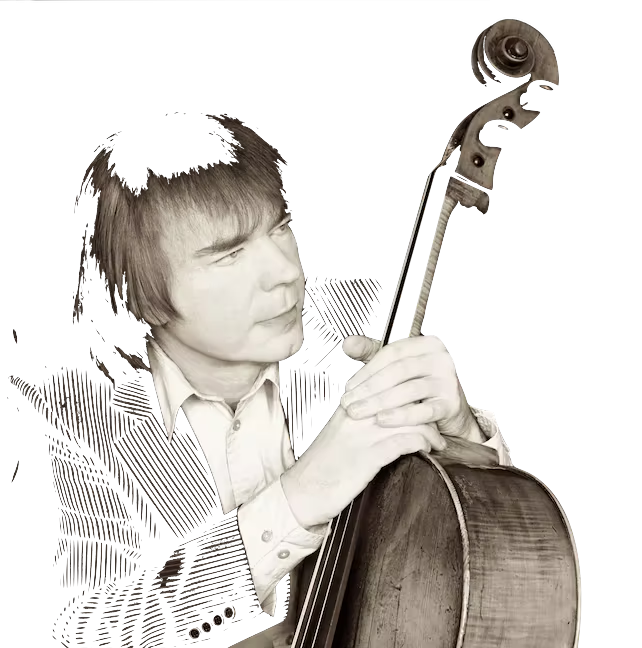
Mendelssohn’s Symphony in B minor clearly demonstrated the strength and richness of the string section, where the balance was felt exactly right with just the single double bass. Augmented by pairs of horns and oboes, the players were joined by Julian Lloyd Webber, who then gave a superb account of Haydn’s C major Cello Concerto. Virtuosity was always at the forefront, especially in the rapid scales of the finale, all despatched with great precision and rock-solid intonation, but Julian’s playing was further enhanced by a most sensitive use of dynamics, and his gloriously rich singing-tone.
The strings gave an especially poignant reading of Tchaikovsky’s rarely-heard Elegy in G, before being joined once more by the winds for an exhilarating performance of Mozart’s Symphony No 29.
The encore, the finale from Haydn’s Symphony No 64, could, however, prove unknowingly prophetic. With its nickname, Tempora mutantur, or Times are changing, it signalled the end of three years of top orchestral concerts coming to the city and, with little immediate hope of any further funding, could very well mean it’s a change for the worse!