
Gramophone August 1997
Britten Cello Symphony/Walton Cello Concerto
EDITOR’S CHOICE
Philips
Britten Symphony for Cello and Orchestra, Op.68.
Walton Concerto for Cello and Orchestra.
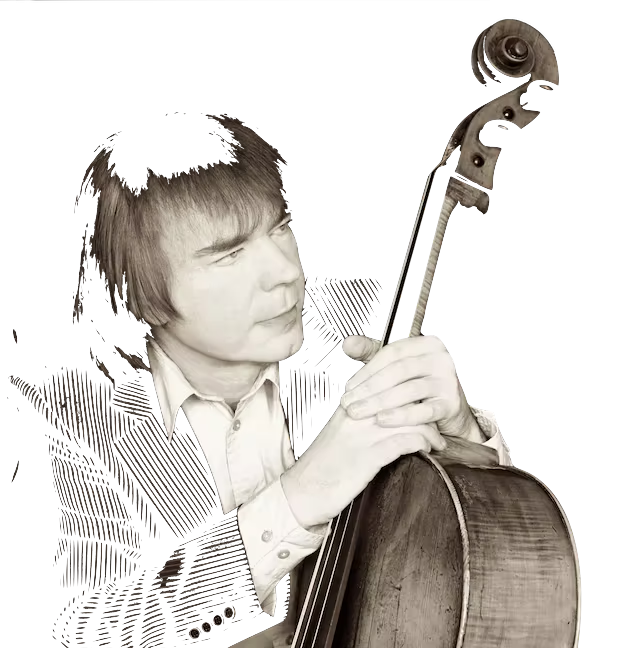
Julian Lloyd Webber (vc); Academy of St Martin in the Fields / Sir Neville Marriner.
Philips CD 454 442-2PH (71 minutes: DDD).
Britten – selected comparisons:
Wallfisch, ECO, Bedford (1/86) (CHAN) CHAN8363 Rostropovich. ECO, Britten (9/89) (LOND) 425 100-2LM Isserlis, CLS, Hickox (2/92) (EMI) CDM7 63909-2
Rostropovich, Moscow PO. Britten (5/97) (EMI) CZS5 72016-2
Walton – selected comparisons:
Wallfisch, LPO. Thomson (9/91) (CHAN) CHAN8959 HarreI!, CBSO, Rattle (12/92) (EMI) CDC7 54572-2
Cohen, Bournemouth SO, Litton (10/95) (LOND) 443 450-2LH
A British pair
This is an inspired coupling of two works, closely parallel in the careers of their composers, each reflecting the mastery of a great Russian cellist (respectively Rostropovich and Piatigorsky), but which could hardly be more sharply contrasted. Julian Lloyd Webber in an illuminating note makes that very point, and the passionate commitment of his playing in both works confirms his views. Not only is the power of each piece fully laid out, the beauty – not just in the lusciously romantic Walton Concerto, but in the grittily taxing Britten piece too – is presented as never before on disc, helped by sumptuous, beautifully balanced sound from the Philips team of Dutch engineers. On any count this is the finest, most formidable disc that Julian Lloyd Webber has yet given us.
Anyone wanting this unique coupling need not hesitate, but my intensive comparisons confirm that both performances are more than competitive with the outstanding versions I have listed above, all with different couplings. In the Britten it almost goes without saying that, like his rivals, Lloyd Webber cannot quite command the power and thrust of the dedicatee, Rostropovich, not just in his original studio recording with Britten and the ECO, but in the Russian radio recording of the world premiere in 1964, which has just appeared as part ofa 13-disc EMI set, “The Russian Recordings, 1950-74”.
That said, Lloyd Webber and Sir Neville Marriner, helped by the far greater dynamic range of the recording, not only convey the extraordinary originality of Britten’s scoring in a way beyond any rival, but find an extra expressive warmth. That is so not just in such reflective moments of the long sonata-form first movement as the tranquillo passage at track 1, 2’30” or the pianissimo lusingando at 4’50”, but in the relentless build-up of the Adagio third movement, where the recording superbly brings out the rasp of the brass, including tuba. It is worth noting, too, that Lloyd Webber takes the mercurial second movement even faster than the others, with an even lighter touch. On the Wallfisch version I was disappointed that the soloist is placed so far forward that orchestral detail is masked, and that the EMI sound for the Isserlis is relatively dim.
Wallfisch’s Walton issue from Chandos, by contrast, is the keenest rival to the new disc both in terms of sound and interpretation, and hearing it again reminds me that he studied it with its dedicatee, Piatigorsky. Yet Lloyd Webber is just as individual and imaginative in his phrasing they both outshine the others, for example, in the deeply meditative statement of the theme in the variation finale – and the sumptuousness of the Philips sound makes this if anything even warmer than the Chandos, while the sparky complexity of the central Scherzo is thrillingly clear and trans¬parent. This is a performance which fully confirms this post-war work as vintage Walton, the equal of his pre-war concerto masterpieces for viola and violin. In both the Walton and the Britten Lloyd Webber makes light of the formidable technical difficulties. Plainly this has been a project that has involved him deeply, and he has been wonderfully well served by his collaborators.
EG