
Die Welt 9th February 1894
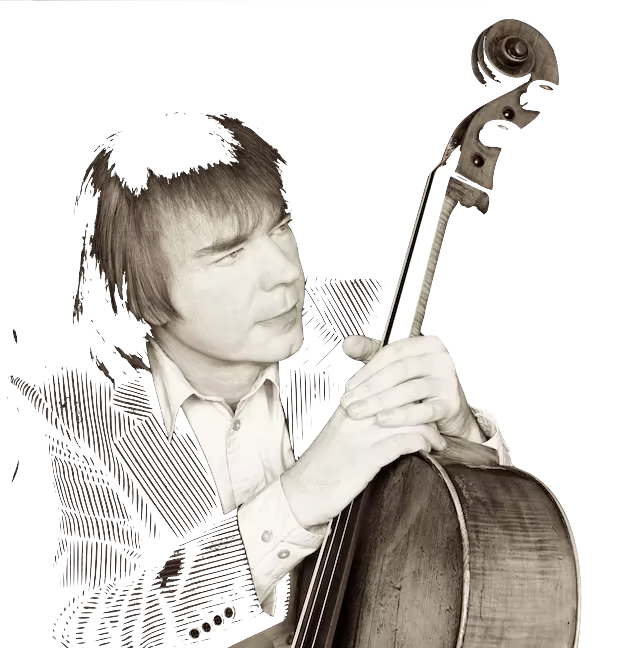
Julian Lloyd Webber plays the Rodrigo Cello Concerto
Works by J. Druckman and J. Rodrigo ‘Toastbrot’ from the Alhambra
In Berlin the Philharmonic, conducted by Richard Dufallo, performed two greatly contrasted German premieres. It proved to be a bewildering display of past and present in contemporary music and showed the artistic diversity of two modern composers. They gave us Jacob Druckman’s “Aureole” -for a large orchestra, and the Cello Concerto “in the form of a divertimento” by Joaquin Rodrigo, who, at 82, is almost a generation older.
Druckman, for the ten minutes or so his composition takes to play, uses a huge orchestra. Rodrigo uses a smaller yet more resonant version in an almost indolent yet always highly colourful manner. Druckman gathers the tone colours into a ring-like form with a melodious ‘solitaire’ in the middle: a Bernstein quote from the “Kaddish” Symphony. And it was probably this zeal in paying homage from a composer no longer in the first flush of youth which enthused Bernstein to sponsor the work’s first performance in New York.
Dufallo is quite a different character who tends to tackle things a little soberly. Musically he presents the works just as they are and not always to their advantage. A little more persuasion to help them along can surely be expended by a conductor without his being suspected of overacting on the rostrum.
It says a great deal for the elderly Rodrigo’s sparkle that his Cello Concerto held our attentions so enjoyably and Julian Lloyd Webber, who commissioned the work from Rodrigo, played with fire and passion: he is a captivating, masterly performer.
Rodrigo – whose “Concierto Aranjuez” for guitar has become a world-famous classical bestseller? does not get involved in ‘contemporary’ music, which is understandable at his advanced age. He has continued past it composing melodious, if virtuosic, music. For the cello – traveller in the warm south – he has served a musical bonbon spiced, as it were, a l’espanol.
Right from the beginning the bolero rhythm is heard and later there is a seguidilla or flamenco-type dance as well, while the orchestra assists the soloist’s nimble fingers with discreet interjections of considerable charm. In the second movement the solo instrument is allowed to do what it was fundamentally created for; it sings abundantly. An Andante Nostalgico, interrupted only by a tortuous cadenza, conjures up moonlit nights over the Alhambra – without the pickpockets and screeching gypsies. After this the finale is devoted once again to the cello’s rousing call of ‘Ole’. An unashamedly entertaining, lightweight piece, the cello repertoire has long lacked a work of this kind. It is as beneficial to the digestion as crisp white ‘toastbrot’ and is good for anyone suffering from heartburn after hearing too much modern music.
KLAUS GEITEL