
June 10th 2007
Elgar really is worth all this pomp
The day of Elgar’s birth in 1857 was a perfect summer’s day. And so was the day when the people of Worcester laid on celebrations for his 150th anniversary in honour of their favourite son. There was a mayor’s reception and chamber concert in the morning, a gala birthday concert in the cathedral in the afternoon, and in the evening a grand dinner in perhaps the most beautiful room in any municipal building in the country. The cathedral, the River Severn and the Malvern Hills beyond, all so vital to Elgar’s inspiration, sparkled in the sun. As my mother loved to say: ‘God’s in His Heaven — all’s right with the world!’
Certainly, that was the only proper response to a wonderfully atmospheric concert in this great cathedral’s unusually sympathetic acoustic. The Royal Liverpool Philharmonic sounded rich and ripe throughout, and four choruses, no less, under the inspired baton of veteran Elgarian Donald Hunt overwhelmed us with the full majesty of Elgar’s orchestral and choral writing.
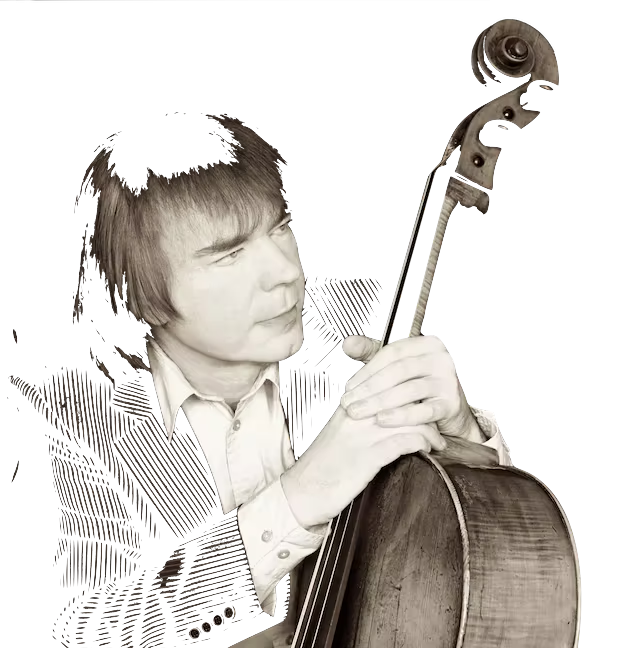
Elgar’s mother, Ann, had a busy day on June 2, 1857, and so did Julian Lloyd Webber 150 years later. After offering a noble account of the cello concerto here, he flew to London by helicopter for a repeat performance in a sold-out Albert Hall.
It was a sure sign that Elgar is back in his rightful place in public esteem, from which he had fallen well before his death, aged 76, in 1934. His 70th birthday concert in London, for instance, in the presence of the composer, was less than half frill. Thankfully, today we recognise him for what he is: not the jingoistic minstrel of empire, as was once thought, but a sensitive genius who bared his soul in some of the most haunting music ever written.
That is why, in our uncertain age, the autumnal cello concerto speaks to us so movingly, and no living cellist does it better than Lloyd Webber. His long-gestated reading was sensitive to every nuance, and the beauty of tone he drew from his 1690 Strad was often breathtaking.
Donald Hunt’s empathy with the composer shone through every bar of a wonderfully detailed account of the Enigma Variations, which I had the privilege of hearing while sitting next to a great-niece of Winifred Norbury, whose delicately etched variation precedes Nimrod.
It was worth the price of the ticket just to hear Elgar’s choral version of the National Anthem, with ‘knavish tricks’ and all the rest of the politically incorrect stuff in verses two and three that is normally suppressed today.
Glorious, too, to hear the full orchestral version of the anthem ‘Give Unto The Lord’, composed in 1914 for St Paul’s Cathedral, when Elgar was still near the height of his powers.
My only regret, not entirely swept away by a vigorous performance, was the inclusion of the Coronation Ode, written for Edward VII in 1902. The forelock-tugging lyrics of A.C. Benson, then an Eton housemaster, simply don’t work today. However splendid the music, this is the kind of thing most contemporary Elgarians have spent half their lives denying is the real Elgar. It’s best experienced by consenting adults in private.
Here, too, came my only quibble about the performers. The four soloists were an ill-assorted bunch, with a soprano whose wobble under pressure recalled Walt Disney’s Clara Cluck, and a tenor who works locally, and who should stick to the entertainment after Rotary dinners.
Even while Elgar’s star was on the wane, broadly between the Twenties and the Seventies, outstanding recordings of his music were made, many by the London Philharmonic Orchestra. So it’s an excellent idea to gather together some of the best on five CDs.
Elgar made his last three recordings with the newly formed LPO in 1933, and all are included here. As are fine recordings by distinguished Elgarians such as Sir Adrian Boult and Sir Georg Solti, as well as a novelty; Dame Janet Baker, the guest of honour at Saturday’s jubilations, in a previously unissued 1984 live recording of the Sea Pictures, which she sings with unique authority.
David Mellor