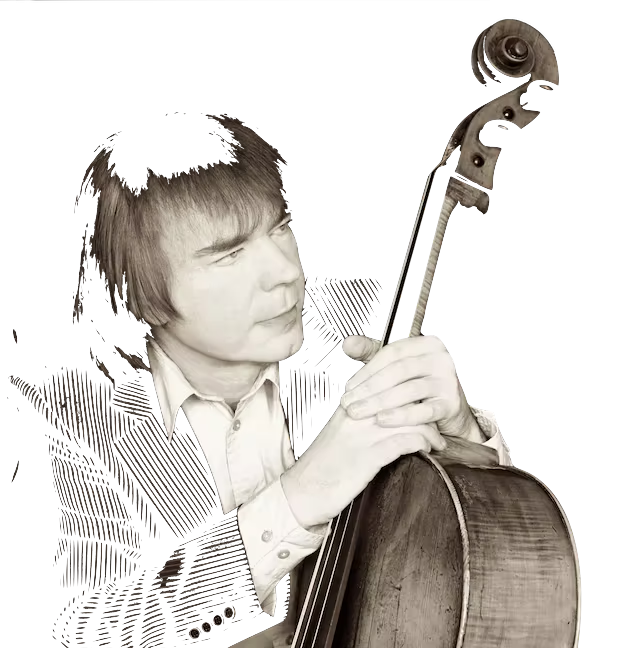

Gramophone Classical Good CD Guide 2003
Favourite Cello Concertos
Albinoni (arr Palmer) Adagio in G minor
Bach (arr Palmer) Cantata No 147 — Jesu, joy of man’s desiring
Dvorák Cello Concerto in B minor, B191
Elgar Cello Concerto in F minor, Op 85. Romance, Op 62. Une idylle in G, Op 4 No 1
Fauré Elegie, Op 24 Gounod Ave Maria
Lloyd Webber Jackie’s Song
Saint-Sans Cello Concerto No 1 in A minor, Op 33. Allegro appassionato in B minor, Op 43. Le carnaval des animaux — Le cygne Schumann (air Palmer) Kinderszenen, Op 15d—Traumerei, Op 15 No 7
Tchaikovsky Variations on a Rococo Theme in A, Op 33
Julian Lloyd Webber c with various orchestras and conductors
Philips © 462 115-2PM2 (155 minutes: DDD) Recorded 1984-98
A first-class package in every way. Julian Lloyd Webber has a firm, richly coloured and full- focused tune. His lyrical warmth projects tellingly over the entire range and his involvement in the music communicates consistently and tellingly. He has chosen his accompanists well too. His account of the great Dvorák Concerto is full of passionate feeling, with a tender Adagio, and Neumann and the Czech Philharmonic give him thoroughly persuasive backing, playing with plenty of bite in tuttis, the Slavonic exuberance always to the fore. His performance of the Elgar concerto has the huge advantage of Lord Menuhin as his partner, a true Elgarian if ever there was one. It is a performance of real understanding and rare intensity, which never oversteps the work’s emotional boundaries and is imbued with innate nostalgia: the Adagio has a haunting Elysian stillness. The Saint-Saëns is played for the splendid bravura war-horse that it is, and we are also given a rare chance to hear the original, uncut version of Tchaikovsky’s Rococo Variations. Lloyd Webber soon proves that it is superior to the truncated version used in most other recordings; moreover his spontaneous warmth in Tchaikovsky’s long-drawn lyrical lines, which he makes sound very Russian in character, makes a perfect foil for the sparkling virtuosity elsewhere. Among the encores the lovely Traumerei stands out for its freely improvisational feeling and Lloyd Webber’s own tribute to Jacqueline du Pré is played as an ardent, tuneful and timely postscript.