
Gramophone June 1983
DELIUS Cello Concerto. Holst Invocation Op.19 No.2. Vaughan Williams Fantasia on Sussex Folk Tunes.
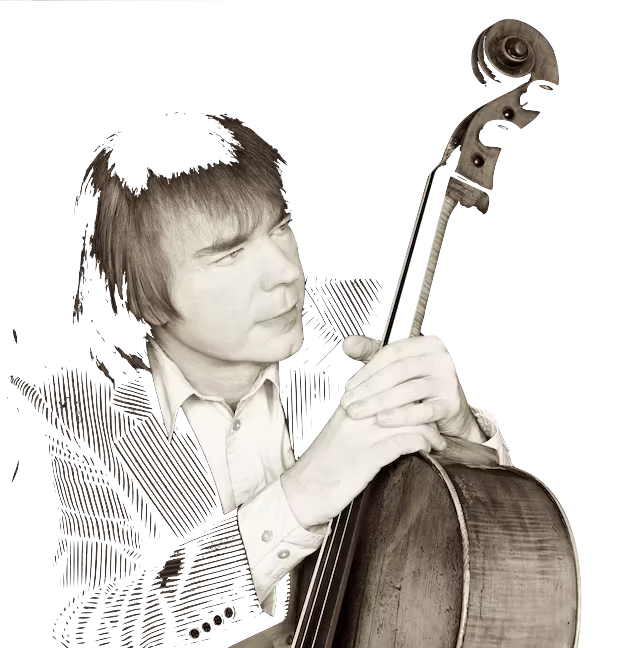
Julian Lloyd Webber (vlc): Philharmonia Orchestra / Vernon Handley. RCA
Cello Concerto comparative versions: du Pre. RPO.Sargent
From his first entry Webber makes the quality of the forthcoming performance of the concerto clear, with those awkward notes (for those first half-dozen bars Delius was obviously trying to write a ‘proper’ cello concerto) assembled into a coherent line. Partly thanks to the excellent editing of the solo part by Herbert Withers all else, too, runs smoothly, the marvellously romantic music given a natural, unexaggerated flow. Handley ensures that the orchestra matches this, and a very clear quality of recording gives soloist and orchestra alike a splendid sound. Balance, too, seems just right; and a feeling of some intimacy is conveyed; perhaps this is helped alone by using a suitably modest number of string-players. In any event this is a version of the Delius to treasure.
So too, in its day, was of course the Jacqueline du Pre/HMV version listed above. And still there are remarkable qualities on offer: a warmly romantic reading which is in little danger of seeming exaggeratedly so unless heard immediately after the Webber; and an equally warm, romantic sound on a somewhat bigger, but not at all necessarily more suitable scale for the orchestra. But the quality of recorded sound of this older disc, once very acceptable, now seems greatly inferior to that of the new one; the strings in particular, solo and orchestral, lacking warmth and clarity.
For coupling, that older du Pre record has the Elgar Cello Concerto. The new record’s couplings, though, are of unusual interest, offering first recordings of unfamiliar cello pieces by Hoist and Vaughan Williams. Holst’s Invocation seems to me to be a real find, not so much a romantic flow for the cello here as a coolly classical, rather ruminative exploration of the instrument’s sedater qualities as a soloist. The piece’s unusual, and very worthwhile virtues are somewhat set in sharp relief, though, by the Vaughan Williams-Fantasia on Sussex Folk Tunes, which was written in the first place for Casals (who played it, perhaps wondering at the time where on earth Sussex was!) Today its general folk-tune flavour seems, of course, characteristic enough of Vaughan Williams; but its exposition in terms of instrumental solo with orchestra does not. Nevertheless the Fantasia can hardly be rated a hardship, and here it has, as does the Holst Invocation, the great advantage of impeccable performance and the same splendid quality of recording given to the Delius. This is a very welcome issue indeed. M.M.