
Records & Recording 1979
Record guide pick of the month
BRIDGE: Oration – Concerto Elegiaco for cello and orchestra (F105). Two Poems after Richard Jefferies (F126).
Allegro Moderato for string orchestra (F162). Julian Lloyd Webber (cello), London Philharmonic Orchestra/Nicholas Braithwaite.
Lyrita SRCS 104. £4.42.
RICHARD D CNOBLE
This exceptionally interesting and important record provides a fitting climax to Frank Bridge’s centenary year. It also fills an important gap in the Frank Bridge discography that would scarcely have been visible only a short while ago. Thanks to Lyrita’s enterprise in recording the major portion of his orchestral work (with a little help from elsewhere) it would seem that only two very early works – the substantial Symphonic Poem Isabella and the tiny Berceuse for violin and orchestra and one very late but not very important one, the Vignettes de Danse for small orchestra of 1940 remain unrecorded although, of course, there still remain. some early but important chamber works to be done, notably the first two String Quartets and the String Sextet. All this has happened within the space of the last two or three years. After so long a time in the wilderness, Bridge’s rehabilitation has been a unique phenomenon and there is every indication that it may be permanent. The record companies deserve a good deal of the credit for this.
The three works recorded here represent three different aspects of Bridge. Two have long been known, but rarely played. One will be new to almost everybody. Perhaps we should deal with them chronologically. The Two Poems after Richard Jeffenes date from 1915 and were published by Augener in 1923. They have at least enjoyed the occasional performance over the years. The two poems which inspired Bridge were The Open Air and The Story of my Heart When we think of the time at which these two short and beautiful pastoral pieces were written it may come as a surprise to find in them an unruffled calm and serenity, as if Bridge was painting a golden sunset to a vanishing world which was never to return. The first piece is a gentle idyll whose pastel shades remind one of Delius while the second is a gay and lively dance of life. These untroubled little works may perhaps have been written before the full impact of the war had registered on Bridge – a war which in 1914 was a local affair that was all going to be over by Christmas.
The Cello Concerto, Oration is a very different work which dates from 1930, long after Bridge had thrown off any notions of an idyllic life and had faced up to the stark reality and disillusionment of the world as it really was. Arch-typical of Bridge’s late manner, it is one of his finest, most deeply felt works. It is quite unlike a cello concerto in the traditional sense, the solo instrument being a vehicle to underpin Bridge’s deeper emotional feelings, clouded by inner grief and despair. The oration is a public eulogy for all who were lost in the great conflict, not without dignity and grandeur as a public utterance of grief and like any well-thought-out eulogy, it has substance and form a one movement arch structure on the concept of the Phantasie framed by an extended introduction full of forboding and a withdrawn, introspective epilogue. In between Bridge evokes many changing, shirting moods but its central march-like section with its insistent four-in-a bar beat on the timpani, heard from afar as if of a distant memory, Mr Payne in his sleeve-note identifies as an evocation of the platoons of the dead marching past. A tone picture, but not a tone poem, there are fleeting moments of happier times recalled but they are of short duration. Bridge’s personal inner conflict is not easily shared with a distracted outside world, especially at this distance in time. Even if the work had been long published and accessible instead of the other way round, it is doubtful that it could ever achieve universal popularity, but it is a key work in our understanding of Bridge and in our own uncertain world it can perhaps serve as a warning not to make the same mistakes as our fathers and grandfathers did. With the cello as the orator, the orchestra as his vocabulary, this remarkable work crystalises feelings that were to be declared in more forceful dramatic form by Bridge’s pupil, Benjamin Britten in his War Requiem of 1962, affected as he so clearly was by Bridge’s philosophy in his formative years and re-enforced by his own experience of yet another human castastrophe that Bridge did not live to see run its course.
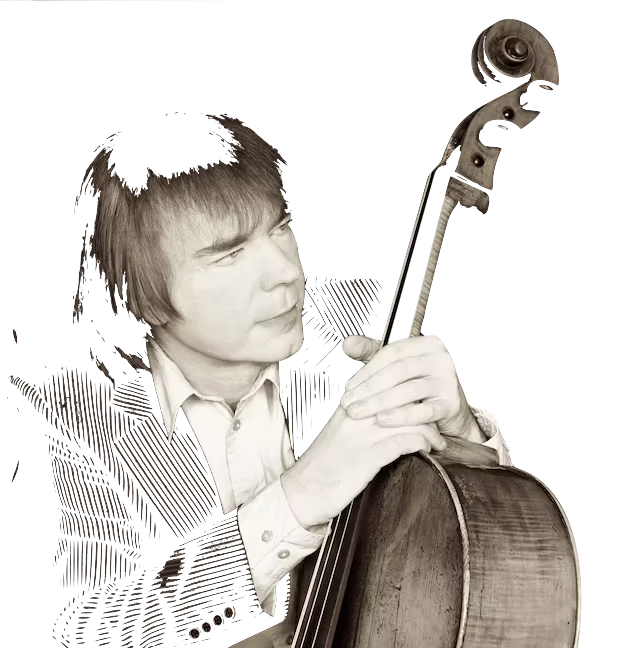
Julian Lloyd Webber generates impressive energy and nervous tension in the Concerto Elegiaco which I would judge to be a very difficult work to interpret and possibly open to more than one valid reading, but I think we have everything to admire here in a pioneer recording of impressive strength and conviction. Nicholas Braithwaite, who seems to have special empathy for a British repertoire of the kind Lyrita have for so long promoted, is a conductor of wide experience and growing stature not only in the concert hall, but also in the opera house. He is currently Musical Director of the Glyndeborne Touring Opera and permanent guest conductor of the Norwegian Broadcasting Orchestra and has toured widely. Clearly recorded and finely balanced, the whole production is of the highest standard and I hope it will meet with the success it deserves.