
The Washington Post 12th October 1989
Lloyd Webber’s Cello Treats
by Joseph McLellan
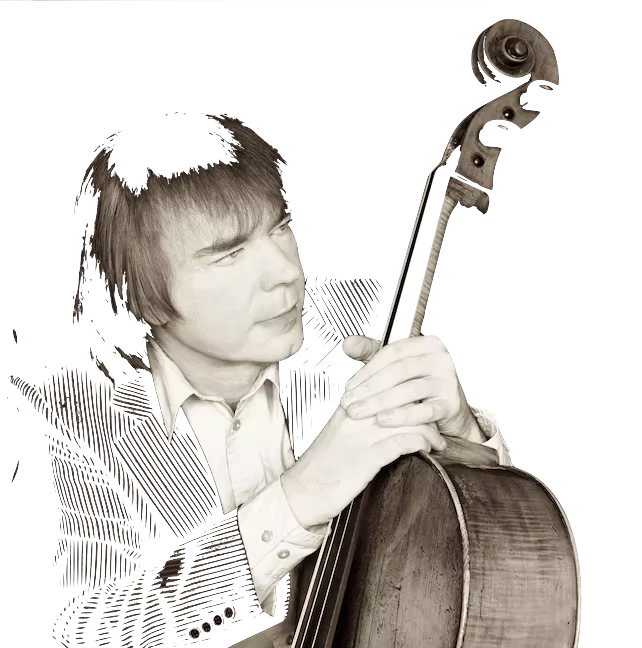
Cellist Julian Lloyd Webber introduced his second encore Tuesday night in the Kennedy Center’s Terrace Theater as the work of “a struggling young composer who has a hard time getting his music played and making ends meet.” It was, of course, composed by his brother Andrew – part of the brilliant “Variations,” which Andrew Lloyd Webber composed to pay off a lost football bet sometime between “Jesus Christ Superstar” and “Evita” – long before “Cats” or “Phantom of the Opera.”
The music, a variation on Paganini’s 24th Caprice, was fast and furious, full of technical fireworks and ending with a sustained tow note that slid downward as Ltoyd Webber re-tuned his C string. His first encore, almost equally spectacular, was a piece by Benjamin Britten’s teacher Frank Bridge that Webber recently discovered in manuscript Between them, they nearly eclipsed a program that was devoted almost entirely to music of the 20th century.
Two works – the second version of Faure’s “Begy” and Rachmaninoff’s Op. 19 Sonata – barely made it into the century, dating from 1901. Lloyd Webber and his pianist, John Lenehan, responded to the music’s high romantic flavor with soaring lyric phrases in the soulful passages and all-out virtuoso playing in Rachmaninoff’s fiery fast movements. A transcription of the “Arioso” from Bach’s Cantata 156 seemed well chosen to open the program: It displayed Lloyd Webber’s deep, rich tone effectively, but it did not quite warm up the players for the harder music that followed.
Debussy’s Cello Sonata began with rather square phrasing that too often made direct, literal statements where suggestions might have been more effective. But the stiffhess faded, and the piece ended in good style. Before playing Britten’s Sonata in C, composed for Mstislav Rostropovich, Lloyd Webber shared a memory with the audience: “When I was about 13, I heard Rostropovich playing in London, and I think it was that more than any other thing that made me want to be a cellist. I would like to dedicate this performance to that great man of the cello.”
This music is enormously demanding, not only in its sometimes manic tempos and advanced techniques but also in its requirements for intense emotional expression, witty dialogue and sound effects that range from an ominous buzz to eerie, high-pitched glissandi. Lloyd Webber and Lenehan rose impressively to the challenges.
by Joseph McLellan